Whether you have a cramped powder room or a full bath crying out for a refresh, farmhouse bathroom ideas work across nearly every layout and budget – from a $14 thrifted mirror to a full clawfoot tub setup. This article walks through 19 real ideas, including small farmhouse bathroom tricks, vintage vanity swaps, and renter-friendly moves that don’t require a single permit or a contractor’s phone number.
Two summers ago I found a clawfoot tub on Facebook Marketplace for $280. Cast iron, painted a truly terrible shade of green on the outside, but the feet were original and intact. Jake helped me haul it into the backyard, I stripped it down to white, hit the feet with a brass metallic paint, and suddenly I was obsessed – not just with the tub, but with the whole category of farmhouse bathroom ideas. I started saving every bathroom photo I could find. I reorganized my inspiration folders the way I reorganize my pantry: compulsively, at 11pm, while Benny slept on my feet. That tub is now the anchor of our bathroom, and everything around it has been slowly, happily replaced, swapped, thrifted, or DIYed. This is what I learned along the way.
1. Clawfoot Tub Against Shiplap That Stops Scrolling
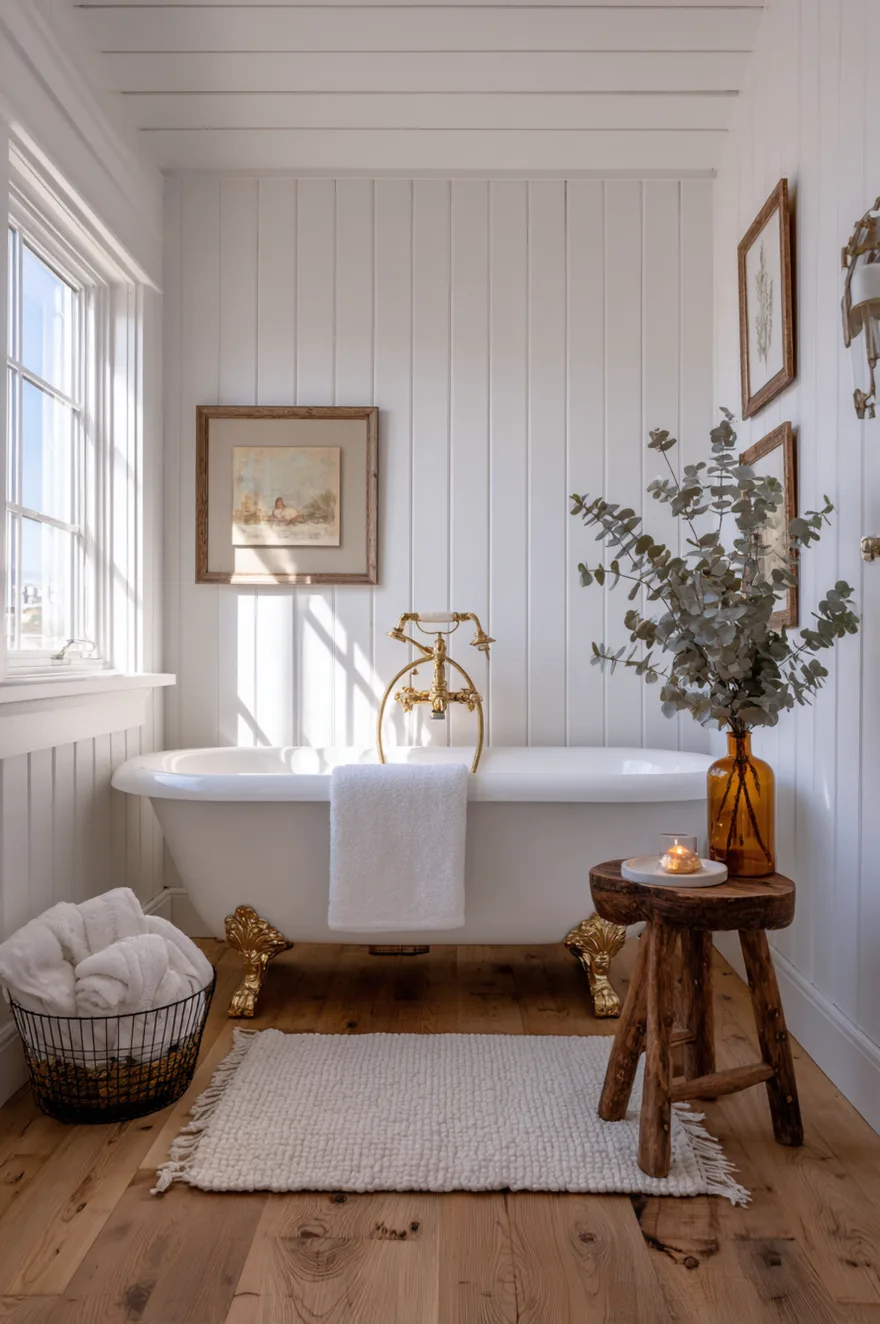
A white clawfoot tub centered against floor-to-ceiling shiplap is the single most-saved farmhouse bathroom image on Pinterest right now, and I get it completely. The combination works because both elements are simple – one horizontal, one freestanding – and together they create a kind of visual quiet that photographs extremely well. The shiplap planks (usually 3-inch or 4-inch boards) give the eye something to follow vertically all the way up the wall, and the tub interrupts that rhythm in the best possible way.
The hardware matters more than people realize. Brass claw feet read warmer and older than chrome, and a freestanding tub filler in unlacquered brass completes the look without trying too hard. Unlacquered brass will develop a patina over time – darker near the base where water hits it, lighter at the top – and that unevenness is genuinely part of the appeal. If you’re working with a thrifted tub like mine, the feet can be repainted with a good metal primer and a brass spray paint. It won’t be the same as buying them new, but it reads beautifully in a room and on camera. Warm afternoon light – even just a 2700K bulb in a sconce aimed at the tub from the side – does more for this look than any accessory.
For the shiplap itself: real pine boards are ideal, but primed MDF cut into strips works fine and runs cheaper per linear foot. Paint it Sherwin-Williams Alabaster (SW 7008) for that creamy white that still reads as white in photos without going stark. Start the installation at the floor and work up, using a nickel as a spacer between boards for the classic gap. Then step back and take the picture from a slight angle, not straight on – the depth of the shiplap lines shows so much better that way.
2. Black Hex Floor Tile For Your Farmhouse Bathroom
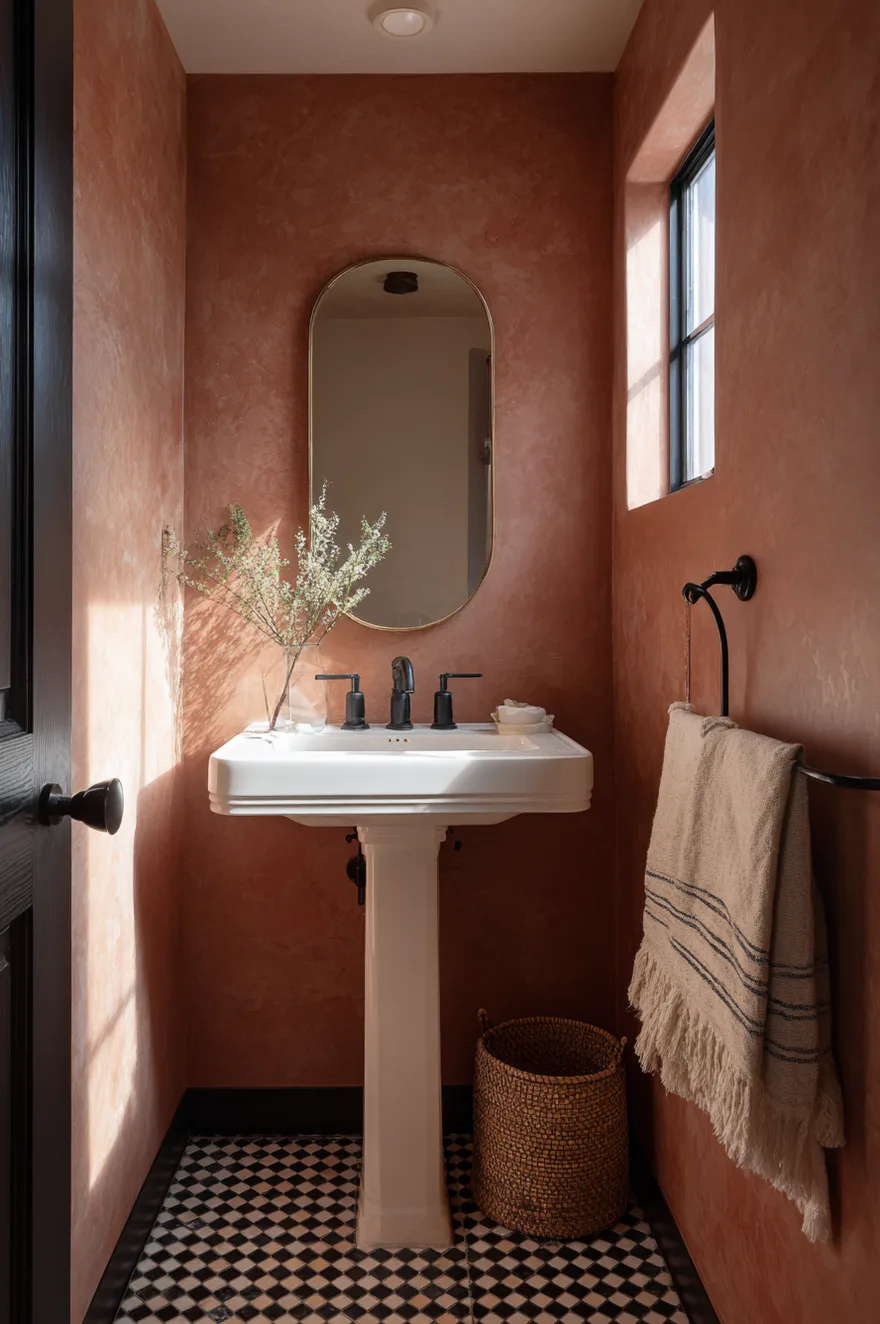
Matte black penny-hex floor tile is one of those choices I resisted for way too long because I thought it would feel cold and modern. I was wrong. Against terracotta walls and a white pedestal sink, the dark floor actually grounds the room – it’s the detail that keeps everything from floating into generic “pretty farmhouse” territory. The matte finish reads softer than polished, and (honestly my favorite part) the smaller tile segments mean more grout coverage, which somehow makes grime less visible for months at a stretch. Less visible grout grime is not a small thing when you have a toddler and a golden retriever.
Pair this with a simple pedestal sink – nothing with a cabinet base, because the floor is the thing you want people to see. A 24-inch round pedestal in white keeps the room open and lets those hex tiles do their job. Pick up a terracotta or clay-toned wall paint at 50-70% saturation – not the bright orange-red terracotta, but the dusty, earthy version – and the whole combination feels warm despite the dark floor.
3. The Vanity Swap You’ll Wish You Did Sooner
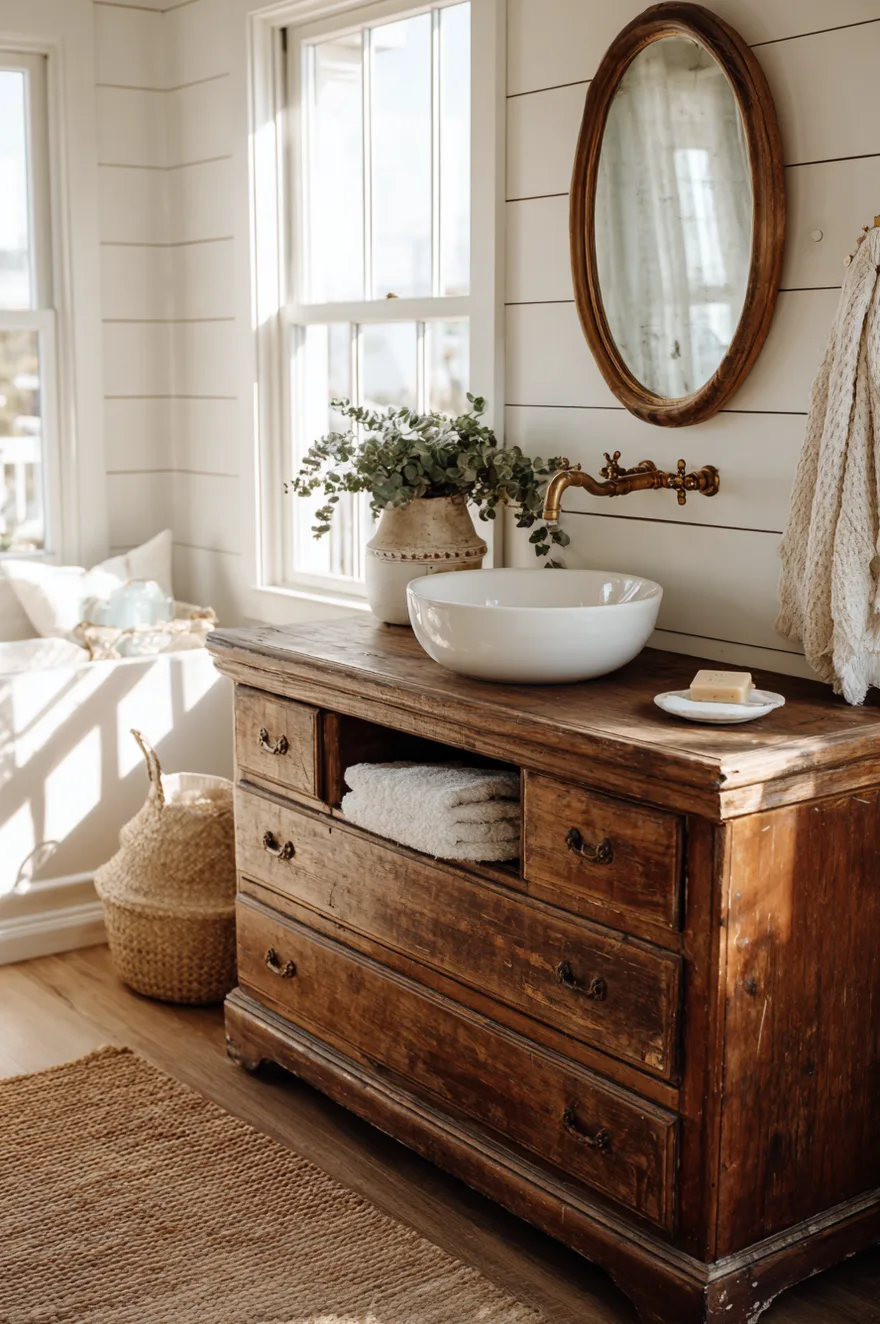
I almost passed on a dresser at an estate sale in Escondido because it smelled like mothballs and the bottom drawer was stuck. It was $45, solid wood, and about 36 inches wide – exactly the right size for a bathroom vanity conversion. I bought it, drove home with the windows down, and spent a weekend with a belt sander and a can of Zinsser BIN primer.
The conversion is less complicated than it sounds. You remove the top drawer – or in some cases keep all the drawers intact and simply mount the vessel sink on a piece of cut-to-fit wood on top. A plumber handles the vessel sink and the exposed P-trap. I specifically asked for aged brass supply lines and a brass P-trap, which added maybe $40 to the plumbing quote but made the whole piece look intentional rather than improvised. And those drawers still work. Nora keeps her bath toys in the bottom two, which is its own kind of beautiful farmhouse bathroom practicality.
When you find your dresser – and you will find one, because Marketplace and estate sales are full of them – look for solid wood construction (not particleboard), check that the drawer slides aren’t warped, and measure the depth carefully. Most antique dressers run 18-20 inches deep, which works for a bathroom but is tight. Under 18 inches and you’ll have trouble fitting standard supply lines behind the back panel.
4. Brass Bathroom Fixtures That Make Rooms Feel Warmer
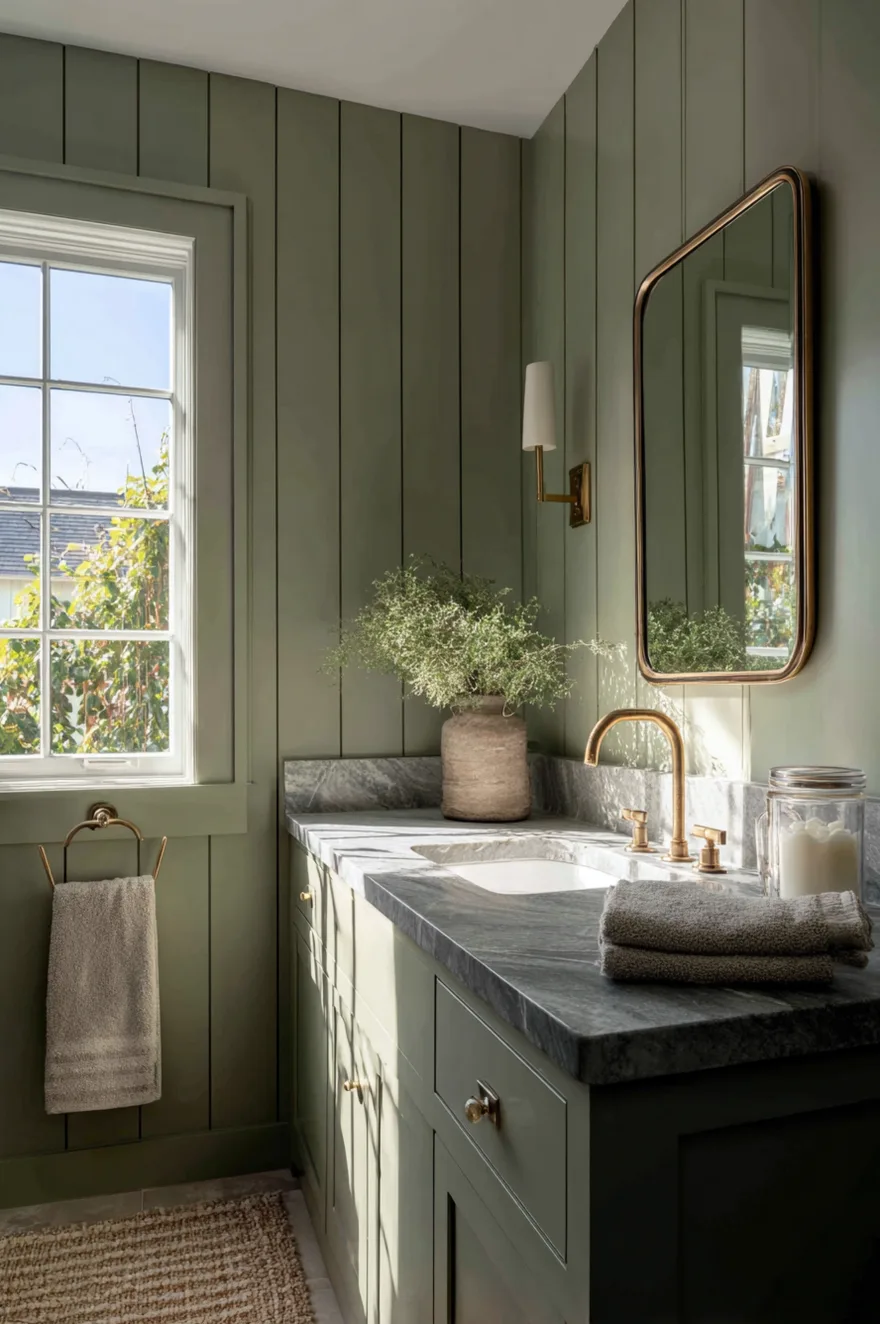
Unlacquered brass is different from the lacquered brass of the 1990s that everyone (fairly) hated. Lacquered brass stays permanently shiny and looks cheap after a year. Unlacquered brass starts bright and slowly oxidizes to a deeper, richer tone – darker where hands touch it, lighter where it’s polished by cloth. Against deep sage green board-and-batten walls, it’s genuinely the finish combination I find myself recommending most often now.
The board-and-batten here matters. Standard board-and-batten uses 1×4 vertical boards over a solid painted base, with the battens sitting proud about 3/4 inch. Paint it all one color – something in the Benjamin Moore Aganthus Green or Sherwin-Williams Jasper range – and the texture reads beautifully even when the color is quiet. Add a honed soapstone countertop if you can stretch the budget there, because soapstone is waterproof, forgiving of marks, and doesn’t need sealing the way marble does. A faucet, towel ring, and robe hook in unlacquered brass from a brand like Kingston Brass or Signature Hardware run reasonable prices and will outlast the trend by decades. Start with just the faucet if you’re testing the look – one fixture change tells you whether you want to go all in.
5. What I’d Do With That Awkward Narrow Bathroom
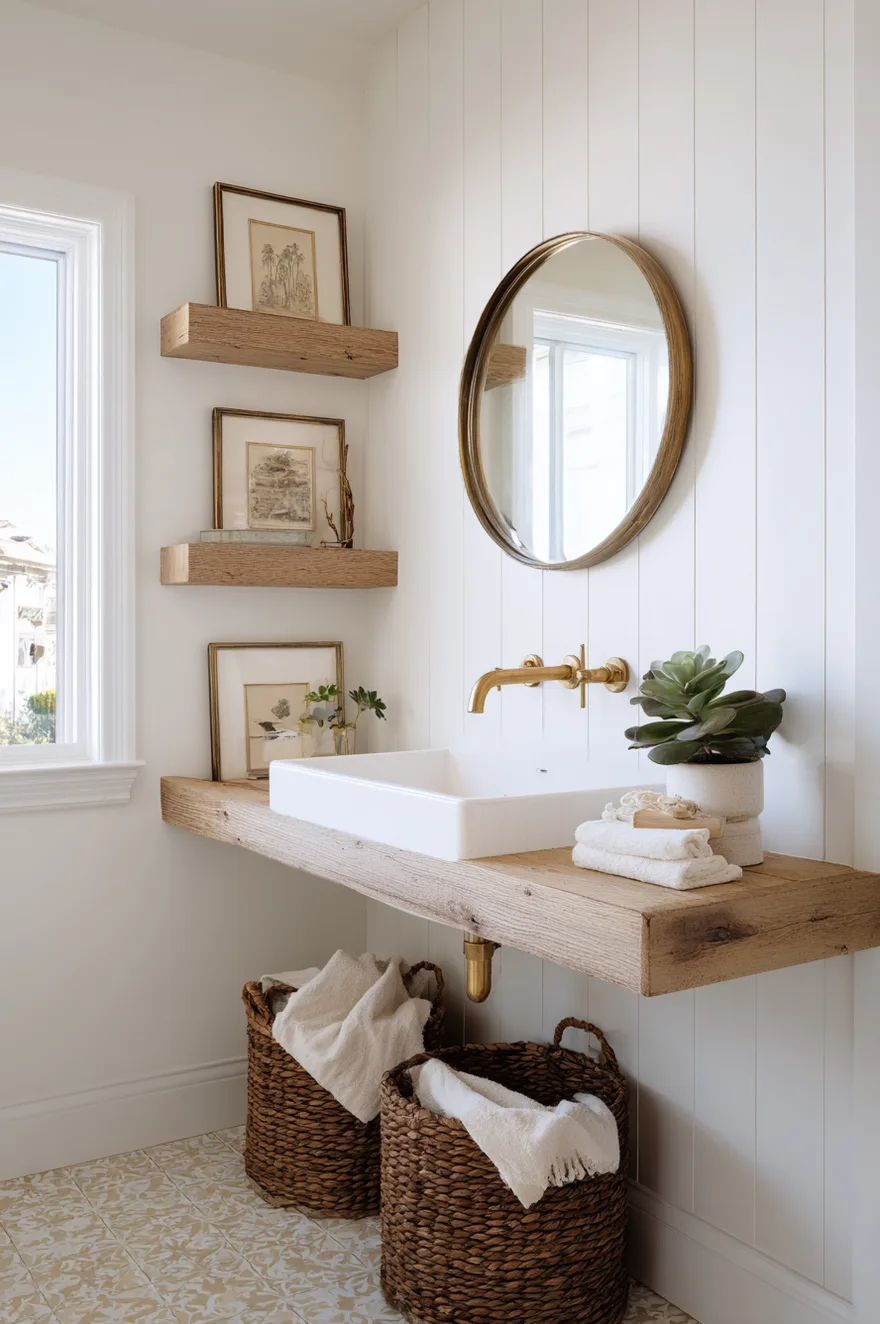
Narrow bathrooms – the classic five-foot-wide layout that came standard in every house built between 1955 and 1985 – feel awkward because there’s not enough room to add much and too much empty wall space if you don’t. Most people reach for a medicine cabinet or a short shelf and call it done. But a single floating shelf in pickled white oak running the entire length of one wall changes the whole math of the room.
Mount it at about 60 inches from the floor – eye level when you’re standing – and it reads as an architectural feature rather than an afterthought. Slide two or three woven baskets underneath (the seagrass ones from IKEA or HomeGoods fit perfectly) and suddenly you’ve got storage and texture in one move. Pair it with a wall-mount faucet and a simple round mirror above it, and the five-foot room starts to feel like a decision someone made on purpose, not a limitation they were stuck with. And honestly, wall-mount faucets are one of those things I assumed were expensive – they’re not, especially from Wayfair’s house brands.
6. Open Wood Shelving For Your Bathroom Storage
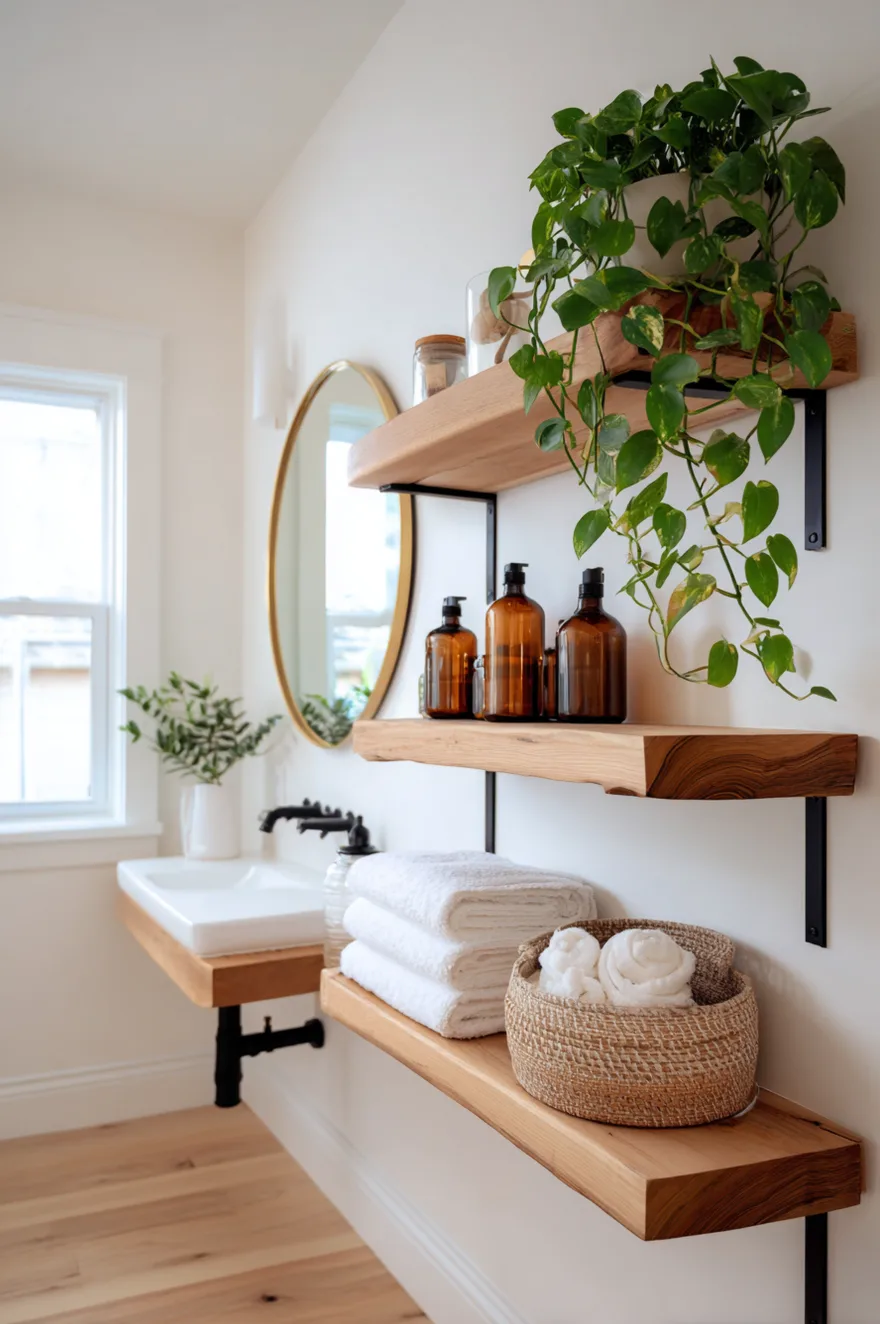
Two tiers of live-edge pine open shelving bracketed in matte black iron is the move I keep coming back to in farmhouse bathroom ideas because it’s storage that doesn’t disappear into the room – it’s actually a visual moment. The live edge (that irregular natural wood edge left on one or both sides of the board) introduces an organic line into a space that’s usually all straight angles and square tiles.
Iron pipe brackets or matte black hairpin shelf brackets both work and run $8-15 per bracket at most hardware stores. Mount the lower shelf at about 48 inches for easy reach, the upper at 68 inches for display. Stack white Turkish towels flat on the lower shelf – they compress nicely and look intentional rather than stuffed. On the upper, trail a pothos (they genuinely do not care about bathroom humidity, in fact they seem to like it) and group two or three amber glass apothecary jars for cotton rounds, bath salts, or whatever you actually use. The amber glass picks up warm light differently at different times of day, which is a small thing but adds up in a room you’re in every morning.
One practical note: live-edge pine boards warp if they’re not sealed, and bathrooms are wet environments. Hit both faces and all edges with a good waterproof polyurethane before you mount them – two coats minimum. Then you’re done and it’ll hold for years.
7. Why I Love Woven Basket Storage In Every Bathroom
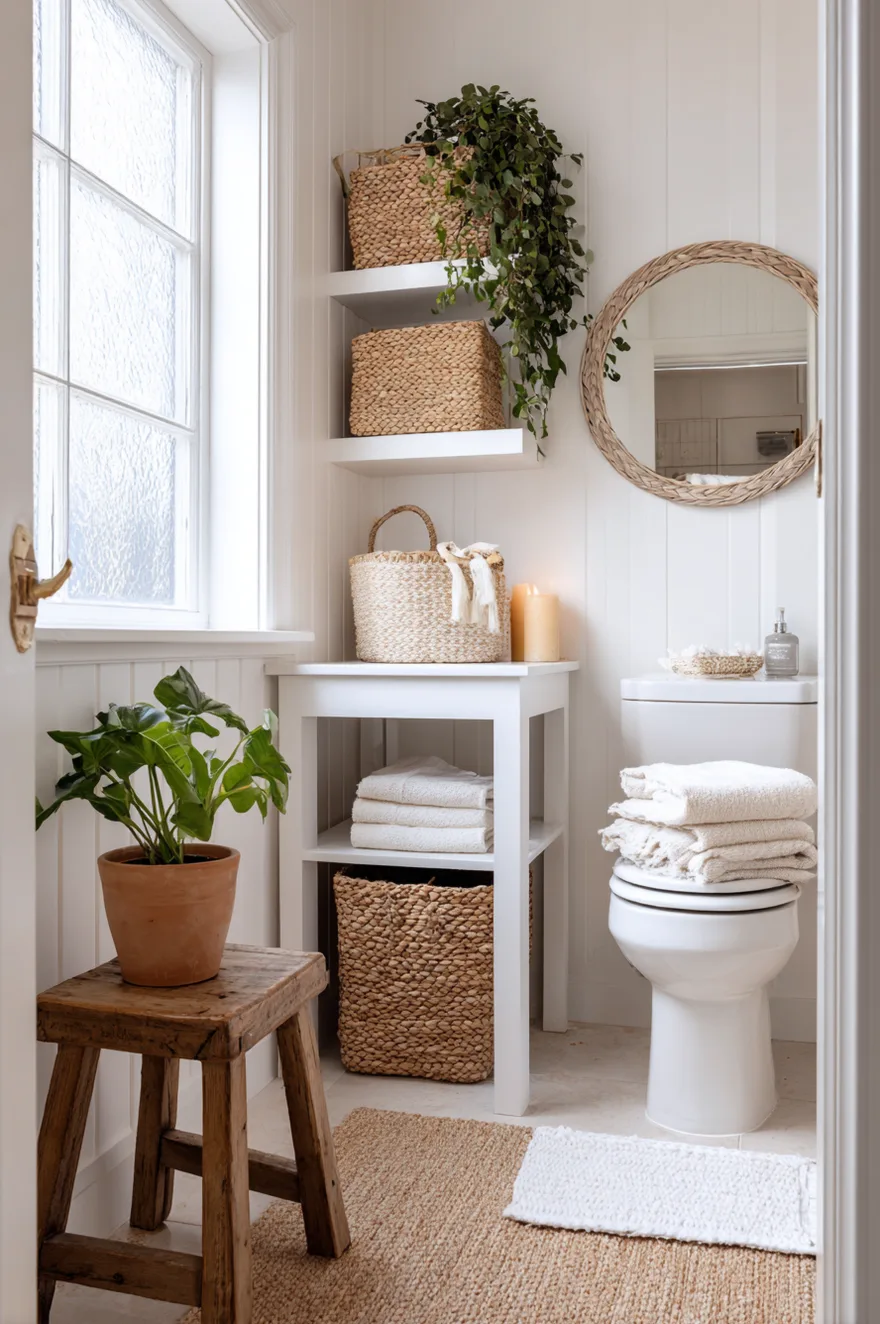
Woven seagrass baskets are my answer to almost every bathroom storage question. They soften a room full of hard surfaces – tile, porcelain, chrome – without adding visual weight. A set of three matching seagrass baskets at the thrift store runs about eight dollars total, sometimes less, and they look identical to the ones selling for $28 each at Target.
Tuck them under an open vanity for toilet paper and backup products, or stack them in the empty space beside the toilet where nothing useful ever lives. And because we’re talking about the back-reference from section 5: the baskets I mentioned for the floating shelf fit here too. Same basket, three different uses in one bathroom. That’s the kind of thing that makes me genuinely happy about thrift shopping.
8. The Tile-To-Ceiling Move Nobody Talks About
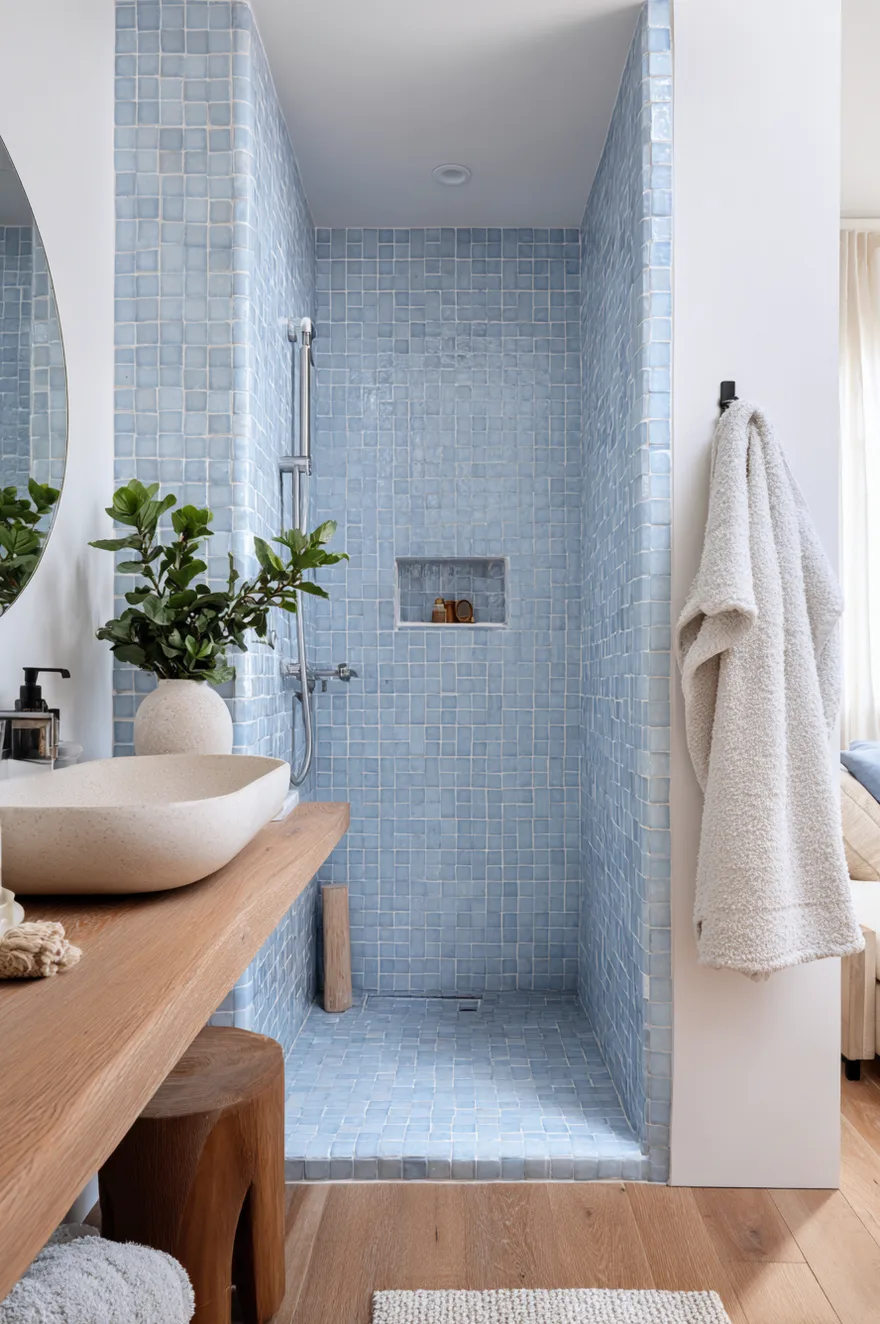
Most shower tile stops at the showerhead. Occasionally someone tiles to eight feet. But taking pale blue zellige-look tile all the way to the ceiling – no border, no accent row, no break anywhere – creates a monolithic wall that reads as intentional and expensive even when the tile itself came from a mid-range supplier. The unbroken expanse is what does it. Borders and accent rows cut the eye’s travel and make a small shower feel smaller.
Zellige-look tile (the slightly irregular, handmade-appearance ceramic) in a pale blue-gray works especially well because the variation in each piece means no two sections of wall look exactly the same, and that imperfection photographs well. Pair the shower with a butcher-block vanity top just outside it – the warm wood against all that cool blue-gray tile is the contrast that keeps the room from feeling like a spa menu. Matte white fixtures throughout: no chrome, no brass in this particular palette. It’s one of the cleaner farmhouse bathroom looks in this list, and still not total sure it belongs under “farmhouse” – but it photographs so well that I’m keeping it.
9. Modern Farmhouse Bathroom With A Moody Twist
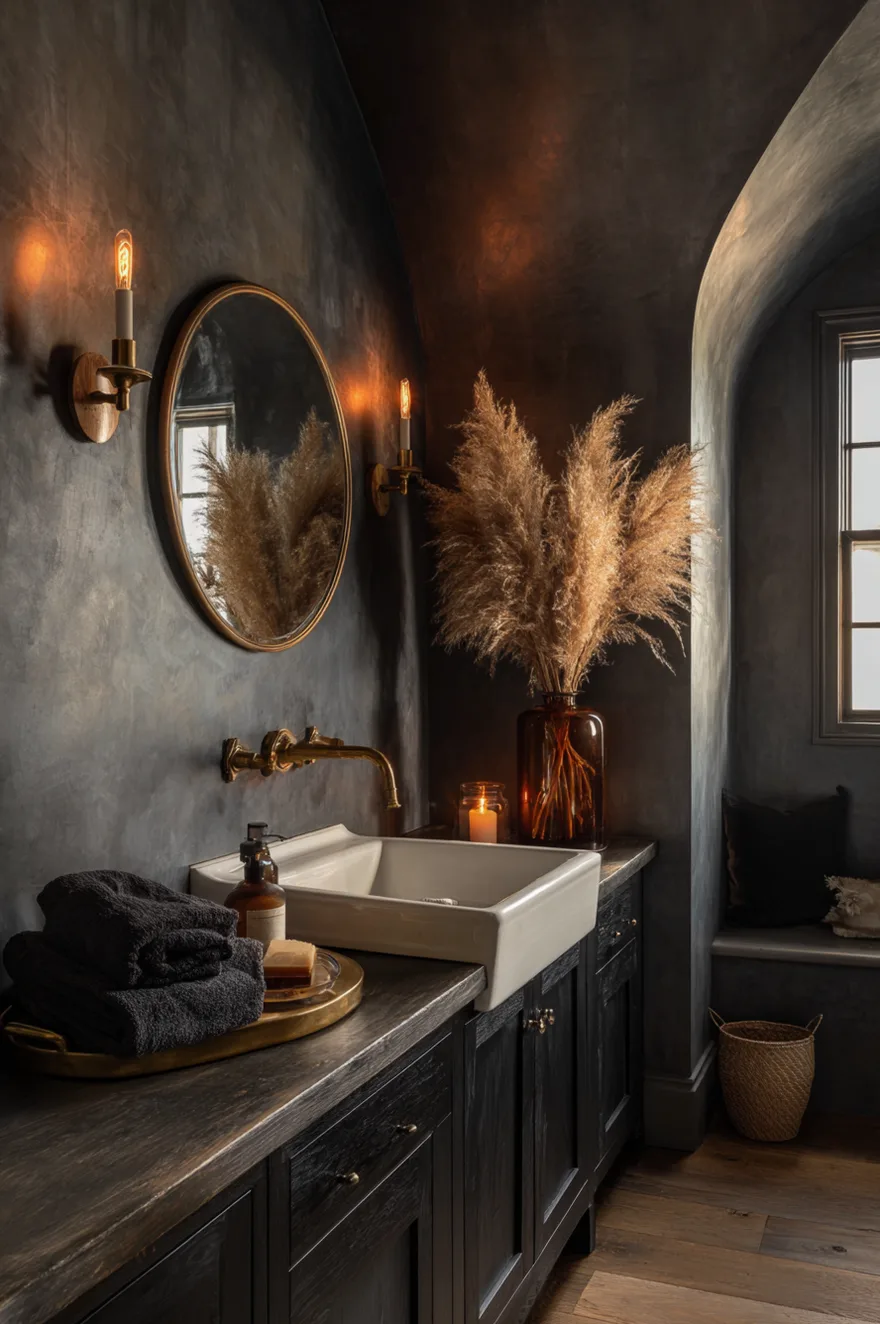
Not every farmhouse bathroom idea has to be white and bright. Charcoal plaster-finish walls with an arched niche holding Edison sconces at golden hour is a different direction entirely, and honestly one I’m more interested in lately than the all-white version. The plaster finish (real lime plaster or a faux plaster paint like Roman Clay from Portola Paints) gives walls a depth that flat latex simply doesn’t have – light moves across it differently depending on the time of day.
Against that backdrop, a white fireclay farmhouse sink reads almost luminous, and aged brass hardware looks like it’s been there for fifty years. This is the kind of modern farmhouse bathroom that feels more collected than decorated – fewer accessories, heavier materials, lower light. If the all-white shiplap look feels too expected, start here instead. One can of a dark plaster paint, some Edison sconces, and suddenly the room has a whole different personality.
10. A Doorway Shot That Sells The Whole Room
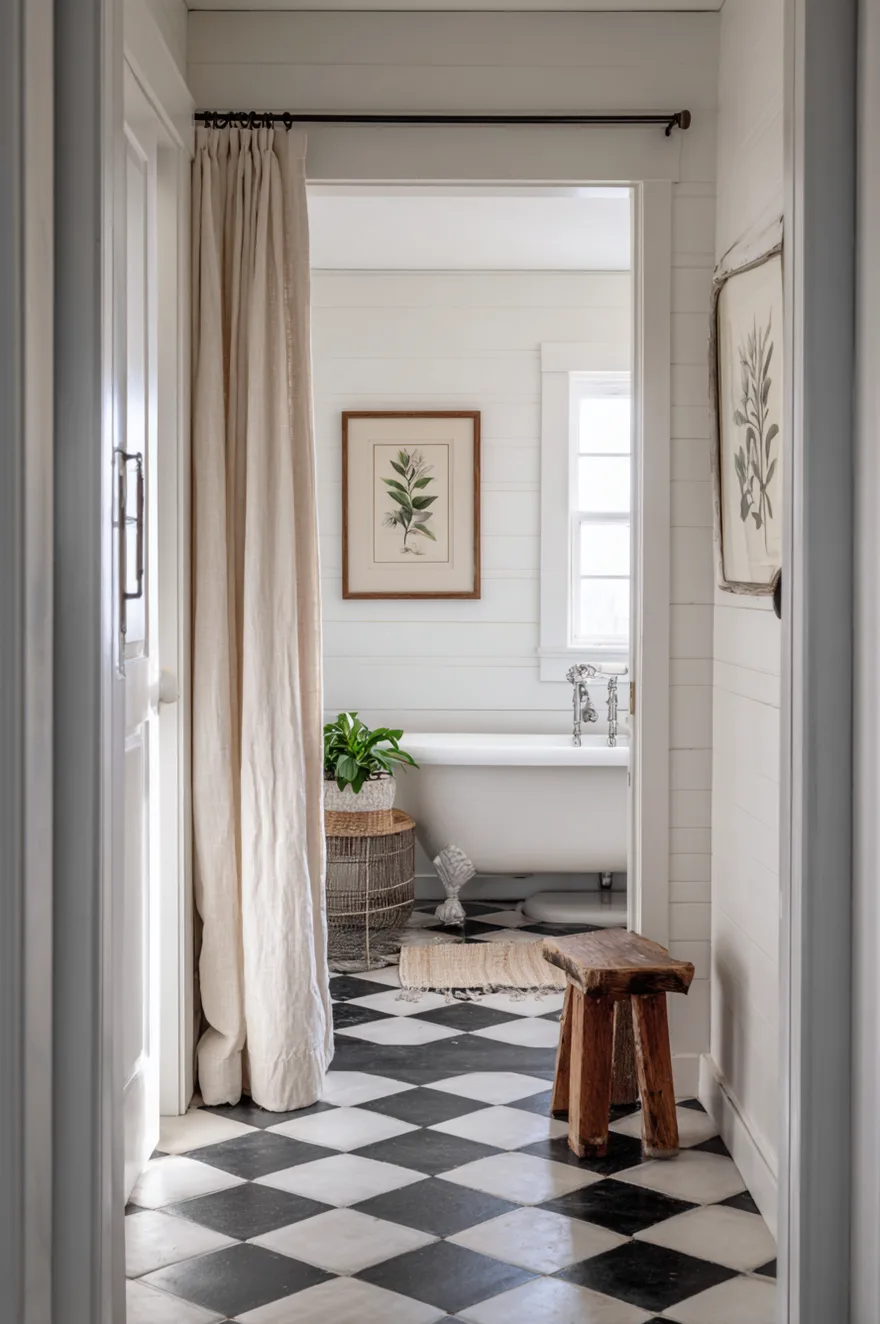
Pinterest rewards composition more than most people realize when they’re planning farmhouse bathroom ideas. A straight-on shot of a vanity is fine. A shot framed from the hallway threshold looking into a room where a clawfoot tub is visible at the far end – that’s the image that gets saved three times as often, and there’s a real reason for it.
The doorway frame creates what photographers call a frame within a frame. Your eye travels through the opening, across the floor, and lands on the tub. If the floor has black-and-white cement tile, the pattern actively leads the eye inward along those geometric lines – it’s not decorative coincidence, it’s how the human eye follows pattern. A simple linen curtain panel hung instead of a door softens the foreground and lets light from the bathroom filter into the hallway, which makes the whole shot feel bigger than it is.
For the actual execution: hang the curtain panel on a ceiling-mounted rod about six inches past the door opening so it frames without blocking. Choose a natural linen in an undyed or raw color – too white reads clinical, too dark closes the frame. Keep a wooden stool visible beside the tub in the background, maybe a basket of towels. Those supporting details tell a story even at thumbnail size, which is exactly the size most people first see your image on Pinterest. Compose the shot from about three feet into the hallway, phone or camera at chest height – not eye level, not floor level. That middle height captures both the tile floor pattern and the tub rim in the same frame.
11. Shiplap Bathroom Walls On A Real Budget
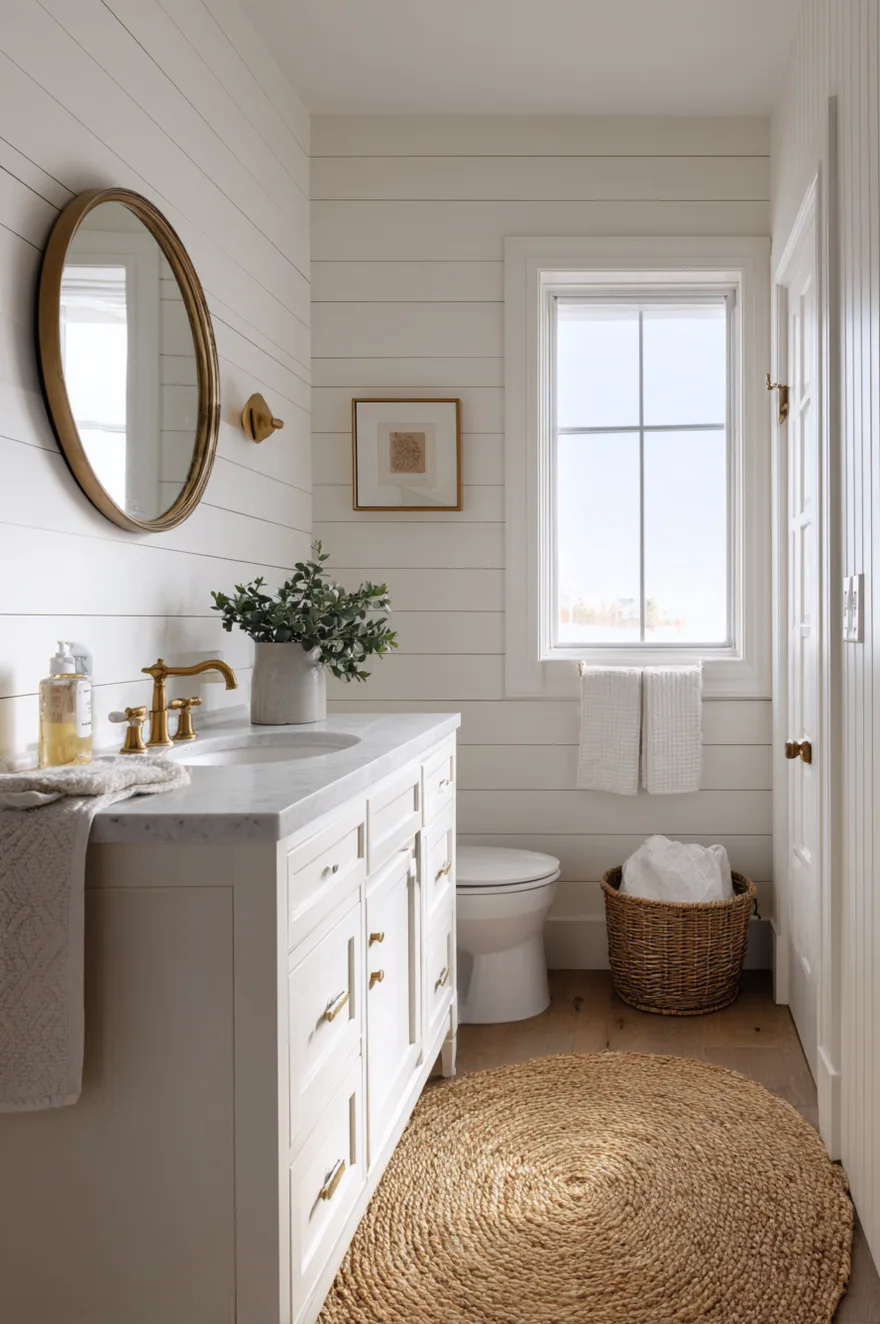
Real pine shiplap is great. But if you’re doing an average 50-square-foot bathroom and you’re watching the budget, primed MDF boards cut to 4-inch widths are a legitimate alternative that most people cannot distinguish from real wood once they’re painted. A sheet of 4×8 MDF runs under $30 at most hardware stores, and you can typically cover an average bathroom for four to five sheets – well under $120 in wall material.
The installation goes over existing drywall with construction adhesive and finish nails. You don’t need to remove anything. Paint the whole thing Sherwin-Williams Alabaster (SW 7008) – two coats – and the result is that warm, creamy white that appears in nearly every farmhouse bathroom photo you’ve ever saved. Pair it with the IKEA Hemnes bathroom vanity (paint it first, before installation, in the same Alabaster or a soft warm white like Benjamin Moore White Dove) and the built-in, custom look comes together for a total cost that’s genuinely under a few hundred dollars. The MDF edges need to be sealed well before painting because they absorb moisture – a coat of Zinsser BIN shellac primer on every cut edge will handle that.
12. The Mirror That Does The Heavy Lifting
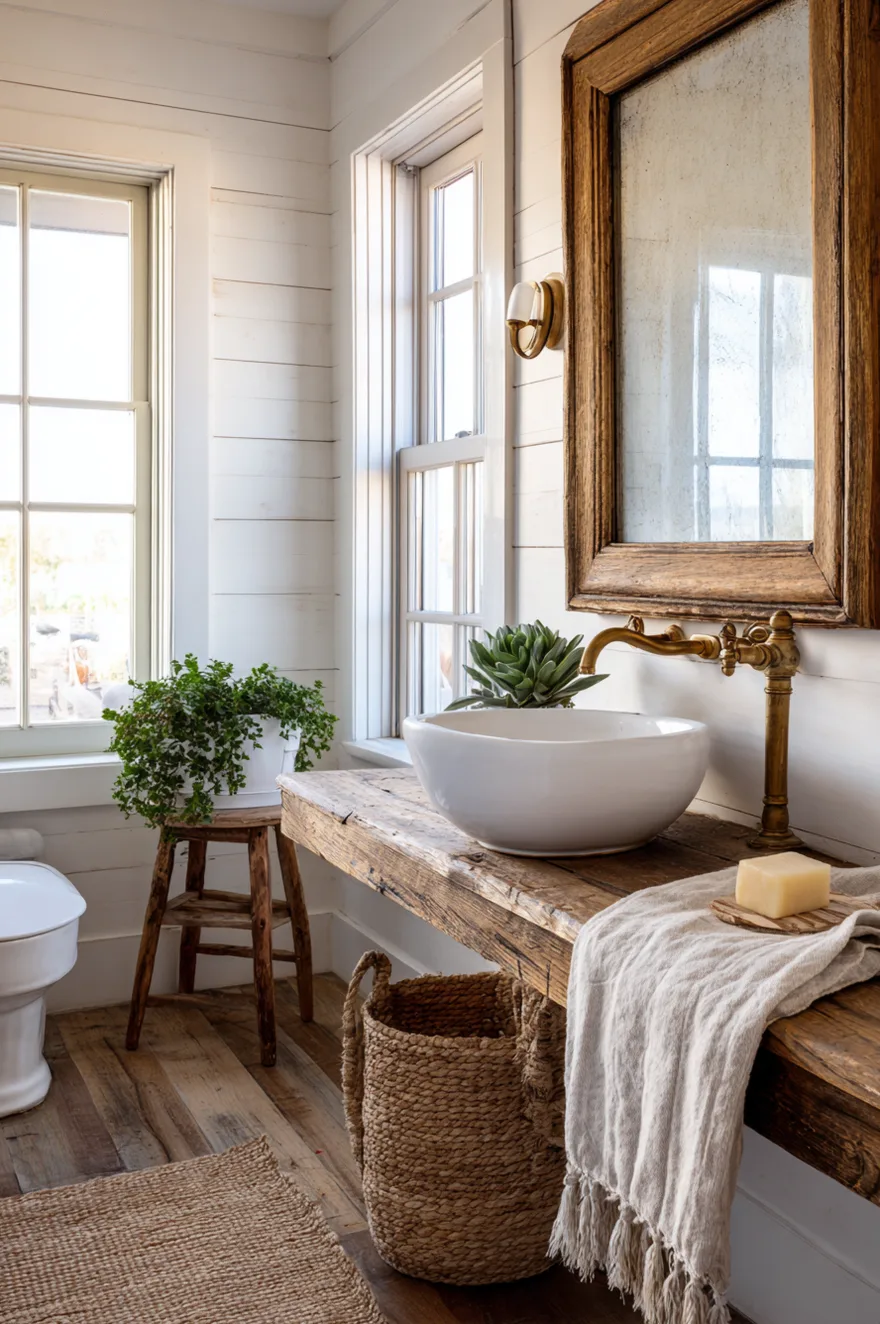
I found it on a Tuesday morning at the Habitat for Humanity ReStore in Chula Vista – a large old window frame, maybe 24 by 36 inches, with the original wavy glass still intact in all four panes. The price tag said $14. I stood there for a full minute trying to figure out what was wrong with it. Nothing was wrong with it. I carried it to the car in two pieces wrapped in an old moving blanket and drove home slightly nervous that the glass would shift and break.
It didn’t. And now it hangs above the vessel sink in our guest bathroom, anchored with two mirror hanging clips at the top and a French cleat at the bottom because it’s heavier than it looks. The wavy glass does something that a flat mirror simply can’t – it reflects the room in a slightly distorted, older-looking way that makes everything feel like it came from somewhere. A vessel sink in bright white below it, a brass faucet, shiplap behind – and the window-frame mirror makes the whole corner look collected rather than assembled.
If you’re hunting for one: ReStores get window donations regularly, especially in older neighborhoods where renovations are happening. Facebook Marketplace is the other place. Search “antique window” or “old window frame” and sort by nearest first. Most sellers want $20-40, which is still a fraction of what a comparable decorative mirror costs retail. Check that the glass is original (it’ll have that slight wave or bubble to it) and that the frame joints are solid before you commit.
13. Warm Terracotta Grout Changes Everything
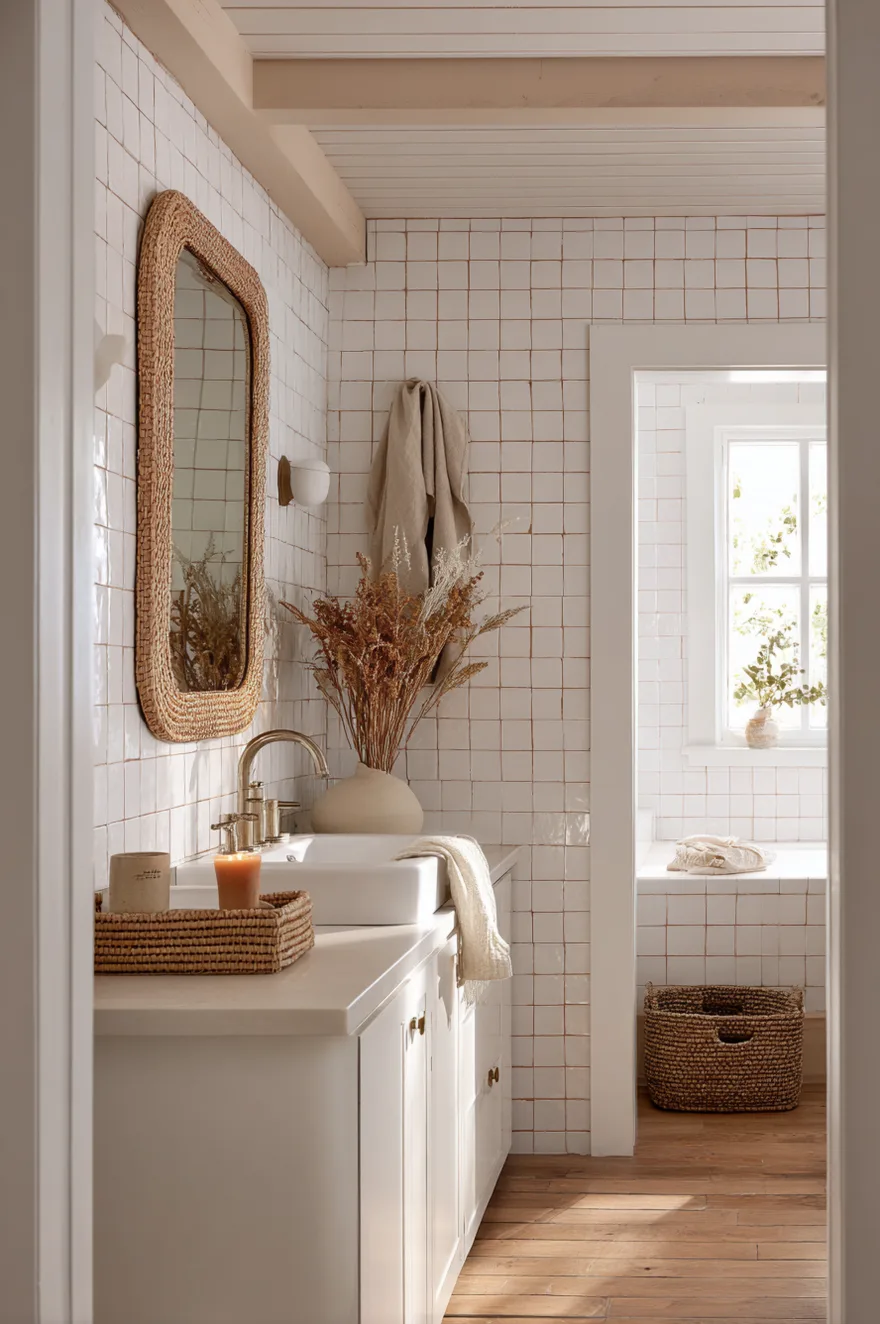
Standard white subway tile with gray grout is fine. The same tile with terracotta-tinted grout is genuinely interesting. The warm undertone pulls the tile away from builder-grade and toward something that looks like it came from an old European farmhouse – which, in a farmhouse bathroom, is exactly the feeling you’re going for. It pairs with rattan accessories and raw linen hand towels without any effort at all because the color families are already doing the work.
Custom Building Products makes a grout called “Sahara Beige” that reads terracotta in most light conditions, or you can tint standard unsanded grout with a colorant from any tile shop. Either way, the material cost is nearly identical to standard gray grout. It’s one of those swaps where the only thing stopping most people is not knowing it exists as an option.
14. Vintage Vanity Ideas That Work In Small Bathrooms
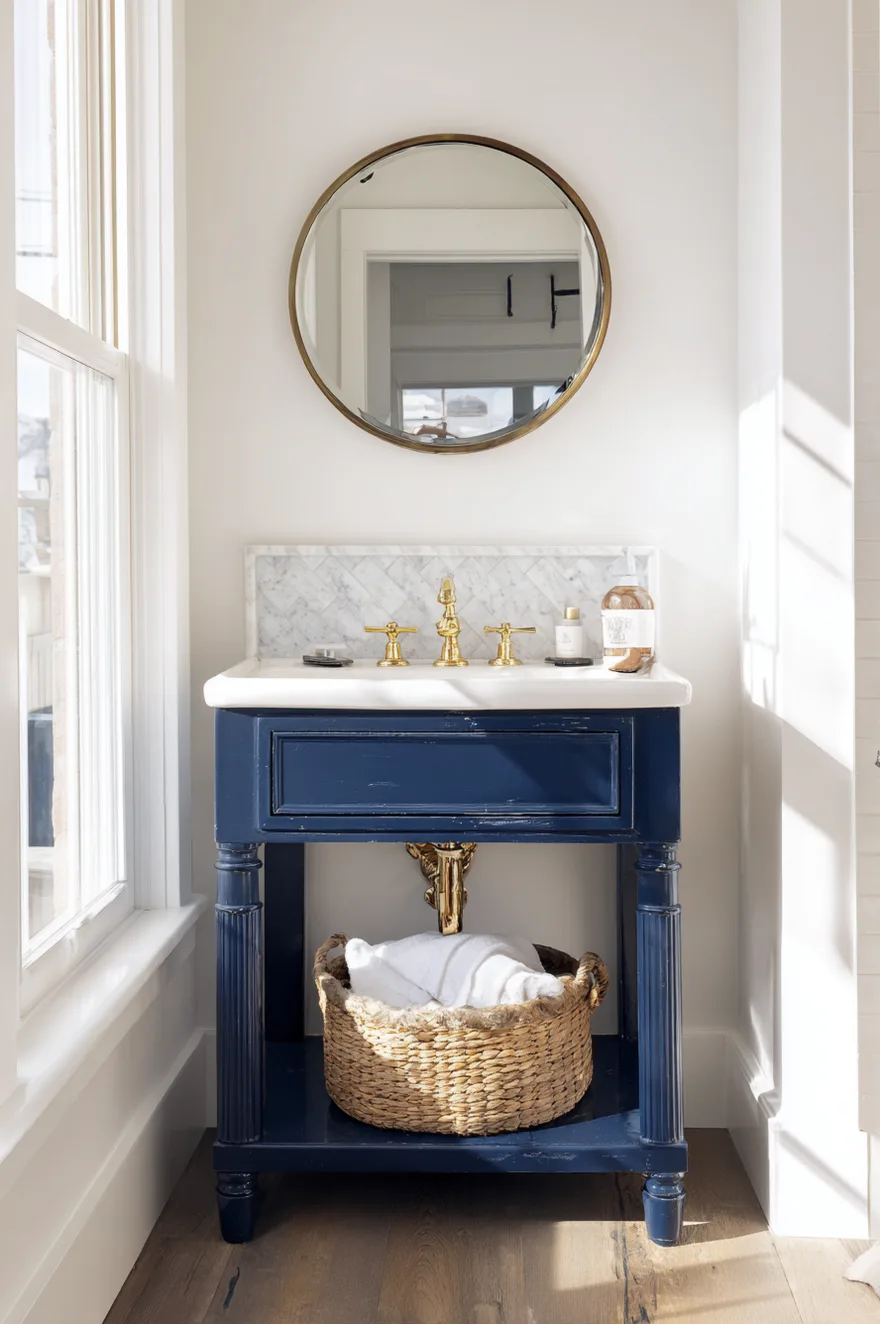
A 30-inch vanity is the sweet spot for a small farmhouse bathroom – wide enough to feel functional, narrow enough to leave clearance on both sides in a standard 5-foot layout. A flea-market washstand refinished in navy (I like Benjamin Moore Van Deusen Blue for this) fitted with a drop-in porcelain sink gives you that vintage vanity look without the full dresser-conversion project from section 3. It’s a shorter path to the same visual territory.
Leave the P-trap exposed – nickel finish for this palette, not brass – and it reads as an intentional design moment instead of a plumbing detail someone forgot to hide. Behind the sink, marble-look peel-and-stick tile (the kind available at Home Depot for around $2-3 per square foot) works as a backsplash that can come down cleanly when you’re ready for something else. For the measurement that matters: make sure your washstand depth is at least 17 inches to accommodate a standard drop-in sink bowl with a rim that clears the front edge. Anything shallower and you’ll be fighting the install the whole way through.
Navy with nickel, marble-look tile, and a simple round mirror above keeps the small farmhouse bathroom from feeling cluttered. Resist adding too much. One basket on the floor for extra towels, one small plant on the vanity – done.
15. Go Rattan On the Ceiling – Seriously
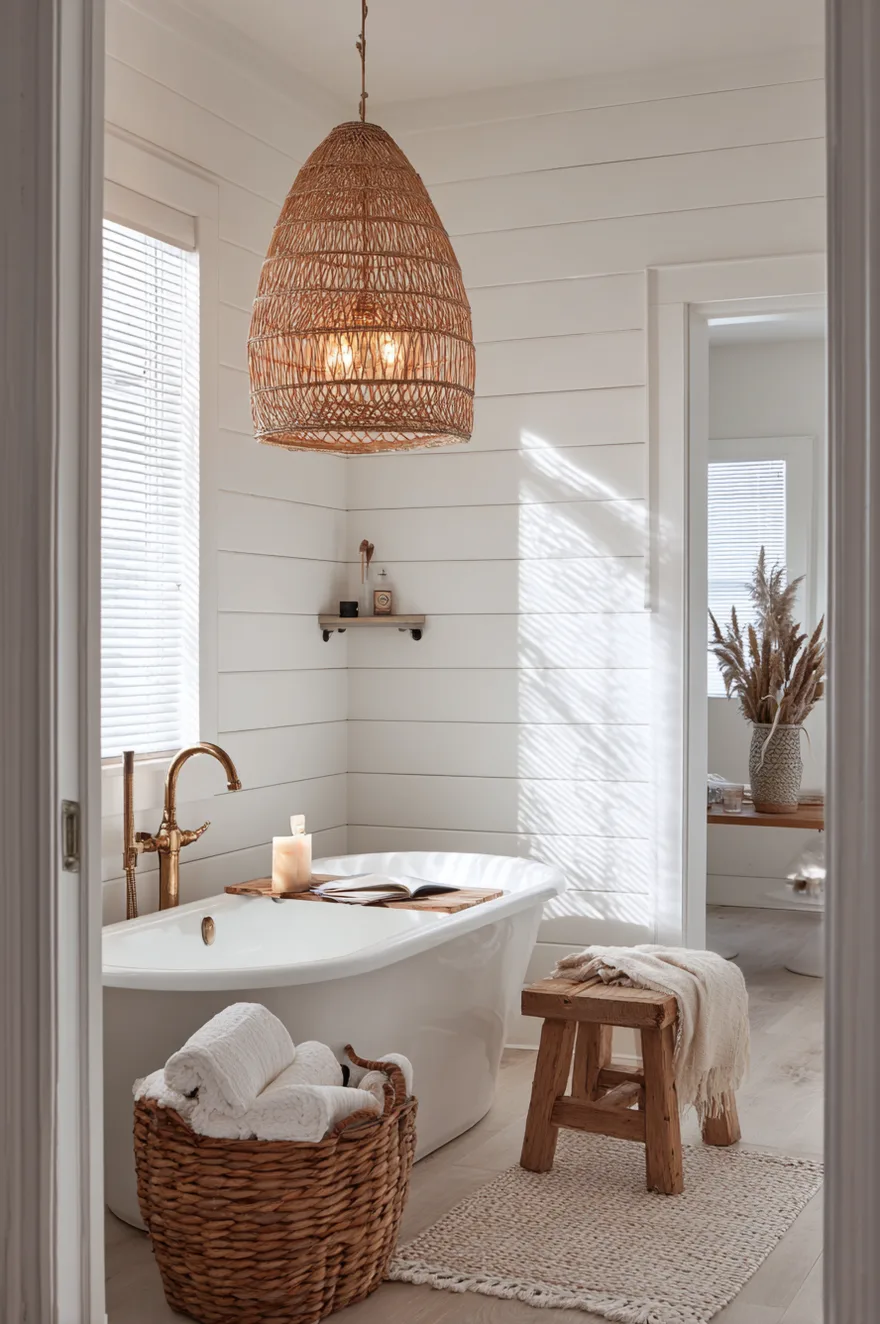
Swap out the builder-grade flush-mount ceiling light above a freestanding tub for a rattan pendant and the room changes in about twenty minutes. Rattan pendants run $40-60 on Amazon and Wayfair, the installation is a straight swap at the existing junction box (if you’re not comfortable with wiring, any handyman can do it in half an hour), and the difference is not subtle.
At night, with a warm 2700K bulb inside, the woven rattan casts a patterned shadow on the ceiling and walls – rings and diamonds of light and dark that shift slightly as the bulb warms up. It’s the kind of detail that makes the whole room feel considered. And a $50 pendant doing that much work for the atmosphere is why I always start with light fixtures when I’m trying to upgrade a bathroom without touching a single tile.
16. Farmhouse Bathroom Ideas For A Rental You Can’t Demo
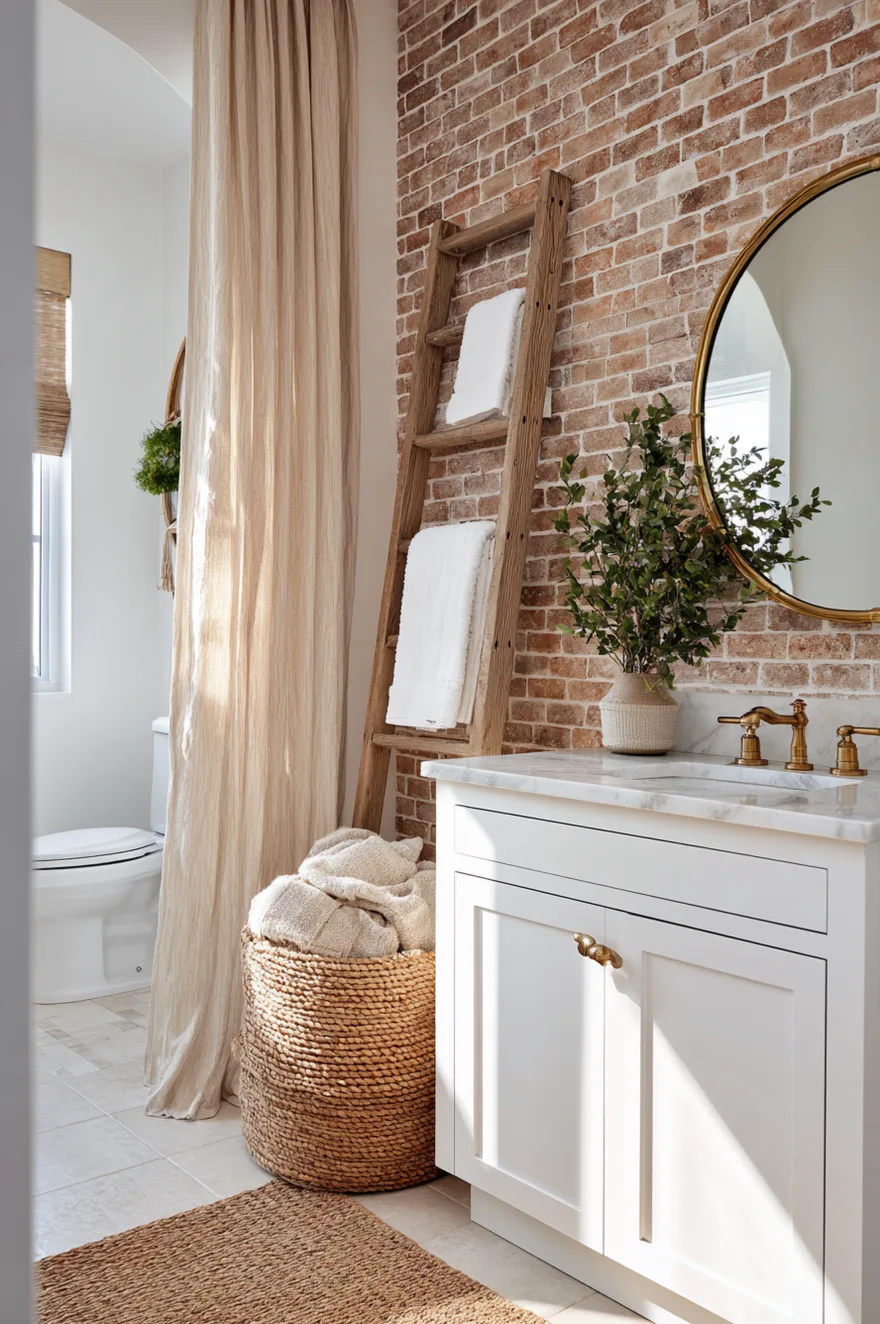
I lived in rentals for years before we bought our house, and the farmhouse bathroom ideas I resented most were the ones that assumed you could retile, repaint, or replumb. You usually can’t. But peel-and-stick brick-look panels on one accent wall behind a freestanding wood towel ladder, combined with stick-on brass cabinet hardware and a tension-rod curtain hiding the under-sink clutter – all of that is completely removable and leaves no trace.
The stick-on cabinet hardware (available from brands like Cosmas and Amerock on Amazon) is the upgrade I wish I’d done in every rental I ever had. Swap the original hardware into a labeled zip-lock bag, tape it inside a cabinet for the move-out, and put it back in ten minutes when you leave. And compare the before and after: original builder chrome pulls versus aged brass knobs. The brass wins by a mile in every farmhouse bathroom photo. But it’s not just about looks – the freestanding ladder holding actual towels instead of a cramped towel bar genuinely makes the room function better.
17. Why Stone Countertops Belong In the Farmhouse Bath
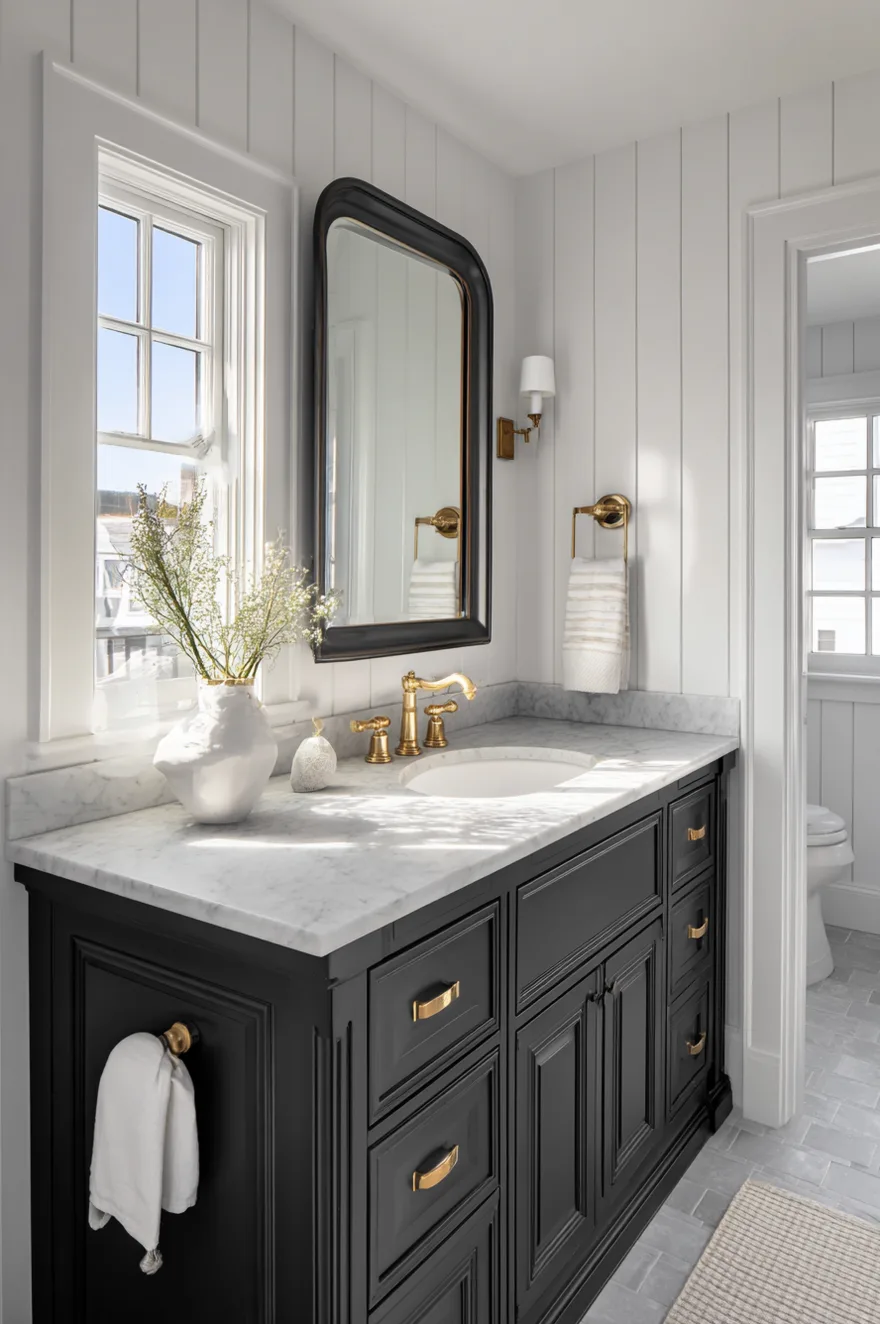
Honed Carrara marble is cooler than polished, more forgiving of water spots, and considerably less likely to look dated in ten years. On a custom-height vanity with inset panel cabinet doors painted Benjamin Moore Wrought Iron, it’s a combination that sits somewhere between classic and current without being obviously either.
The dark cabinet does something important here: it grounds the white marble so the counter doesn’t float visually. And honed stone – that flat, non-reflective surface – pairs better with unlacquered brass than polished marble does, because the matte and the metal have a similar quality of light absorption. This is the kind of farmhouse bathroom idea that makes a small guest bath look like it belongs in a much more expensive house. Not because marble is cheap (it’s not), but because the finish combination is specific enough to read as intentional design rather than a contractor’s default choice.
18. The Close-Up Detail Shot That Gets Saved Every Time
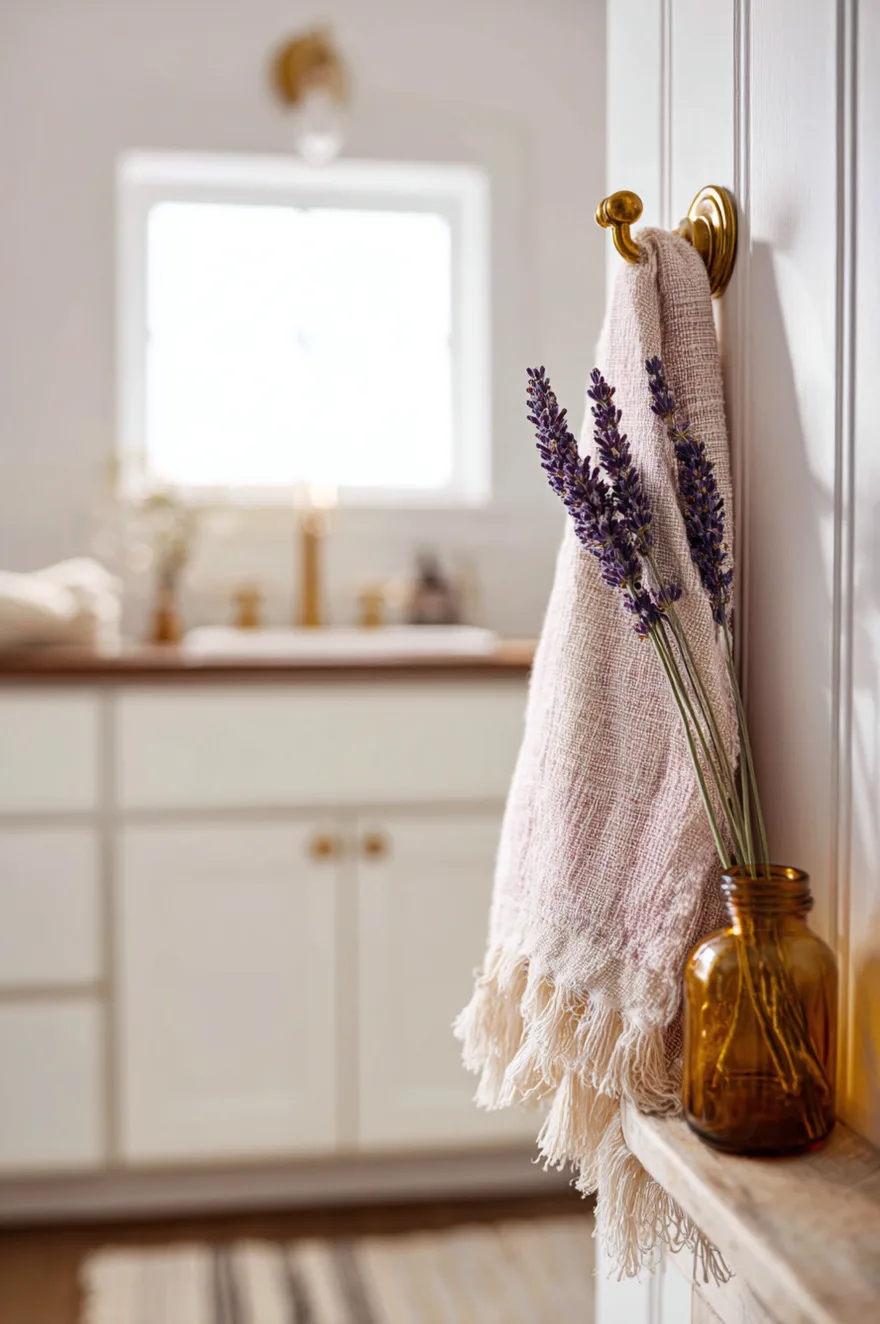
Full-room farmhouse bathroom photos get scrolled past. Close-up detail shots – an unlacquered brass hook, a folded linen hand towel with a fringe edge, one dried lavender stem against white shiplap – get saved. Pinterest data consistently shows that detail shots earn more saves per impression than full-room images, because they give someone a specific, achievable thing to replicate, not a whole room to recreate.
For your own bathroom, find your best corner. The hook with the towel and the dried stem is a genuinely good one because it’s three materials with totally different textures (metal, linen, dried botanical) in a six-inch square. Natural light from the side, not overhead. Shoot it close – 12 inches from the subject if your phone allows – and let the background go soft. That blur makes the detail pop and the room feel bigger than it is behind the shot.
19. Small Farmhouse Bathroom With Big Storage Moves
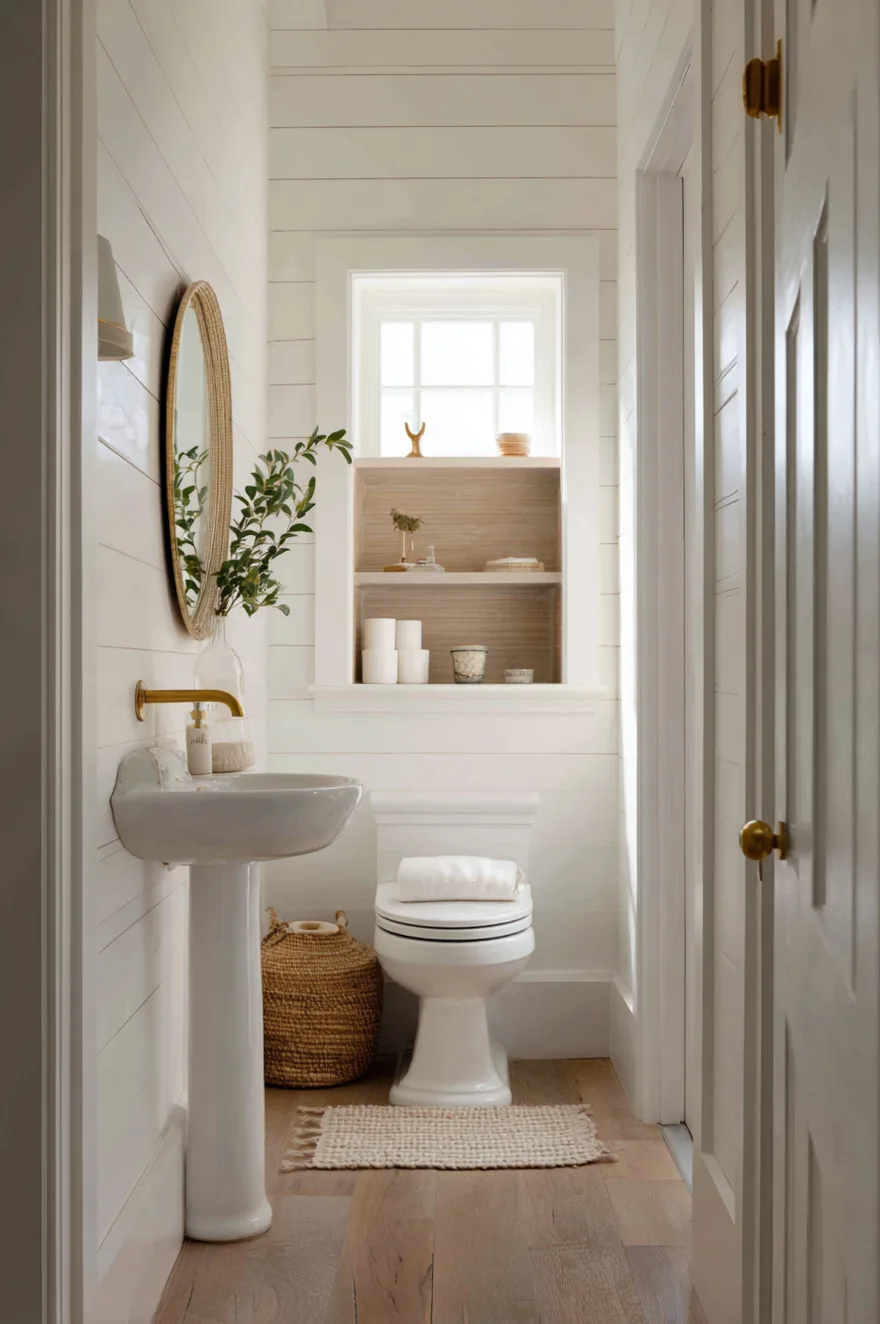
A recessed cubby built between two wall studs beside the toilet is the storage move that costs almost nothing and looks like a custom built-in. Standard wall framing puts studs 16 inches apart, giving you a 14.5-inch clear opening between them. Standard drywall is 3.5 inches deep (the thickness of a 2×4 stud wall), which is enough for rolled hand towels, a few bars of soap, and a stack of extra toilet paper rolls. That space is currently just drywall in most bathrooms. It doesn’t have to be.
Start with a stud finder to locate both studs beside the toilet. Mark the opening, cut with a drywall saw (go slowly – there are sometimes horizontal blocking boards in there, though usually not), and clean up the edges. Line the inside of the niche with peel-and-stick fluted oak contact paper – the kind with a real wood-look texture, available on Amazon for around $15 a roll. Install a small brass rail across the front of the opening; a basic 12-inch brass towel bar works perfectly and costs about $18 at any hardware store. That rail keeps things from sliding out and looks intentional, not improvised.
For the finishing styling: roll three hand towels and stack them vertically on one side, stack four or five toilet paper rolls on the other. You don’t need a door on it – the open niche reads as design. Paint the inside of the niche a slightly deeper shade than the surrounding wall if you want it to feel like a shadow box, or keep it the same white as the shiplap for a more recessed, quiet look. Either way: you took a patch of drywall and turned it into storage that people will ask about every time they use your bathroom. That’s the best kind of small farmhouse bathroom upgrade there is.
Okay, I know that’s a lot of ideas – but honestly, you only need to pick two or three that fit where you are right now. If you’re renting, start with section 16 and the rattan pendant. If you own and you’ve got a weekend free, the shiplap walls or the recessed niche will change your bathroom more than almost anything else on this list. I’d love to know which one you’re trying first – drop it in the comments below, seriously, I read them all.
With love,
Liv