Living room shelf ideas can be the difference between a room that looks finished and one that just looks like furniture pushed against walls. Whether you’re working with built-ins around a fireplace, floating shelves behind a sofa, or an open shelving unit doing double duty as a room divider, this guide covers 17 approaches – from dramatic floor-to-ceiling built-ins to a single ledge shelf swap – all styled for real homes with real budgets.
Last winter I repainted our living room built-ins. Jake thought I was going through something. I had Nora on my hip and a roller in my free hand at 9pm on a Tuesday, and honestly he was not entirely wrong. But those shelves had been bothering me for two years – the builder white, the slightly awkward proportions, the hardware that came with the house and looked like it cost about four dollars. I knew that if I could just get the shelves right, the whole room would click.
That project sent me down a months-long spiral of researching living room shelf ideas. I pinned obsessively, drove to three different flea markets in one weekend (Benny came to one of them, which was a mistake), and ended up rethinking pretty much every surface in our main living space. Some ideas cost nothing. Some cost more than I expected. And a couple of them changed the way I think about shelving altogether. Here are the ones worth actually trying.
1. Built-In Shelves Around The Fireplace That Stop People Cold
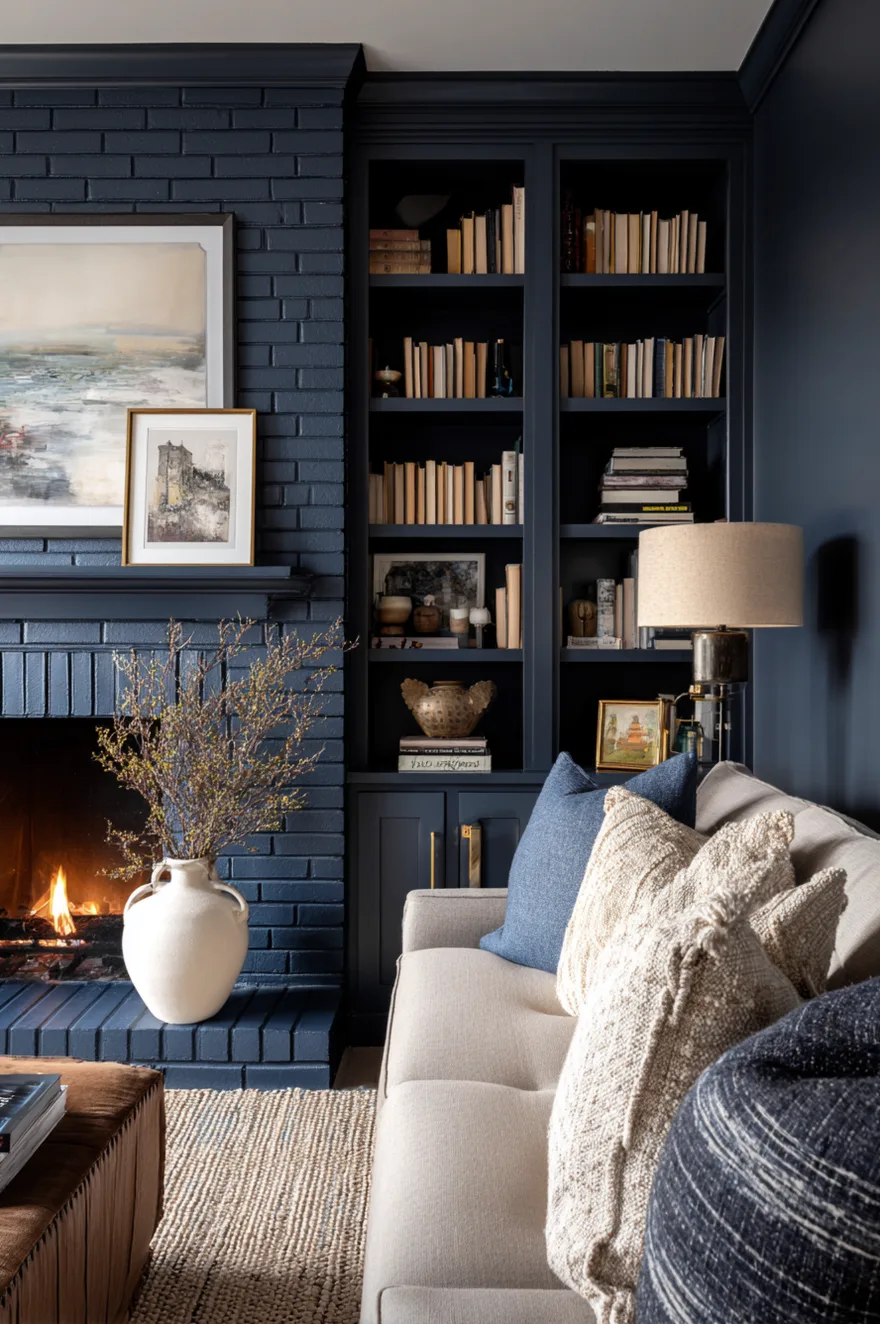
Floor-to-ceiling built-ins flanking a fireplace are the single highest-impact thing you can do to a builder-grade living room. I know that sounds dramatic but I stand by it. The scale of them – running all the way to the ceiling – is what does the work. Most builder fireplaces sit as a sad little island in the middle of a wall with nothing anchoring them. Surround that same fireplace with deep navy painted built-ins and suddenly it looks like an architect made a decision.
The details matter a lot here. Paint the inside back panel of the shelves the same deep color as the cabinet face (Benjamin Moore Hale Navy is the one I keep coming back to, though any saturated navy reads well). Swap the hardware for unlacquered brass – not brushed gold, actual unlacquered brass that will patina over time. Then style with restraint: a few fat stacks of art books on the lower shelves, one oversized ceramic vase at hearth level, and some breathing room. Resist the urge to fill every inch. The shelves themselves are the statement; let them be one.
If you are building these from scratch, standard shelf depth for a living room built-in is about 12 to 14 inches – deep enough to hold a real object but not so deep that things get lost at the back.
2. Wall-To-Wall Shelves For A Library Feel
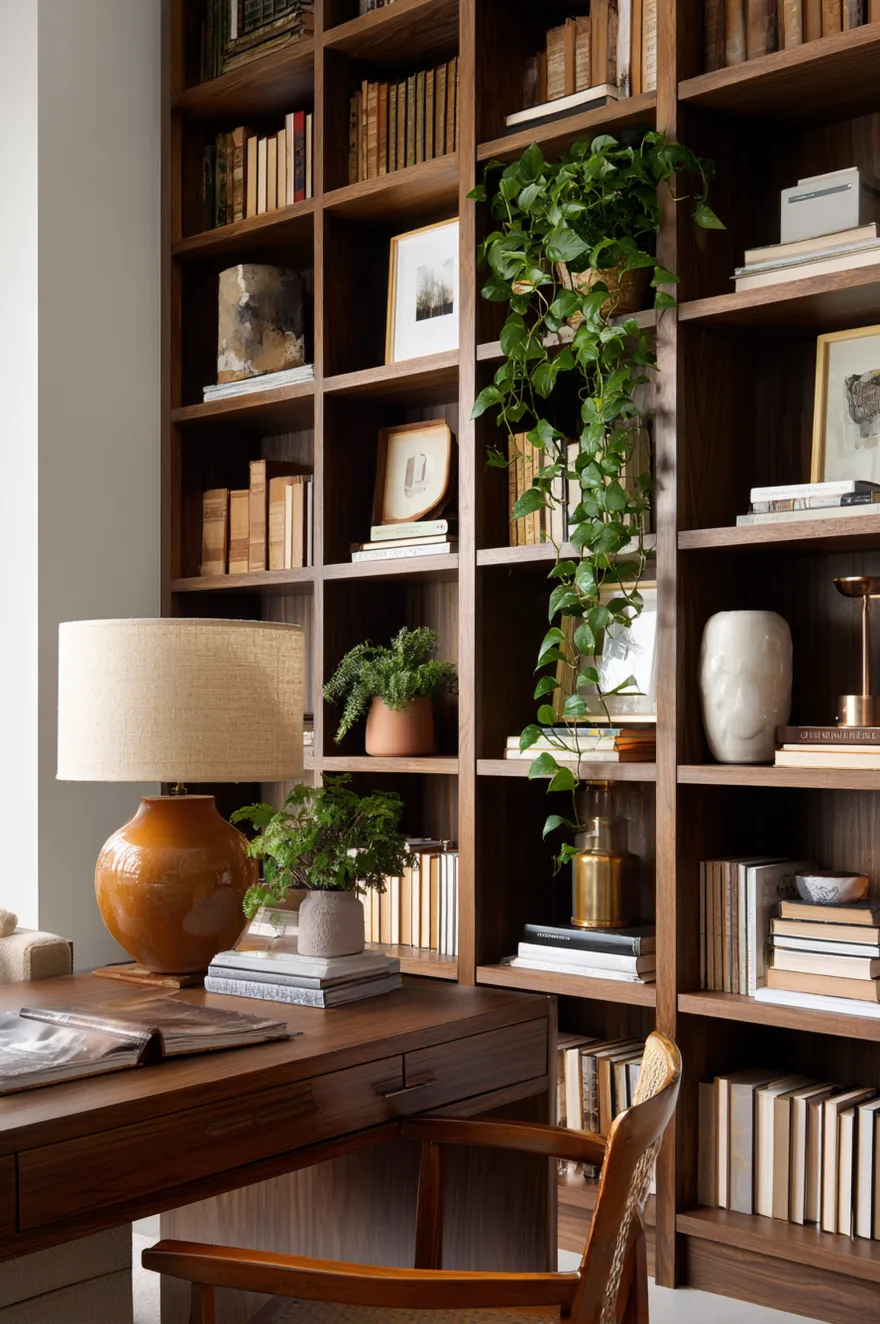
I grew up wanting a home library. Like, badly. Floor-to-ceiling books on every wall, a rolling ladder, the whole thing. Our San Diego rental was not exactly accommodating on that front, so I did the next best thing: one full accent wall of open shelving in a warm walnut-tone finish, shot from the doorway so the whole room reads like a study.
Here is the thing nobody tells you about a full wall of books – it looks chaotic if all the spines face out. Try turning every third or fourth row backwards so you just see the cream or ivory page edges. The texture that creates is genuinely interesting, and it slows the eye down in a way that feels intentional rather than messy. Break up the book runs with a small framed print or a trailing pothos that spills over the shelf edge. That combination – the reversed spines, a bit of green, one or two personal objects – reads as a private collection rather than a furniture showroom setup.
Stand at the doorway before you style anything. That is your Pinterest shot and your sanity check at once.
3. The Ledge Shelf Trick Nobody Talks About
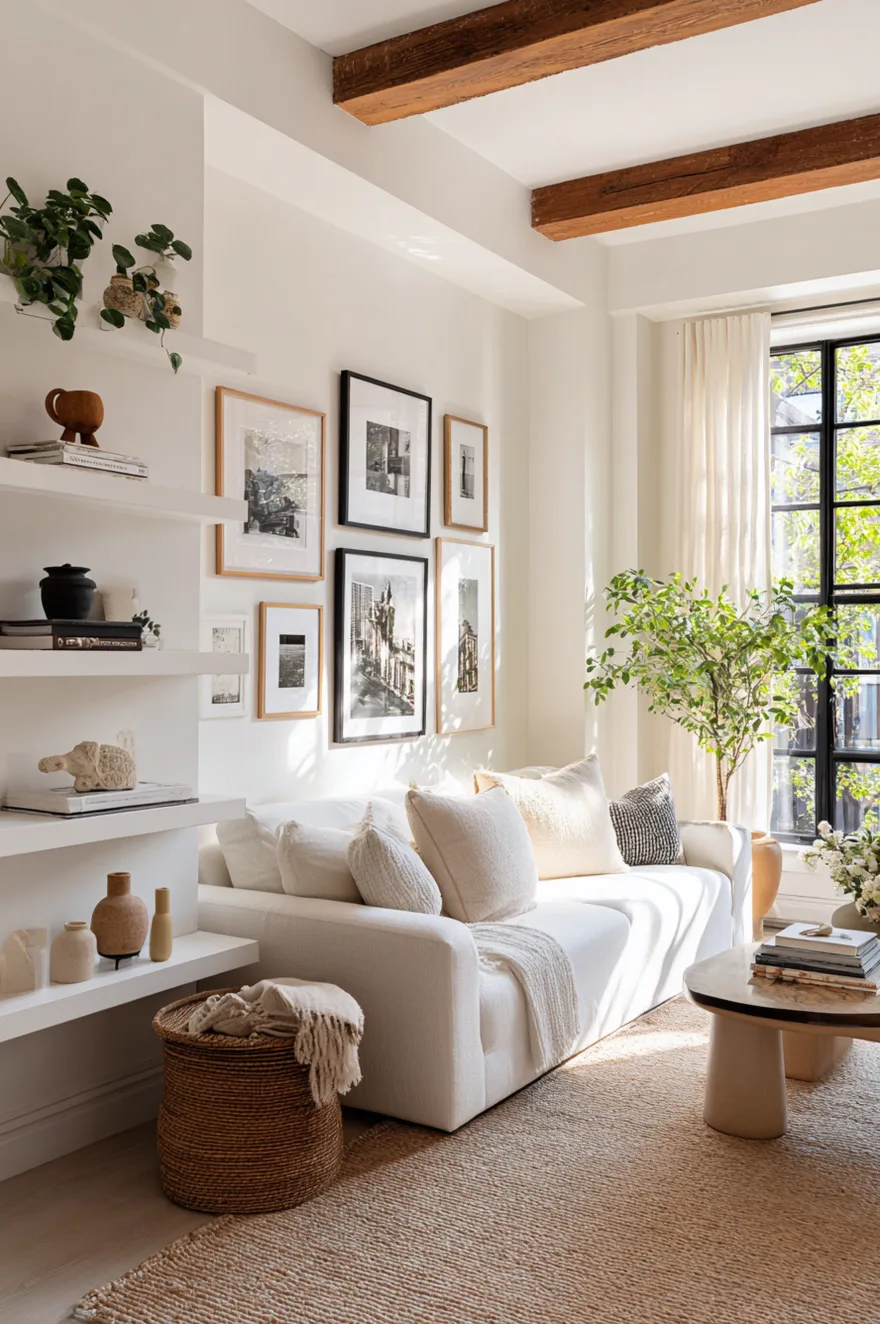
Picture ledges instead of traditional floating shelves. Three of them, staggered at slightly different heights behind the sofa, running maybe 36 to 48 inches wide. You can swap art seasonally without drilling a single new hole – just slide out one leaning print and slide in another. IKEA’s Mosslanda ledge is about $10 a piece and looks completely fine painted the same color as your wall.
This is one of those solutions I feel slightly embarrassed I did not think of sooner. And it is genuinely rental-friendly since you are making the same number of holes regardless – you just have infinitely more flexibility with what sits on them.
4. Mid-Century Modern Shelving Unit Done Right
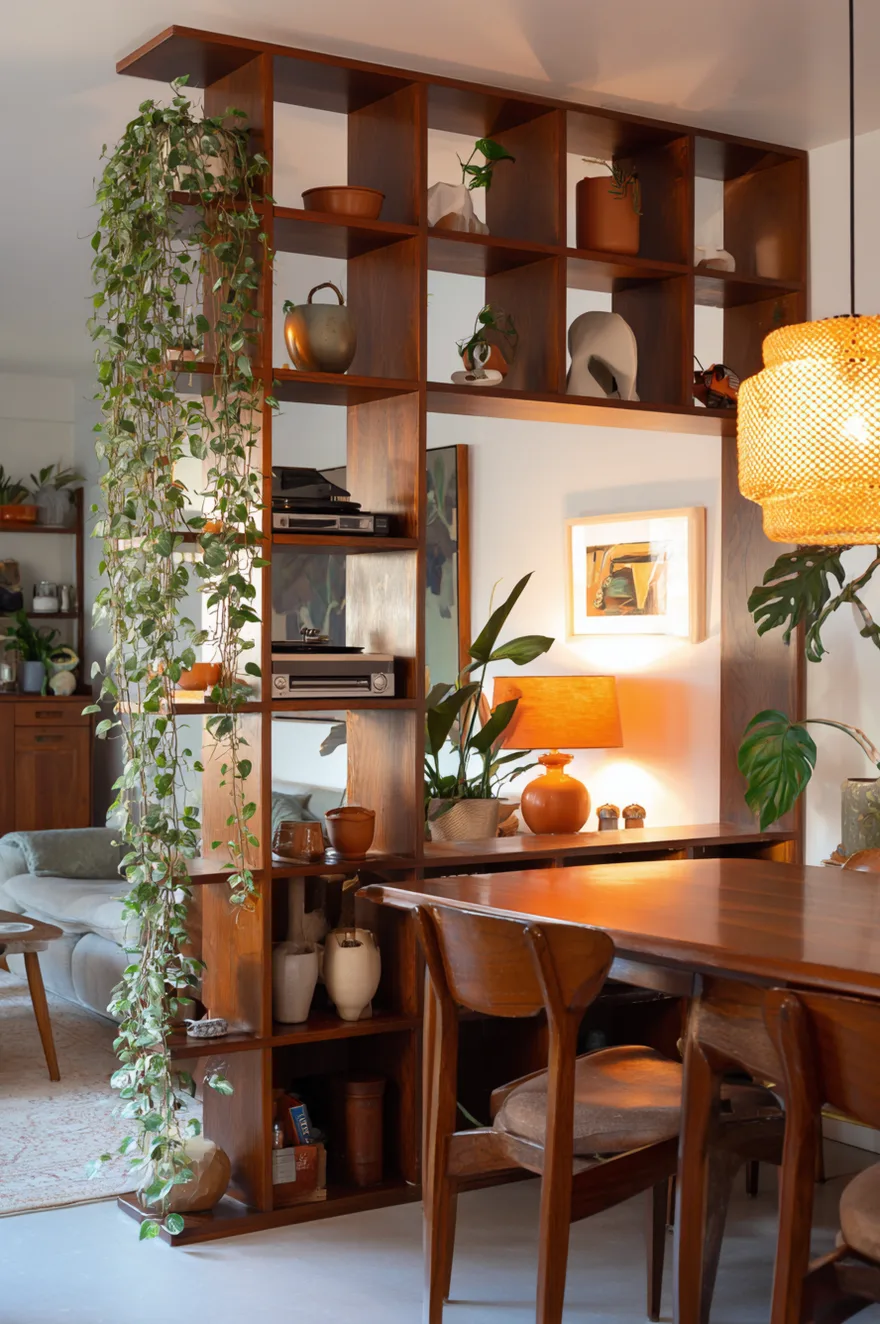
The open-back teak room divider gets a bad reputation because people style it wrong. They overload it. Every shelf crammed with stuff until it looks like a yard sale display case. The whole point of an open-back unit is the negative space – the way light and background come through the shelves and make the objects on them feel considered rather than stored.
A teak-finish divider between a living room and dining space is one of my favorite living room shelf ideas for open-plan layouts. Put a record player on one shelf, two or three chunky ceramics on another, and one trailing string-of-pearls plant at the end where it can hang. Then put a warm table lamp behind the unit – the amber glow coming through the open shelves at around 2700K is genuinely one of the best things you can do to a room at 7pm. The rest can stay empty. That is not laziness – that is the point.
5. Floating Shelves Behind The Sofa In Terracotta And Cream
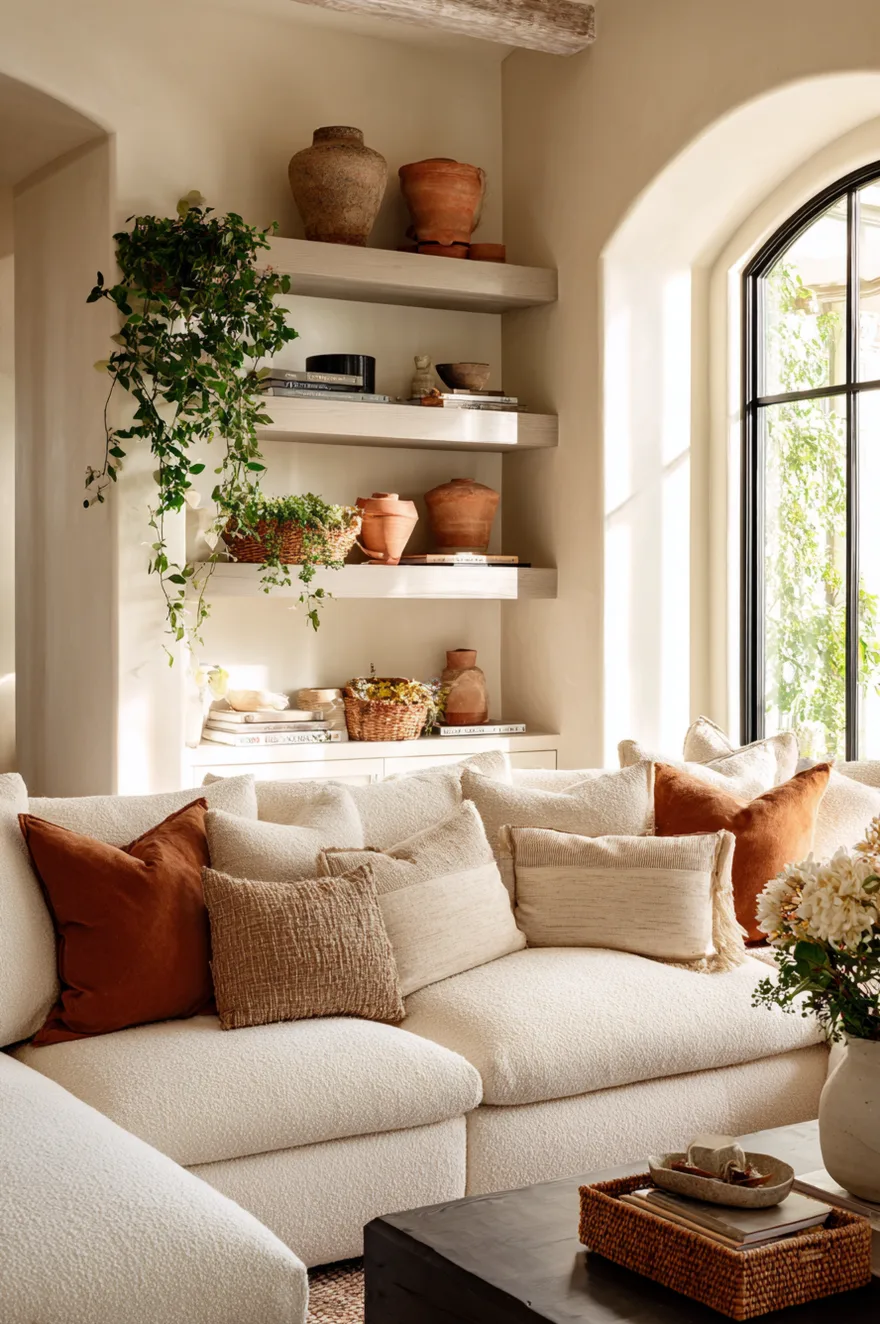
Two wide floating shelves, mounted low and close together – maybe 8 to 10 inches apart – above a cream boucle sofa. Not a gallery spread across the whole wall. Just two deliberate shelves, almost like a cabinet that lost its doors.
The palette here does the heavy lifting. Terracotta pots in varying heights (the unglazed ones from the hardware store work perfectly and cost almost nothing), a small tight-weave woven basket, and a stack of linen-covered books with the spines facing inward. Against a warm greige or soft plaster wall, that combination of matte terracotta, natural linen, and cream boucle sofa below it is genuinely one of the warmer living room shelf ideas I keep returning to. No plants required, though a small trailing plant at one end never hurts.
Mount the lower shelf about 8 inches above the sofa back – close enough to feel intentional, high enough that you are not knocking objects off when you settle into the cushions.
6. A Swap You’ll Wish You Did Sooner
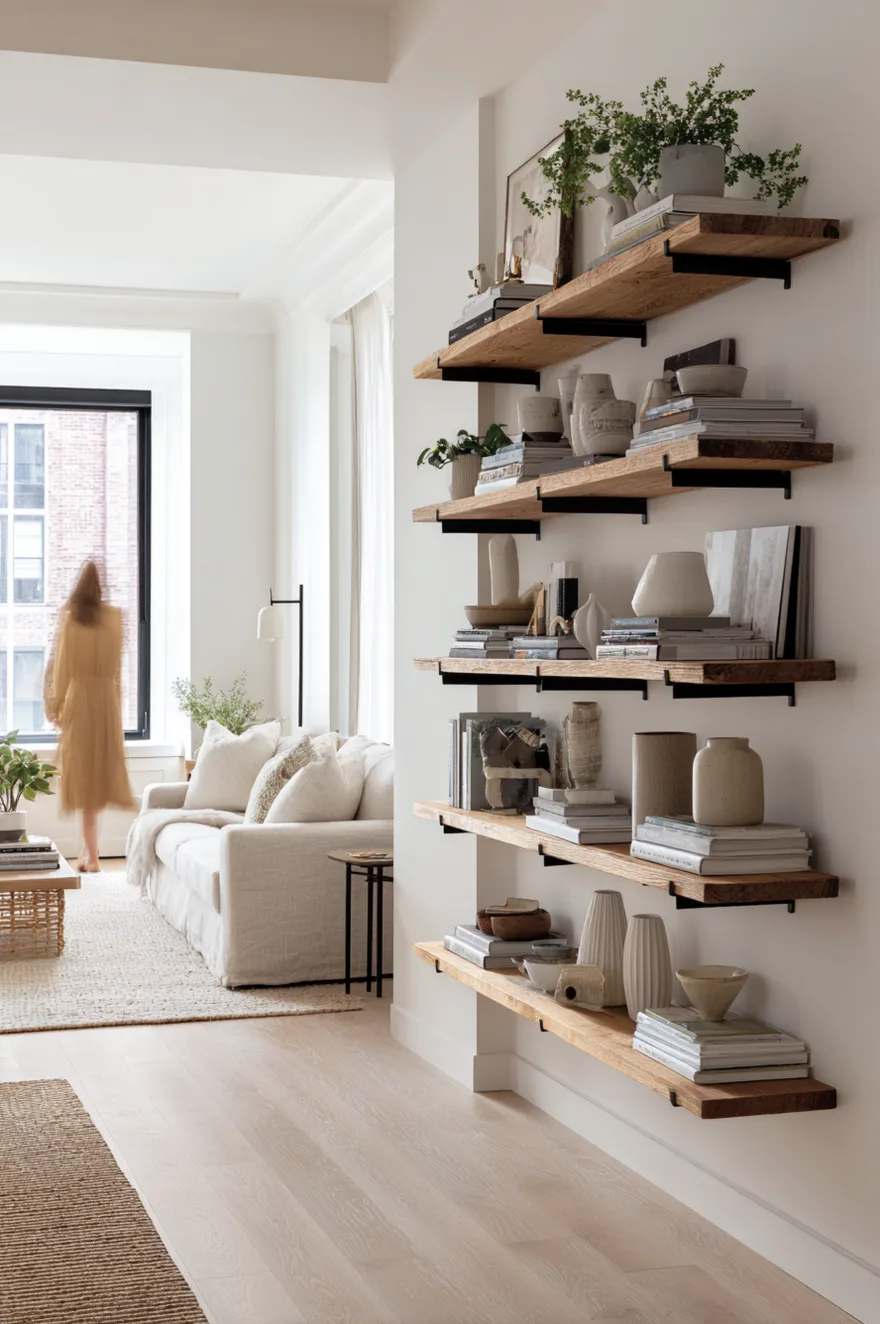
Pull the stock brackets off your IKEA Lack shelves and replace them with chunky blackened-steel floating shelf brackets. That is the whole move. The Lack shelf itself is fine – it is the spindly silver hardware that makes it read as dorm room furniture. Blackened steel brackets with some visual weight behind them make the same shelf look intentional. I was skeptical until I did it in our hallway, and now I am annoying about it.
You can find decent blackened-steel shelf brackets on Amazon or Etsy for around $15 to $25 a pair. The shelf stays the same. The room does not.
7. Shelves Flanking The TV Wall Without Looking Cluttered
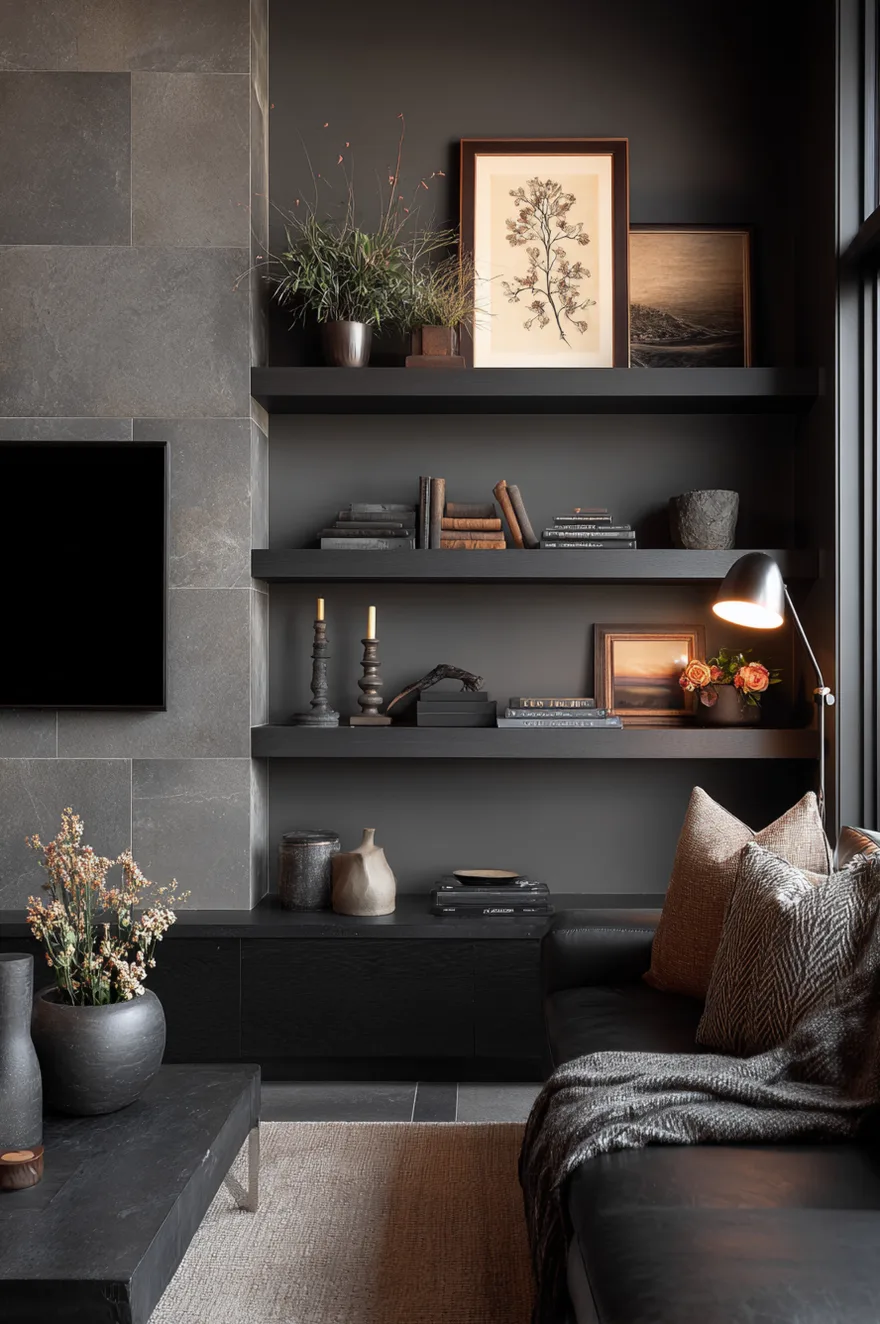
Asymmetry is what saves a TV wall from looking like a furniture catalog page. Two shelves on the left, three on the right – or one side heavier with books and the other holding a single large framed botanical print and one sculptural candle holder. The imbalance reads as considered rather than incomplete, as long as there is visual weight on both sides.
A matte charcoal finish on the shelves (rather than white) does something useful here – it lets the TV recede into the wall instead of floating awkwardly on it. And if you can do a concrete-look porcelain tile as a backdrop running floor to ceiling, the whole arrangement reads as one intentional composition rather than a collection of separate decisions. Still not totally sure about the exact tile spec for every budget – porcelain runs wide – but the visual effect is worth the investment if you are already renovating.
Keep the shelf objects large and few. A single object that is 10 inches tall reads better from across a room than four objects that are 3 inches tall.
8. Organic Modern Shelf Styling That Actually Stays Put
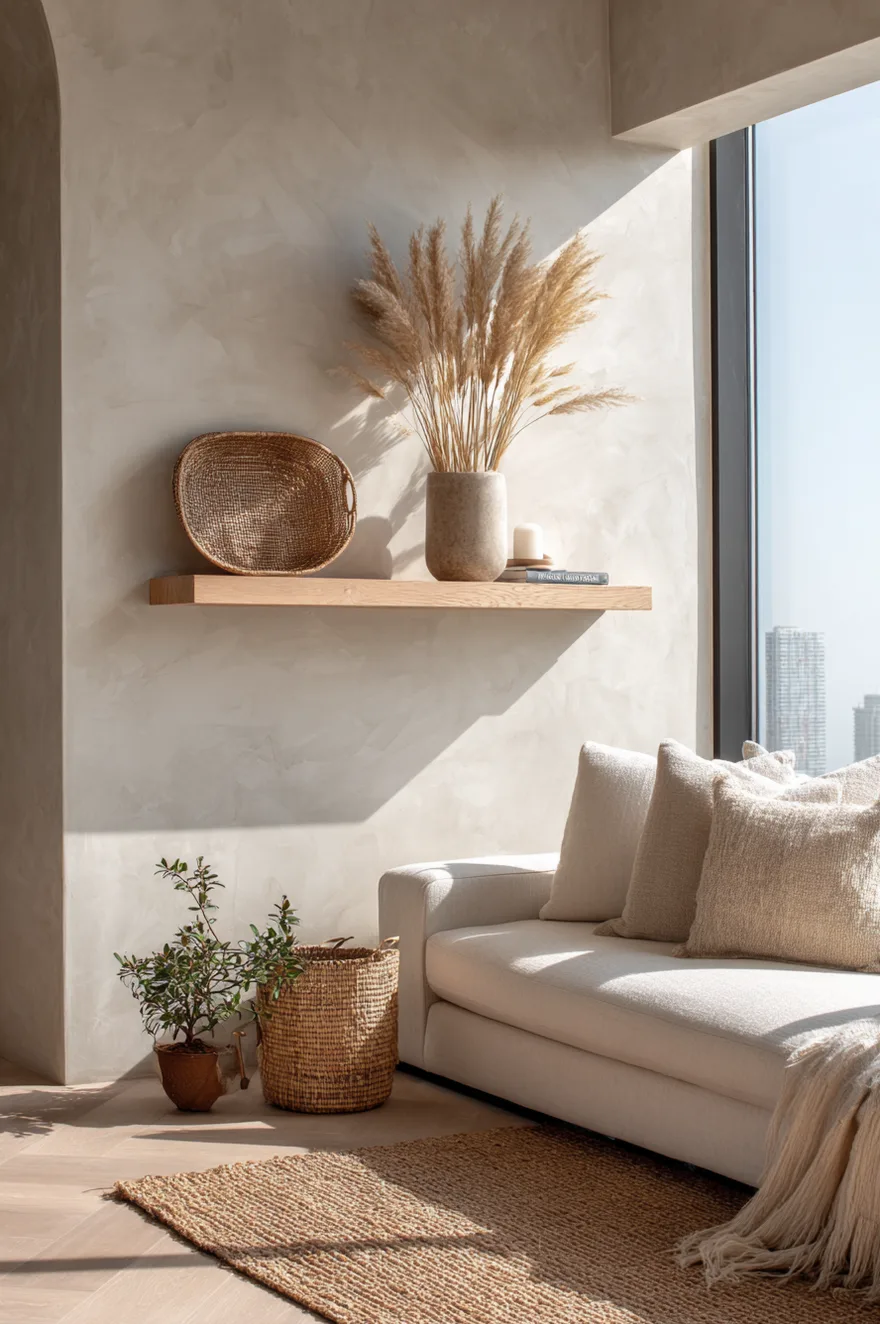
Most shelf styling falls apart within two weeks. You swap something, add something, move the plant, and slowly it becomes a surface where things just land. Organic modern styling is good because it has almost nothing on it to begin with, which means there is less to disturb.
A whitewashed oak floating shelf on a plaster-texture accent wall: start with a curved rattan tray as your anchor. Everything else goes inside or beside the tray, which forces you to edit. Dried pampas stems in a stone-finish vase (the heavier, more matte the finish the better), and one art book lying flat with something small on top – a small piece of coral, a river stone, a tiny ceramic. That is genuinely it. The restraint is the whole design choice, and the reason it holds is that there is no gap inviting you to add one more thing.
I used to over-style shelves constantly – I had a phase where every shelf had at least seven objects on it and I thought that looked collected. I was wrong. Fewer, larger objects with honest negative space between them ages better and photographs better and requires you to actually like each thing you put up there.
When you are done styling, step back about 10 feet and take a photo. If you can see more objects than wall, remove one thing.
9. Christmas Decor On Living Room Shelves Without The Chaos
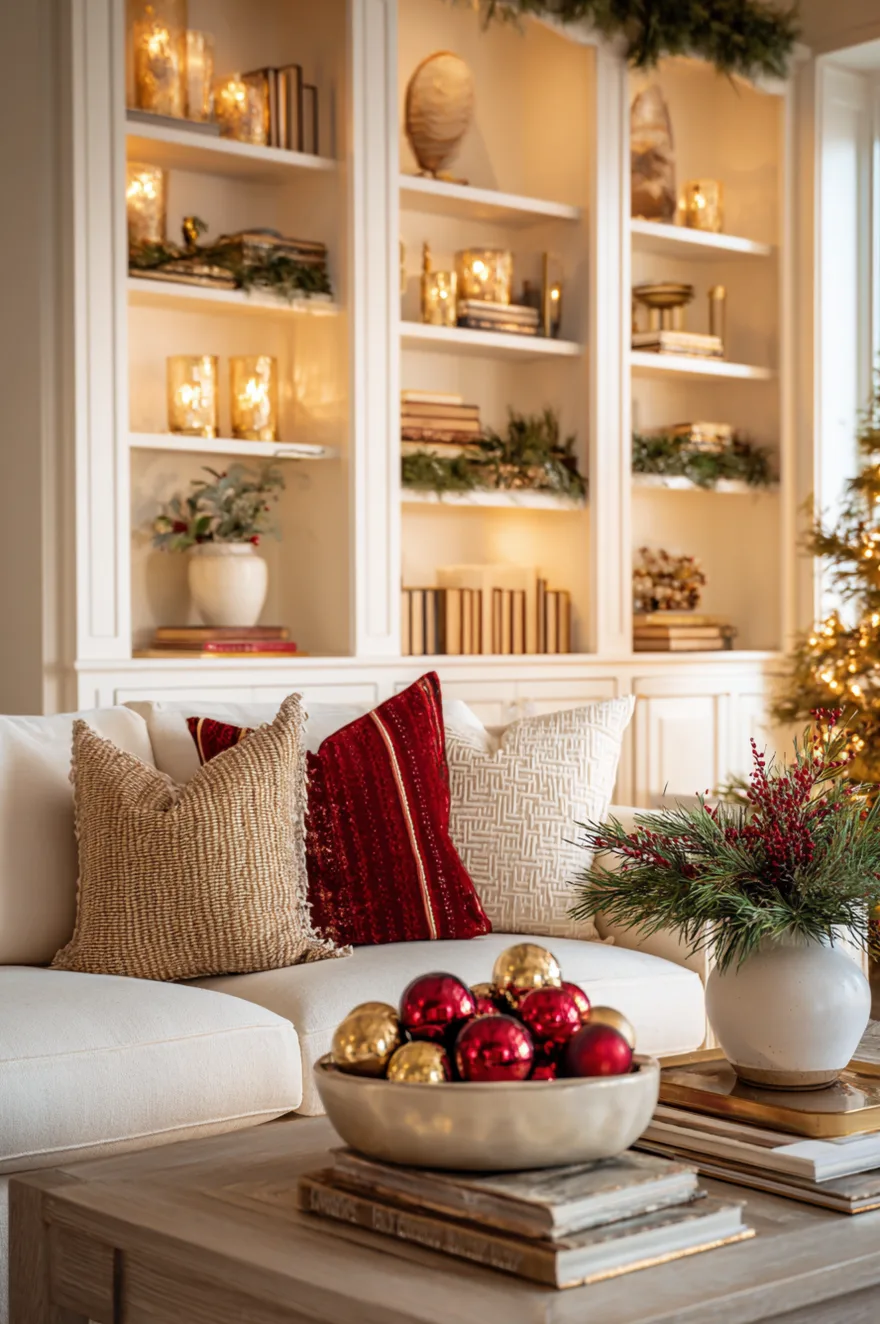
Holiday shelf styling is one of those things I used to genuinely dread – the whole room would feel taken over, the regular stuff would get boxed away, and by the end of January I’d spend a weekend restoring everything. Now I approach it differently: the bones stay, the seasonal things layer on top.
The built-ins from section one? Cedar garland woven loosely through the shelf edges (not draped heavily, just threaded so you see the green between objects). Mercury glass votives replace summer ceramics – they are small, they catch the light, and they pack away tiny. A wide bowl on the coffee table or bottom shelf holding a cluster of matte red ornaments and a few brass ones reads festive without toppling into kitsch. The lamp behind the shelves at 2700K does the rest. You do not need to change everything; you need to change the right four things.
10. Why I Love Warm Wood Shelves In A Neutral Living Room
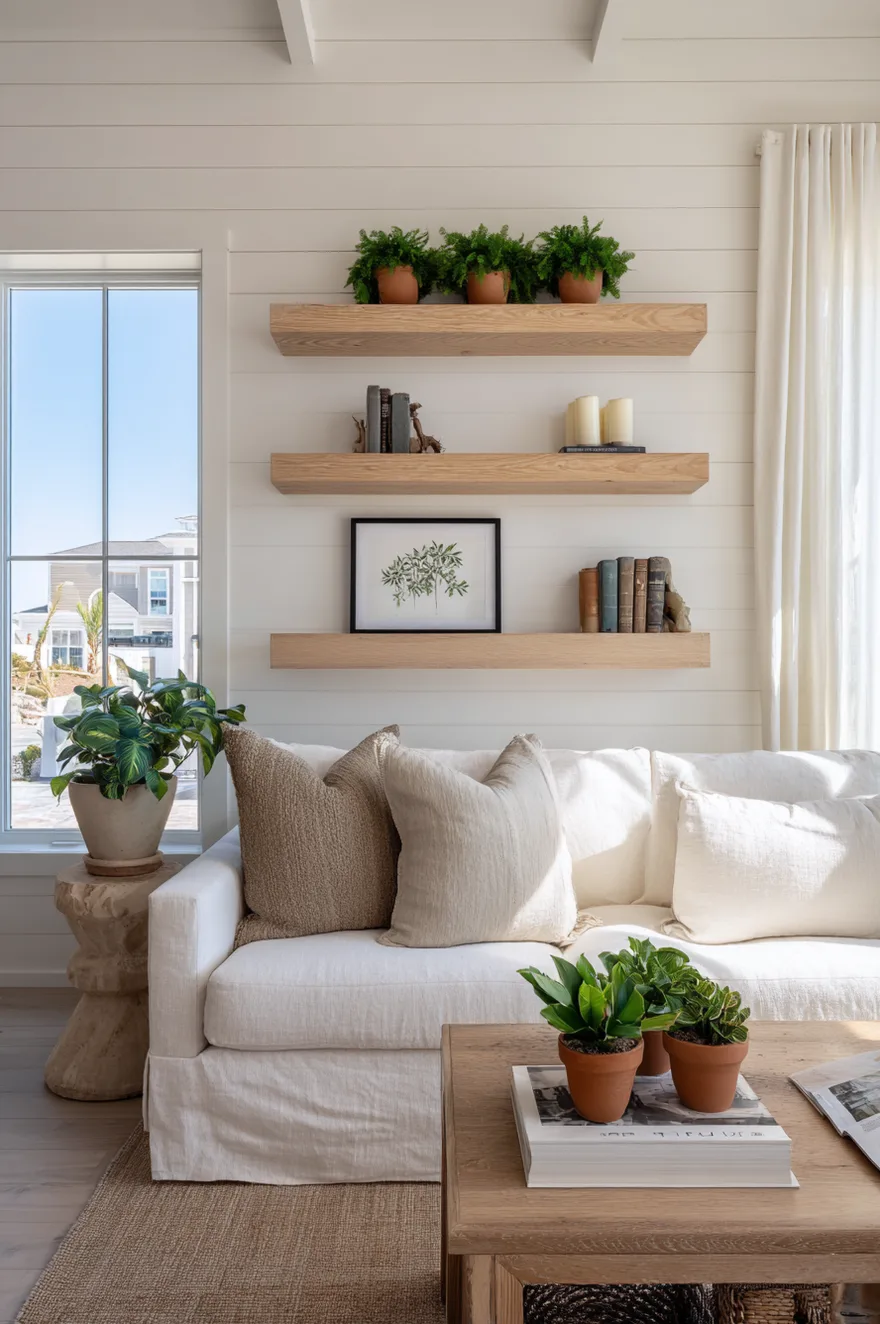
Honey-toned pine open shelves against soft white shiplap just work. The wood does all the heavy lifting thermally – it brings warmth to a palette that could otherwise read cold – so the styling can stay genuinely simple. Three plants. Two candles. One framed print. Done.
And this is the living room shelf idea I come back to when I need to convince someone who is nervous about shelving. No dramatic color, no complicated bracket system. Just honest warm wood against a pale wall. Budget-wise, pine boards from the hardware store stained in a honey or amber tone run cheaper than almost any retail shelf option, and they look more considered than most of them too.
11. What I’d Do With That Awkward Alcove
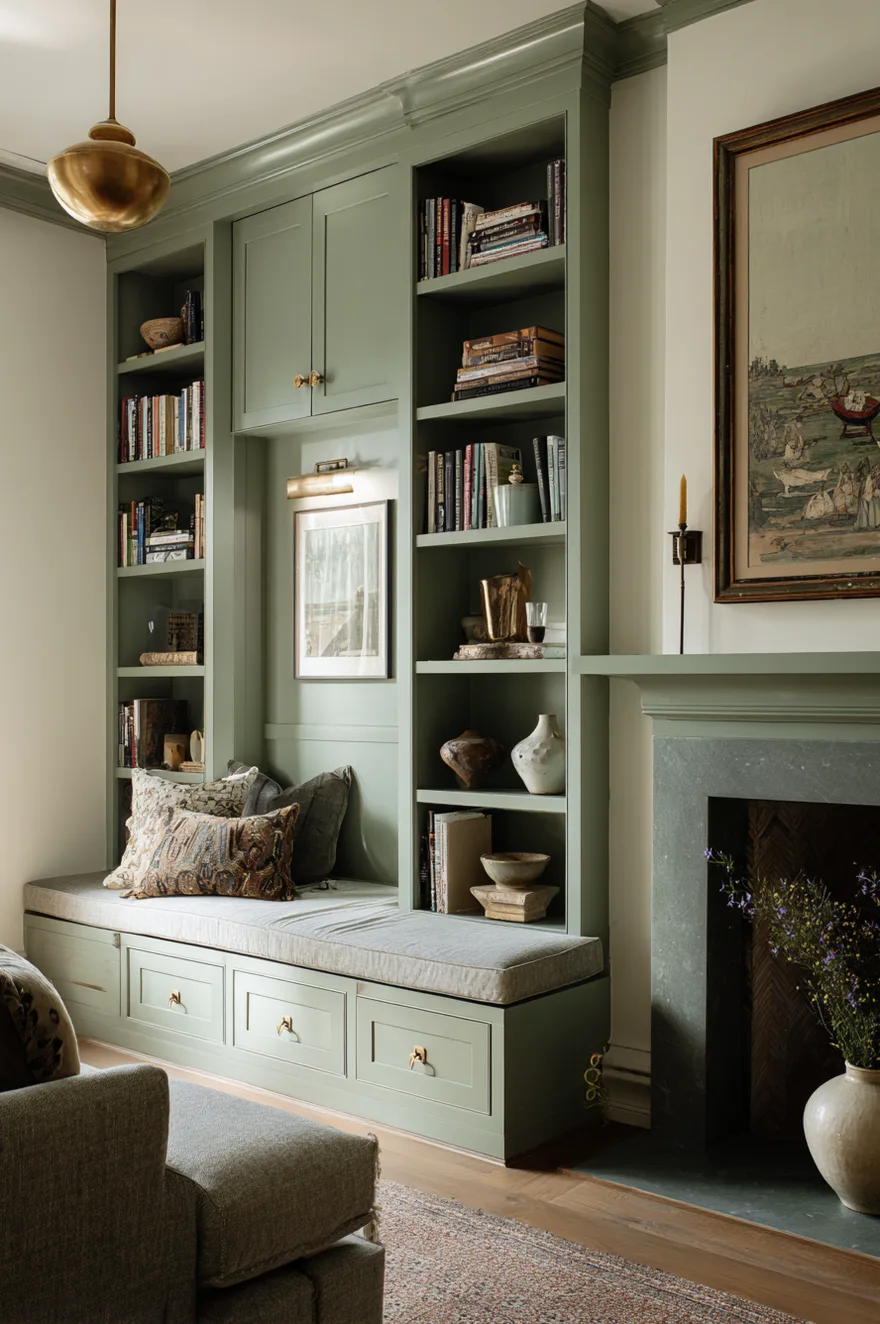
Every older house has one – that recessed nook beside a chimney breast that is too narrow to be useful and too prominent to ignore. I used to think built-ins were the only answer, which meant it was an expensive answer. But a full-height painted shelf unit in sage green, fitted into that alcove and used as a combination bar and book display, is genuinely one of the most livable things I have seen done with that space.
The soapstone-look countertop on the bottom shelf as a drinks ledge is the detail that makes it feel intentional rather than improvised. Add two small cabinet doors below with antique brass cup pulls, and you have concealed storage for bar tools, extra candles, whatever needs hiding. Books and objects on the open shelves above. Sage green paint means the unit reads as part of the room rather than furniture added to it – especially if you carry that green into one or two accessories elsewhere in the space.
12. DIY Floating Shelves On A Budget That Look Custom
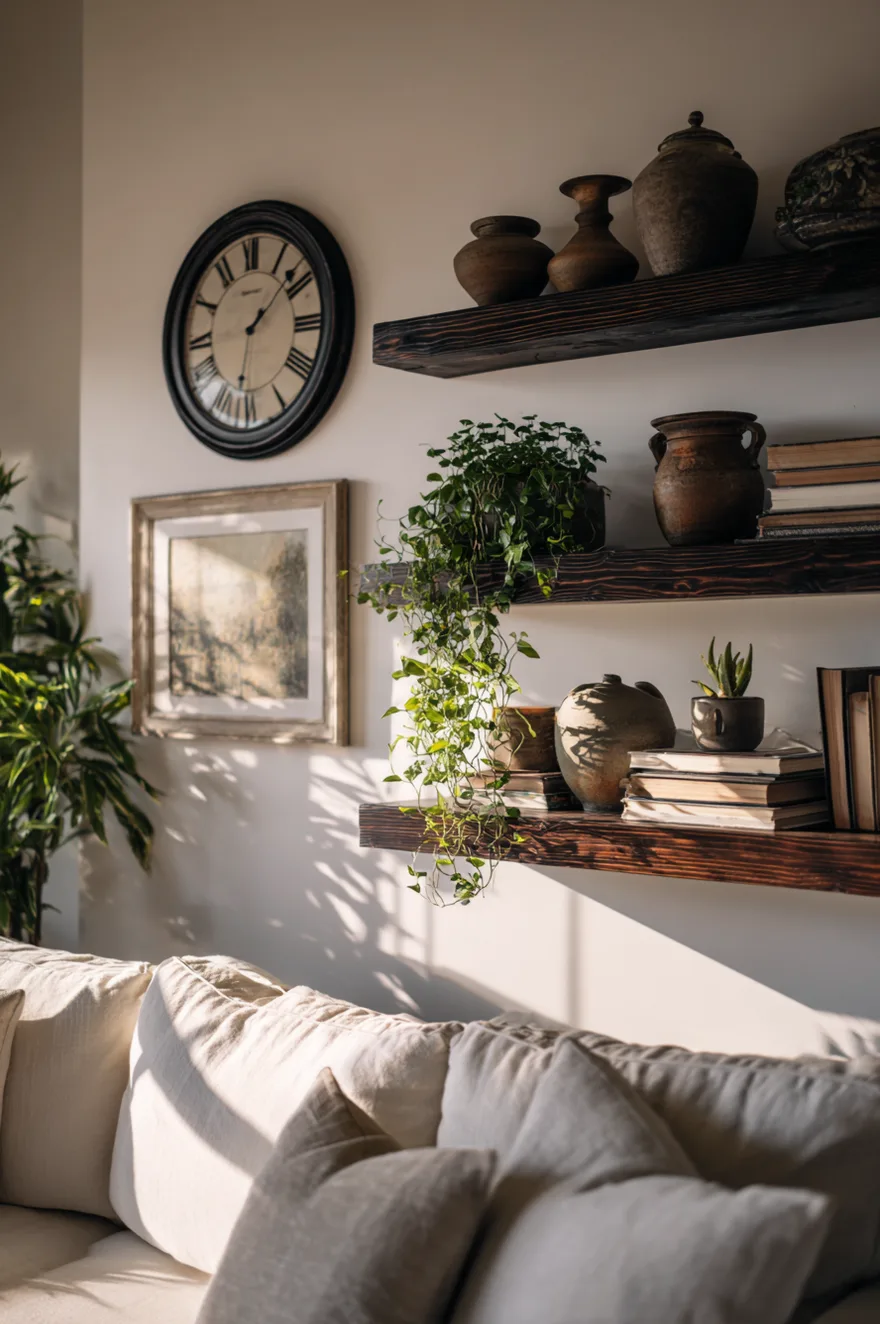
Solid pine from the hardware store, cut to your width (most stores will cut for you), stained in a dark espresso to match existing trim or furniture. Hidden floating shelf brackets – the kind that slide into a routed channel in the shelf back – mean no visible hardware at all. The shelf appears to grow from the wall. Total cost lands somewhere around $30 to $40 per shelf depending on length, which is genuinely hard to beat for something that reads as custom millwork from across the room.
Style with thrifted pottery (Facebook Marketplace and estate sales are full of interesting ceramics for under $10), a small stack of books, and one object with some height – a vintage clock, a small sculptural piece, anything that breaks the horizontal line. Shoot from a slight angle to capture the depth of the wood. A 2-inch-thick pine board stained dark reads completely differently from the flat-fronted MDF shelf it is probably replacing, and that depth is what photographs well.
13. Minimalist Floating Shelf Arrangement For Small Living Rooms
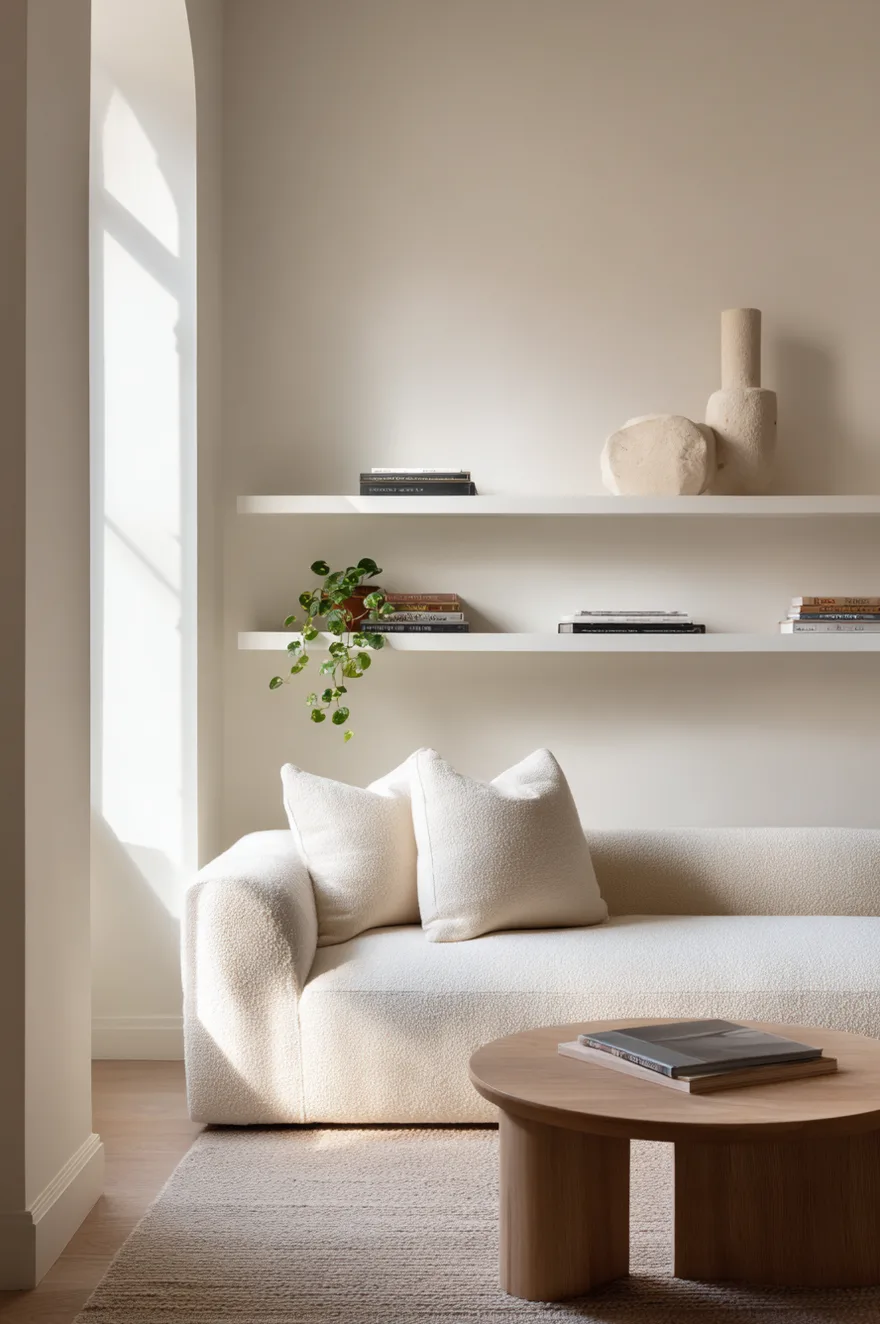
One shelf. Extra-long, extra-thin, painted the same white as the wall so it almost disappears. A sculptural ceramic on one end, three books stacked flat in the middle, a trailing plant at the other end with one stem hanging down. Everything else: wall.
The negative space is not an editing problem – it is the actual design choice. In a small living room, one shelf done this way reads more confidently than three shelves crowded together. And it is easy to maintain, which matters when you have a three-year-old redistributing objects throughout the house on a daily basis.
14. Fireplace Mantel Shelf Styling Ideas For Every Season
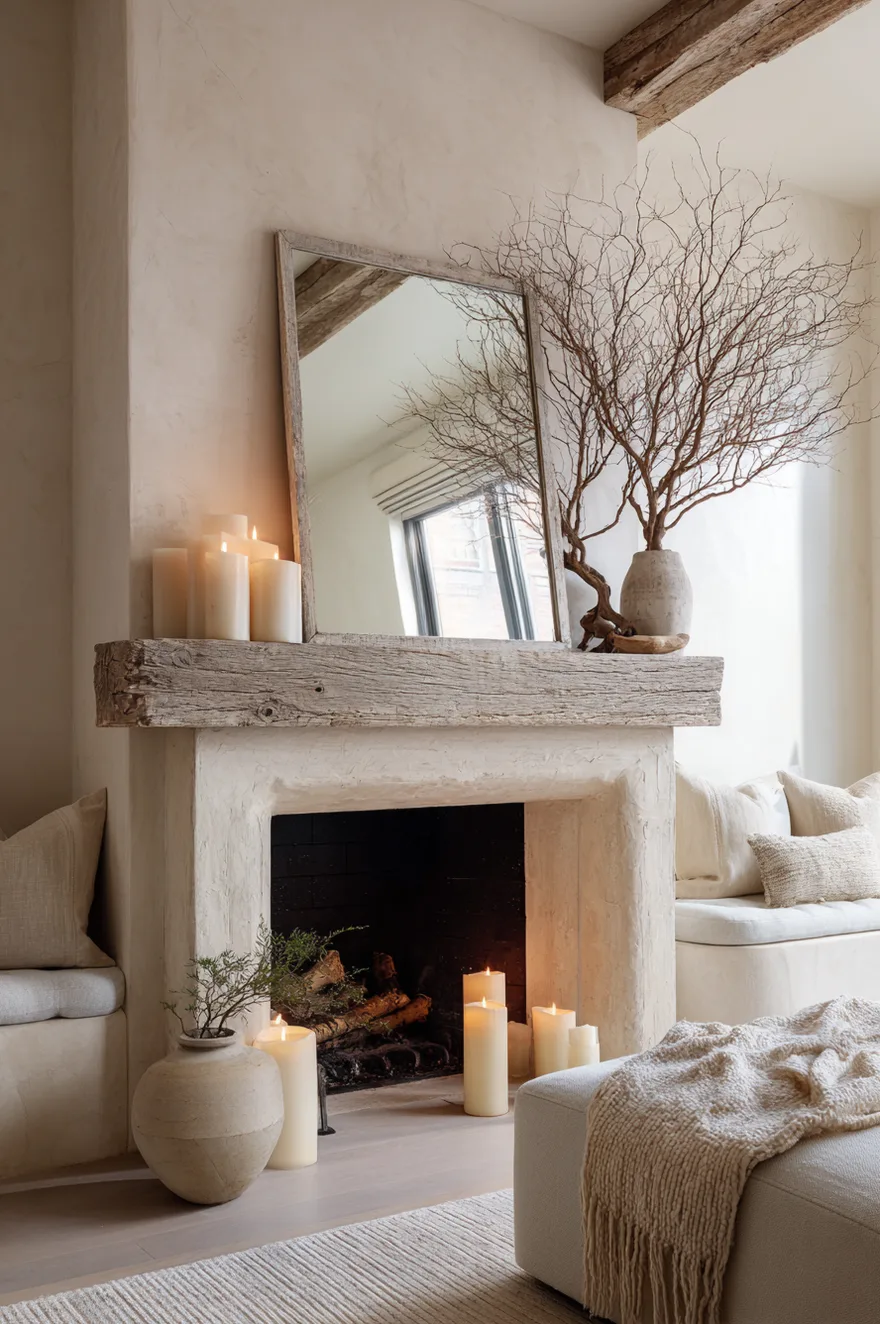
A chunky raw-wood mantel on a limewashed plaster surround is one of the best canvases you can have in a living room, and also one of the easiest to overcomplicate. I used to do the matching-pairs thing – two candlesticks, two small vases, a little clock centered between them. It looked like a hotel lobby.
The approach that has held up best: one oversized leaning mirror (large enough that it reads as art, not just reflective surface), a cluster of pillar candles in three different heights grouped off-center, and one single large dried branch or sculptural stem – something with presence that you found rather than bought. No matching sets. Nothing symmetrical. The asymmetry is what makes it look like a person made a choice rather than a stylist following a formula.
Edit down to these three elements and then genuinely stop. Seasonally, you swap the dried branch for something that fits – cedar in winter, a large leafy stem in summer, dried wheat in fall. The mirror and candles stay year-round. This is the mantel styling framework I keep returning to because it works across every season without requiring a complete reset.
15. The Color No One Expects Behind Open Shelves
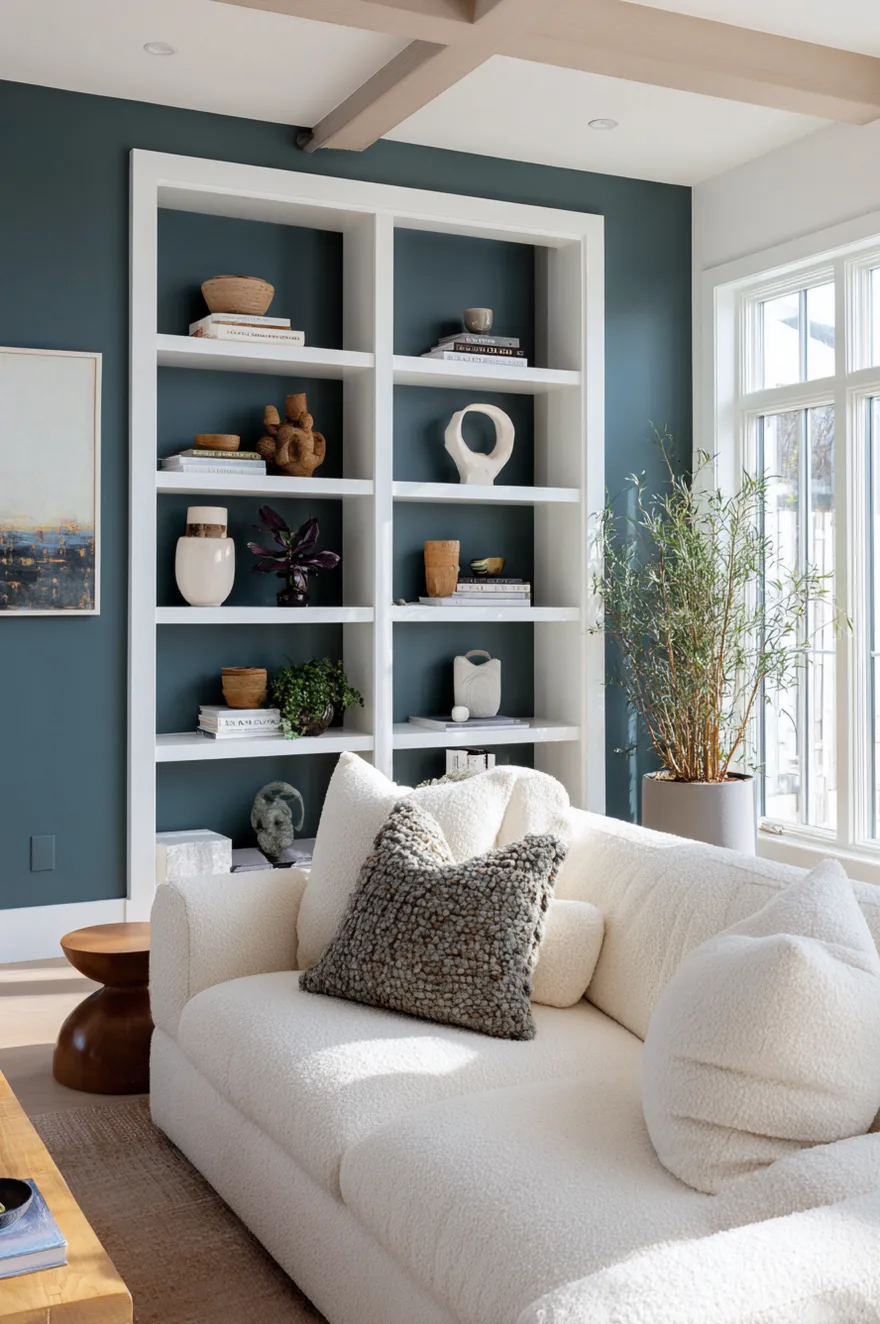
Paint just the wall behind the shelves. Not the whole room – just that one section of wall that sits behind your floating shelves. A deep dusty blue-green (I keep thinking about something in the Farrow and Ball Mizzle or Oval Room Blue family) while the rest of the room stays warm white. The shelf contents pop immediately because they are reading against a dark ground instead of disappearing into a light one.
But here is why I love this for living room shelf ideas specifically: it makes your open shelves read like a styled cabinet without the cost or permanence of actual cabinetry. The color frames the arrangement. And if you rent, it is one wall – one wall that likely goes back to white when you leave, and it costs about $40 in paint to try.
16. Open Shelves Styled With Books And Art That Feel Collected
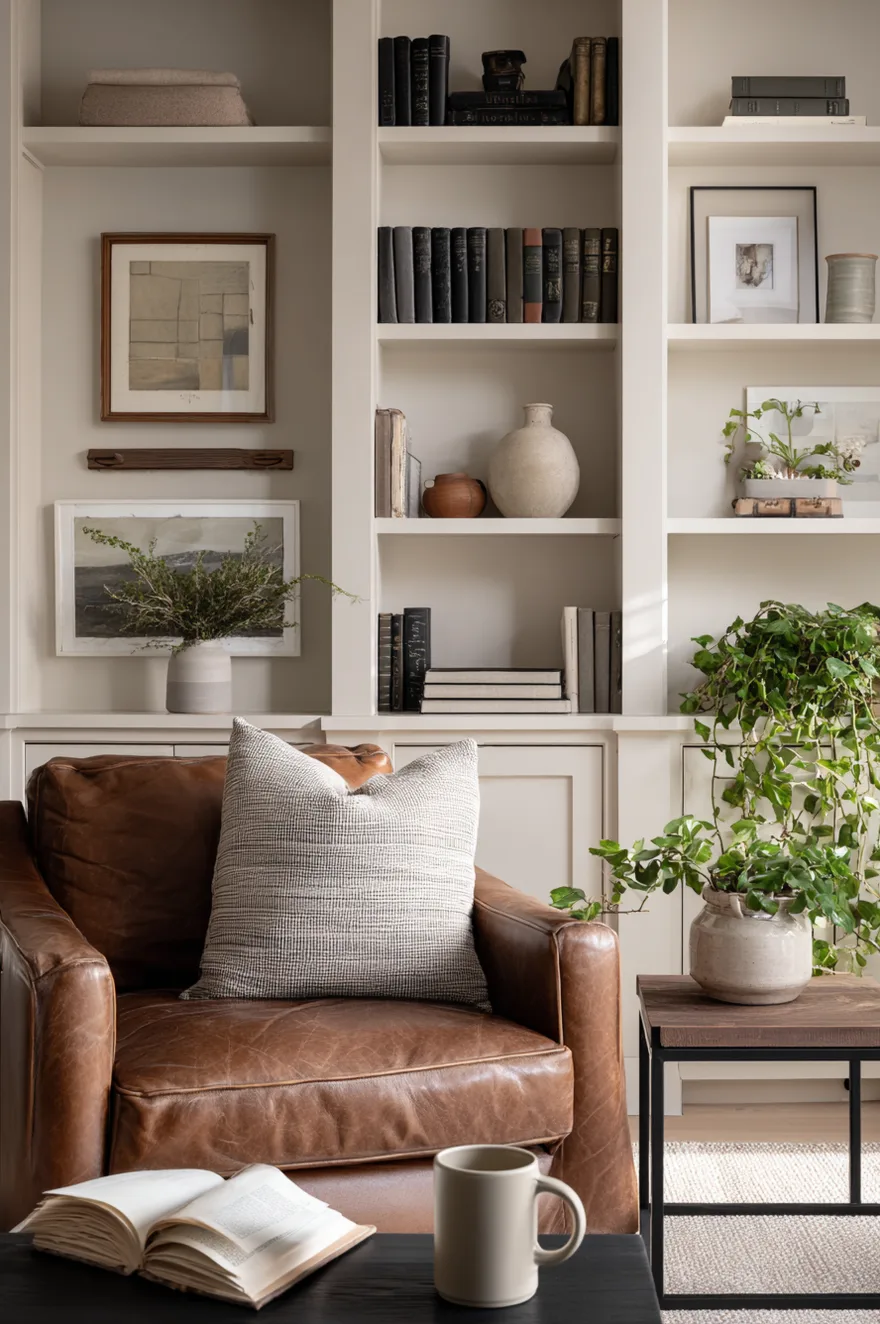
The “collected over time” look is actually very achievable and costs almost nothing if you are willing to shop your own house first. Pull every book you own. Sort by spine color into rough groups: cream and ivory, black and dark navy, muted linen tones. Arrange them in horizontal stacks rather than vertical rows – or alternate, one vertical run of five books followed by a horizontal stack of three. Then go through your existing framed prints and lean two or three of them casually against the back of a shelf rather than hanging them.
I did this one rainy Saturday when Nora was napping and I genuinely did not spend a dollar. What I added later – two small pieces of original art from a local flea market, under $20 each – just built on what was already working. The key to not buying anything new is looking at what you have as raw material rather than finished objects. A plain white frame from a thrift store with new matting looks completely different from how it arrived. A book turned backward stops looking like a book and starts looking like texture.
17. Living Room Shelves 2026 – The Style Worth Stealing
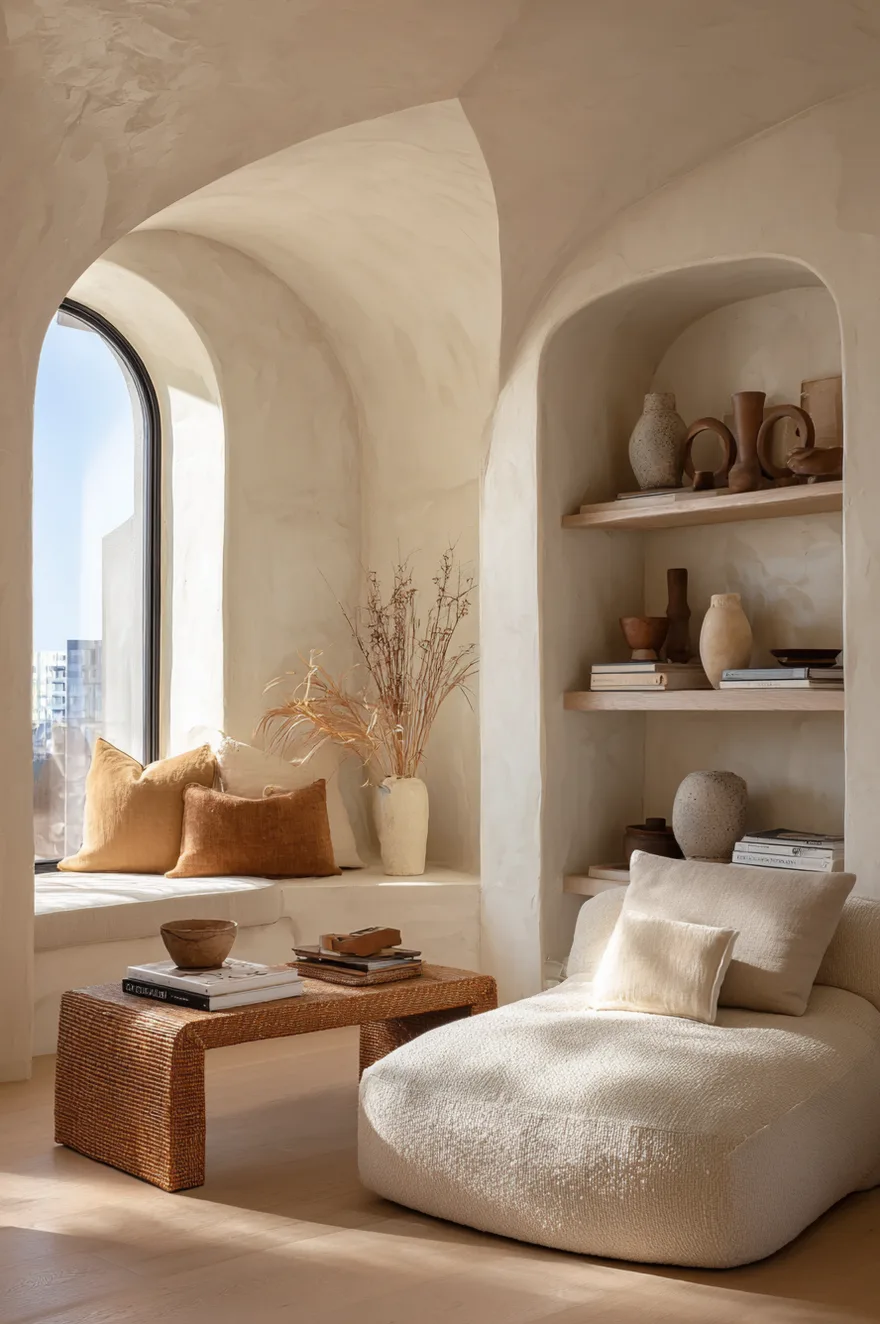
Flat-front painted MDF floating shelves had a long run. They are clean, they are affordable, and they go with everything, which is also why they are starting to look like background furniture rather than a design choice. What is replacing them – slowly, in the places I keep seeing on Pinterest and in newer design projects – is the curved-front floating shelf in a warm limewash or plaster finish.
The curve is subtle, usually just a slightly rounded front edge rather than a fully scalloped shape, and the limewash or plaster finish reads handmade in a way that flat paint never will. Where to find them: small makers on Etsy are producing these, and a few boutique home stores are starting to carry them in the $80 to $150 per shelf range – which is real money, but not unreachable if you are doing two or three rather than an entire wall. Style them with handmade ceramics that have irregular forms, a wabi-sabi stone or piece of driftwood, one dried botanical stem. The objects should look like they were found, not ordered. Against that textured plaster shelf surface, even simple things read as intentional. This is the living room shelf direction worth watching in 2026.
You do not need to try all seventeen of these. Pick two – maybe the ledge shelf swap because it costs almost nothing, or the painted back wall because it is one afternoon and $40 in paint – and see how it feels. Sometimes one change is enough to make a whole room click into place. I’d love to know which of these living room shelf ideas you are actually considering. Drop a comment below and tell me which one you’re doing first.
With love,
Liv