Warm minimalist living room ideas sound great in theory – until you actually try to pull one off and the room ends up feeling like a hotel lobby. This article walks through 19 real approaches to minimalist living room design, from earthy limewash walls to thrift store scores, showing how to strip back the clutter without losing any of the warmth that makes a room feel like somewhere you actually want to sit.
A few years ago I walked into a friend’s rental in North Park and completely stopped in the doorway. The room had almost nothing in it. A low linen sofa, a single ceramic lamp on a little wood table, and this deep terracotta-plastered wall behind everything. That was it. No gallery wall, no throw pillows multiplying like rabbits, no woven tray holding seventeen small objects. Just the wall and the sofa and that lamp glowing at around 2700K and the afternoon San Diego light coming in sideways.
I stood there for a weirdly long time.
I had always associated minimalism with cold – all that white Swedish furniture and empty shelves giving off “nobody eats food here” energy. But this room was the opposite. It was warm. Actually warm. The terracotta did a lot of the heavy lifting, and the lamp did the rest. I drove home and immediately started rearranging my own living room, which at the time had, by conservative estimate, sixty-four too many things on every surface. These 19 ideas are basically what I’ve been working through ever since.
1. The Warm Minimalist Living Room That Started It All
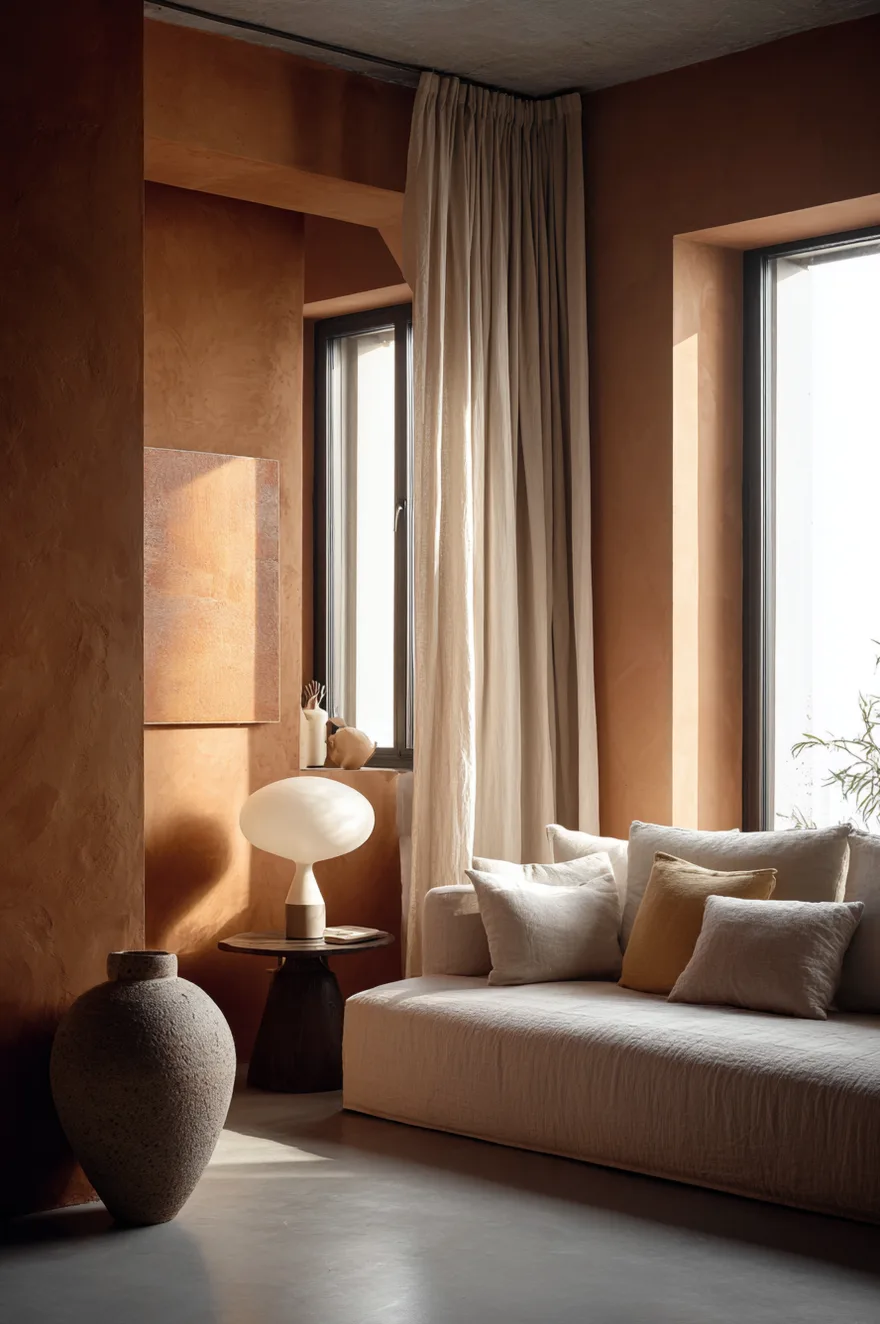
That terracotta wall is still the reference point I come back to every time I’m working on a warm minimalist living room. The finish wasn’t wallpaper and it wasn’t standard latex paint – it was real plaster applied in layers, which gives it this slightly uneven, almost handmade quality that flat paint just cannot replicate. You catch the texture differently depending on where the light hits. Morning light makes it look almost pink. Evening light turns it a deeper rust.
The sofa was low-slung – I’d guess the seat height was around 15 inches, maybe 16. That low profile is what made the wall feel like the whole room. Nothing was competing with it. And the ceramic lamp was sculptural enough to count as an object but quiet enough not to fight for attention. Honestly, the restraint of that room taught me more about minimalist living room design than any Pinterest board I’d spent time scrolling. One strong material choice plus one good light source. That’s a complete room.
If you want to try the terracotta plaster look without hiring a plasterer, American Clay makes a DIY-friendly version that goes on with a trowel. It takes a weekend and some practice on a sample board first, but the result is genuinely worth it.
2. Earthy Minimalist Living Room Ideas With Limewash Walls
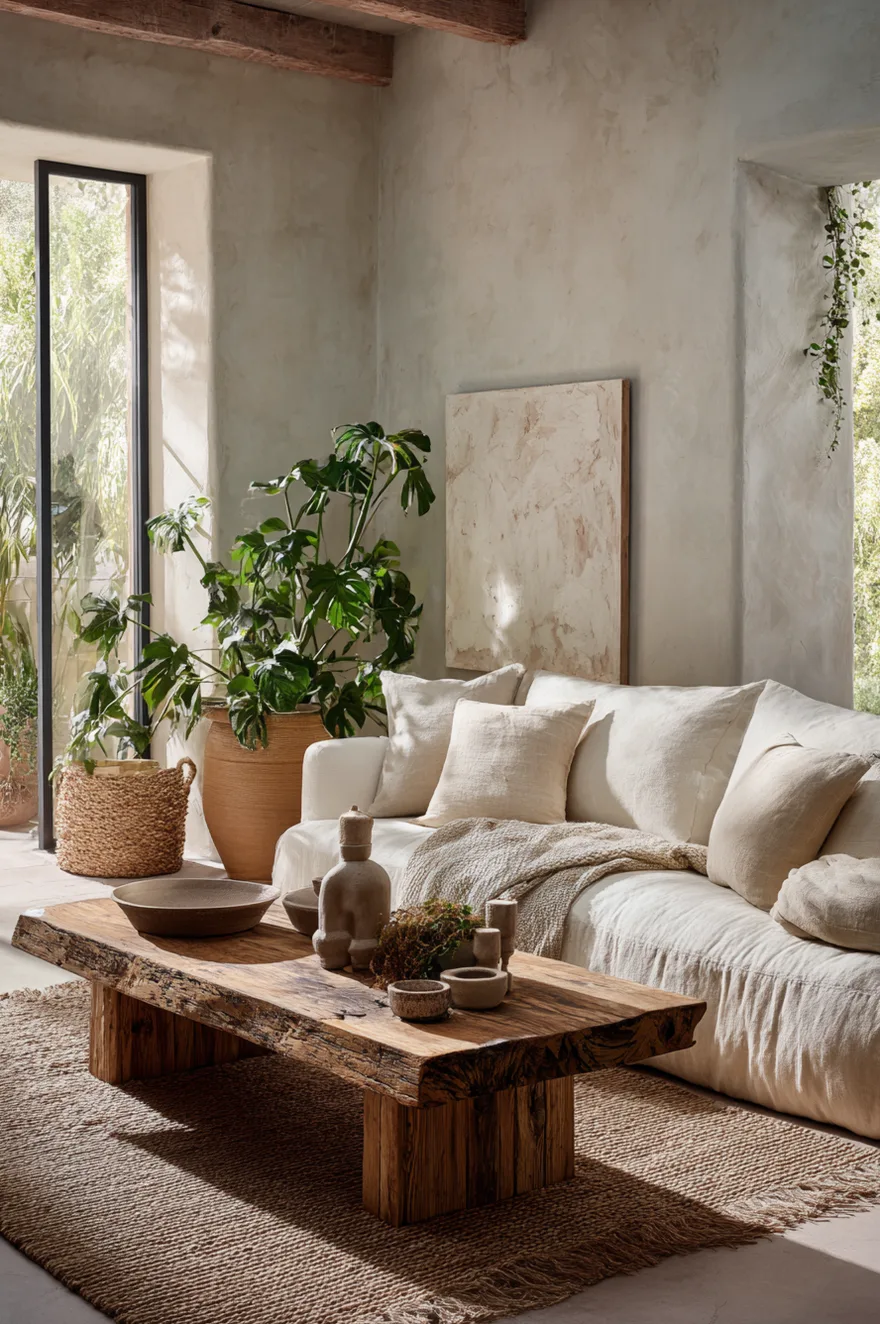
Limewash paint is having its moment and honestly it deserves it. Unlike the terracotta plaster I just described, limewash is something most people can apply themselves in an afternoon – it goes on with a brush in overlapping, slightly uneven strokes and the variation is the whole point. Portola Paints makes a limewash line that’s widely available and comes in good earthy tones. For an earthy minimalist living room, a dusty sage-green reads warmer than it sounds on a paint chip – it has enough yellow in it to keep the room from going cold.
Pair that wall with a natural jute rug – something chunky, not the flat-woven kind – and a walnut slab coffee table, and you’ve got three different textures all in the same warm brown-to-green range. That tonal layering is what makes earthy minimalist living room ideas feel rich instead of sparse. One oversized abstract canvas leaning against the wall (not hung – leaning) keeps it feeling casual. The leaning is important. Hung art reads finished; leaning art reads “I’m still deciding,” which is somehow more alive.
Keep accessories to almost nothing. A single ceramic object on the coffee table and one trailing plant in a handmade pot. The limewash texture is already doing a lot of visual work – let it.
3. The Sofa Swap You’ll Wish You Did Sooner
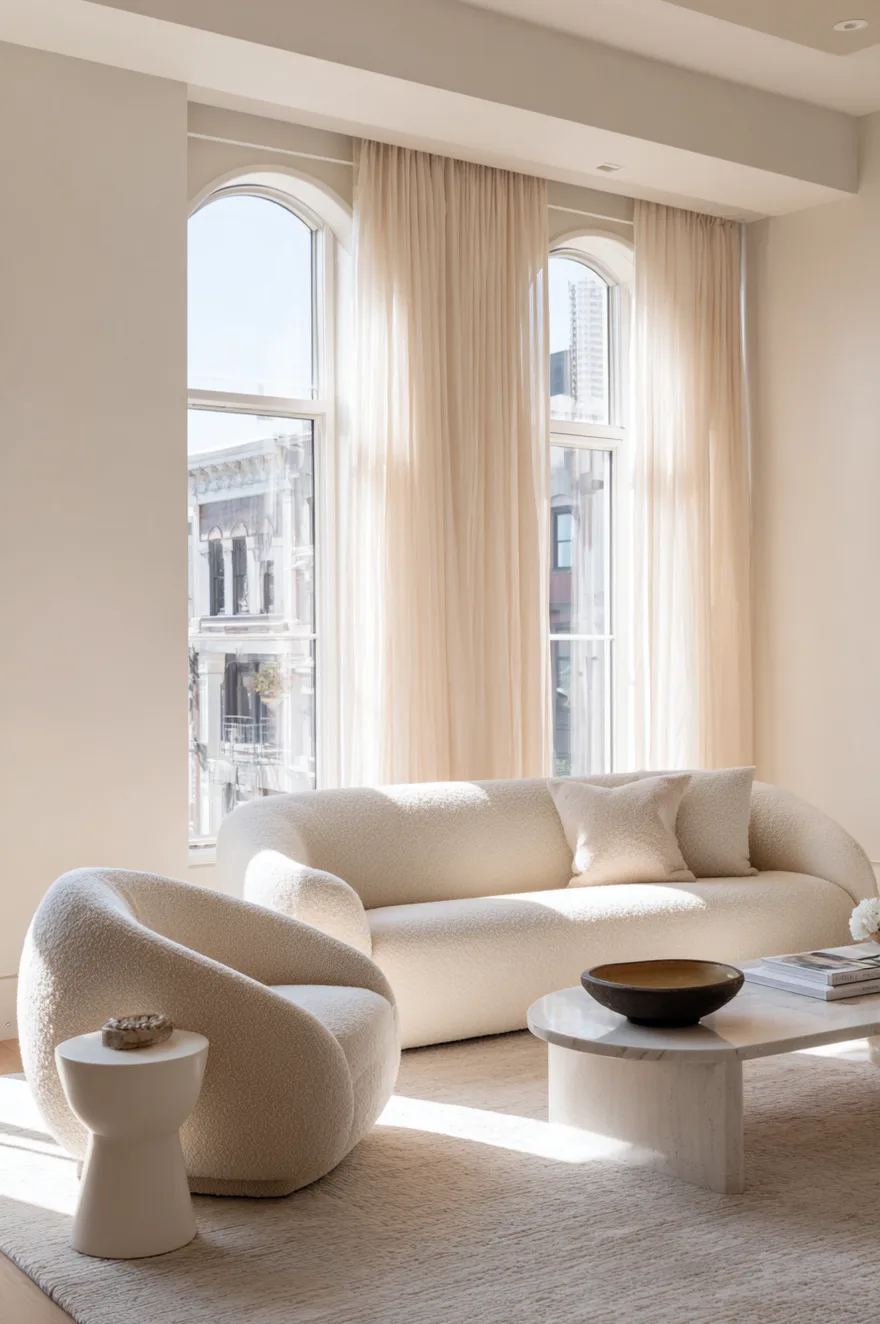
I spent three years with a massive sectional that ate the entire living room. Every time I tried to add a chair or a lamp or literally any other piece of furniture, there was nowhere to put it. The sectional had claimed every square foot and it was non-negotiable about it. When I finally swapped it for a smaller two-seat bouclé sofa in oat, the room felt twice as big – and we hadn’t changed a single other thing.
Adding one good accent chair across from the sofa actually created more seating than the sectional had, because now people could sit facing each other instead of all pointing at the TV like passengers on a flight. Bouclé in oat is forgiving in a way that white isn’t – it reads warm, it hides Nora’s snack crumbs reasonably well, and Benny’s fur basically disappears into the nubby texture. The visual breathing room you get from losing the sectional square footage is immediate. Start smaller than you think you need to.
4. Scandinavian Minimalist Living Room Ideas On A Real Budget
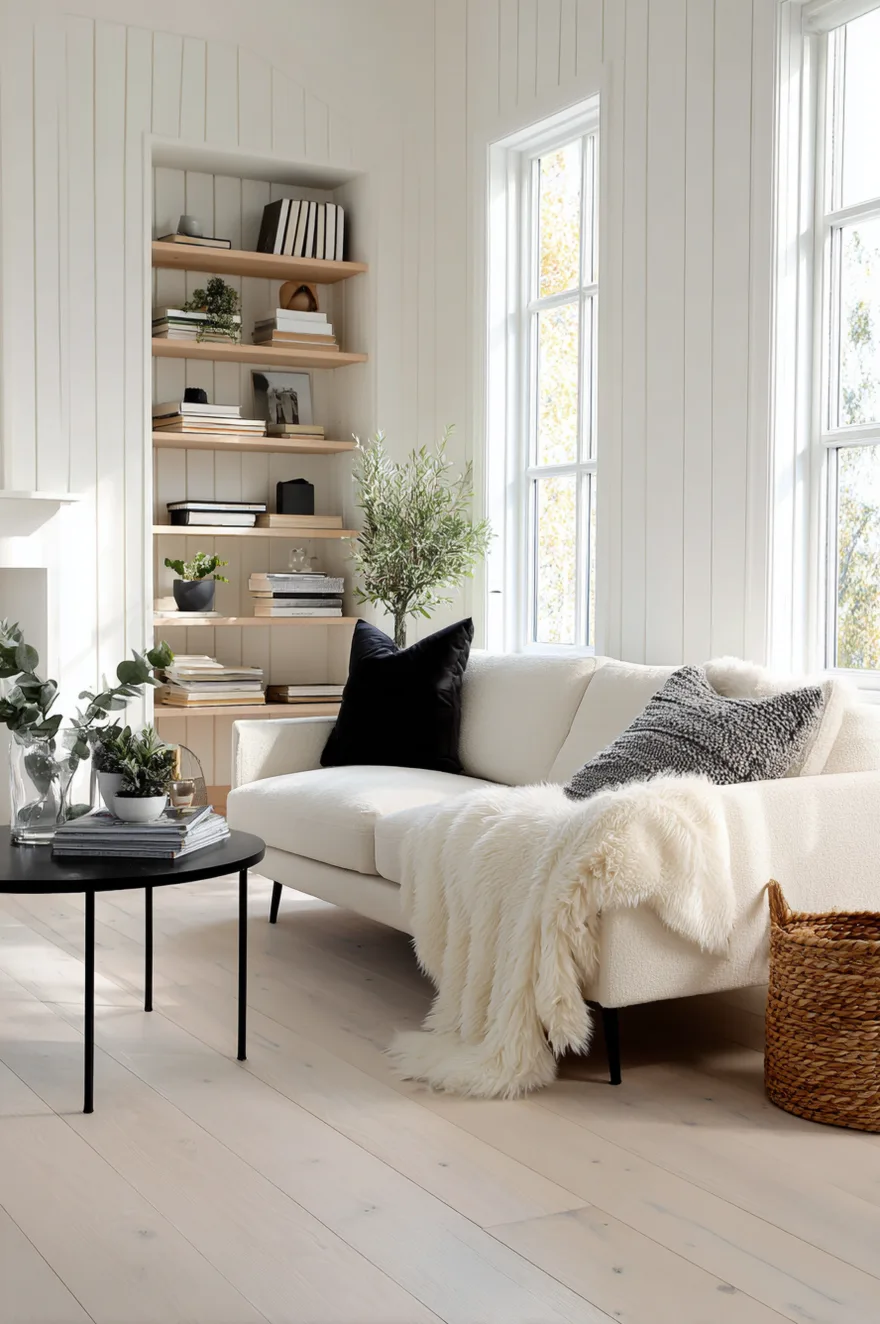
The Scandi formula is almost embarrassingly simple once you see it laid out: white walls, light wood tones, black metal legs on everything, and one texture that’s unambiguously soft. IKEA does this formula as well as anyone at a third of the price. The KALLAX shelves in the birch-effect finish, the ALEX or EKET units – they’re not trying to look like something they’re not, and that honesty reads better in a minimalist space than cheap wood trying to fake walnut.
Black powder-coated steel legs are the move for lifting any sofa or coffee table off the floor visually. IKEA lets you add their LEGS to several sofa frames at checkout – it’s like $30 and it completely changes the silhouette. A sheepskin throw over one arm of the sofa is the “one soft texture” that does most of the warmth work. White-painted shiplap is optional but adds that architectural interest that plain drywall can’t deliver. If you’re in a rental, peel-and-stick shiplap boards from Amazon are surprisingly convincing.
Budget check: a full Scandi-style living room through IKEA and Target’s Threshold line will run you significantly less than a single sofa from a boutique furniture shop. Spend the difference on one quality rug.
5. What I’d Do With An Awkward Fireplace Wall
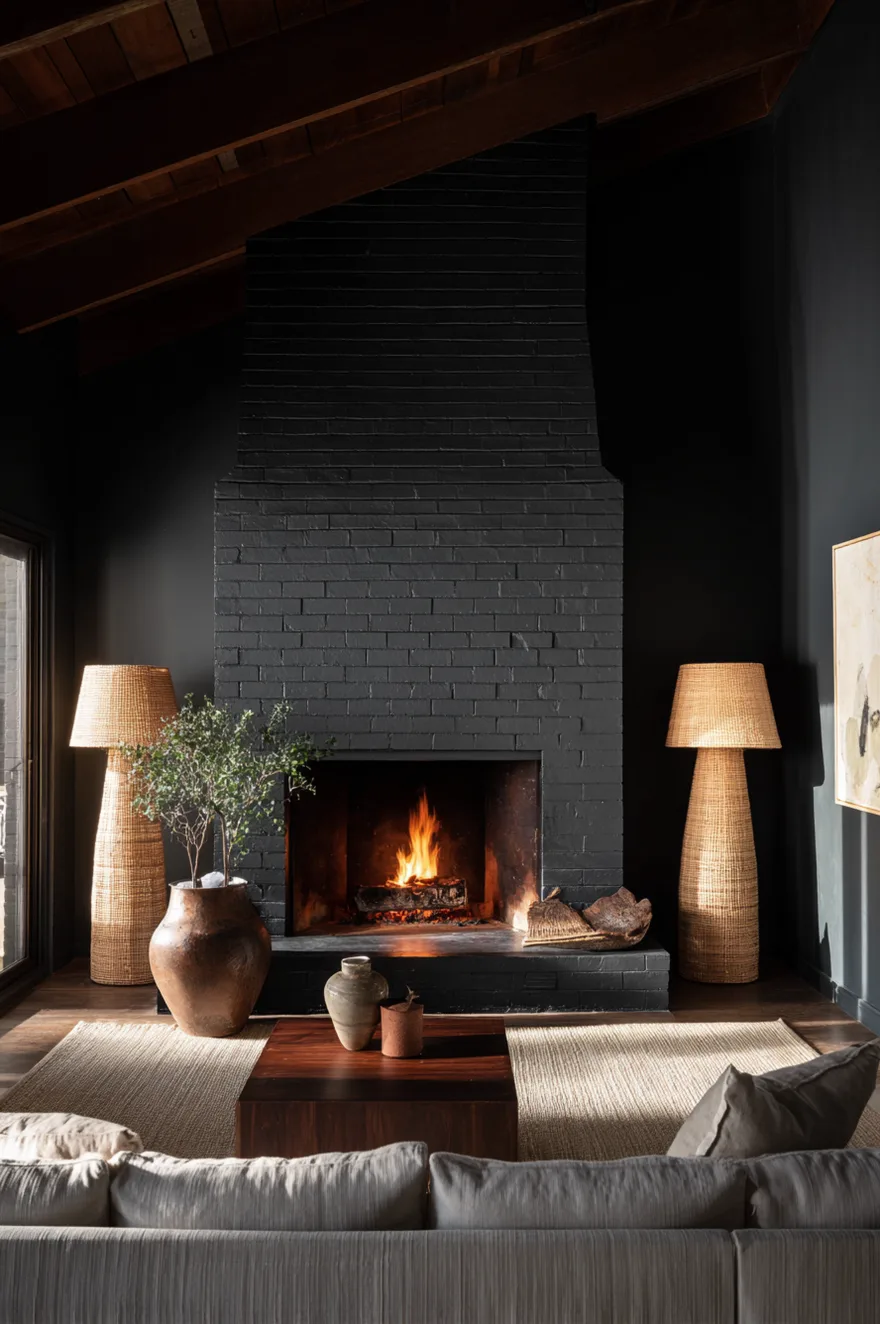
Painting brick is still divisive in some design circles and I genuinely do not care. A warm charcoal (not cool grey – there’s a difference, and it matters) over an outdated brick surround reads intentional and moody in a way that exposed orange-red brick rarely does in a modern room.
Flanking it with two identical tall rattan floor lamps – symmetrical placement, same height – gives the wall a quiet formality without any fuss. At golden hour with those lamps on, the whole wall becomes a focal point you actually want to look at. I’m still not totally sure about whether to add anything to the mantle or leave it completely bare, but I lean bare. Let the charcoal and the lamplight be enough. Swap the lamps before you touch the mantle.
6. Organic Minimalist Living Room Design With Concrete And Linen
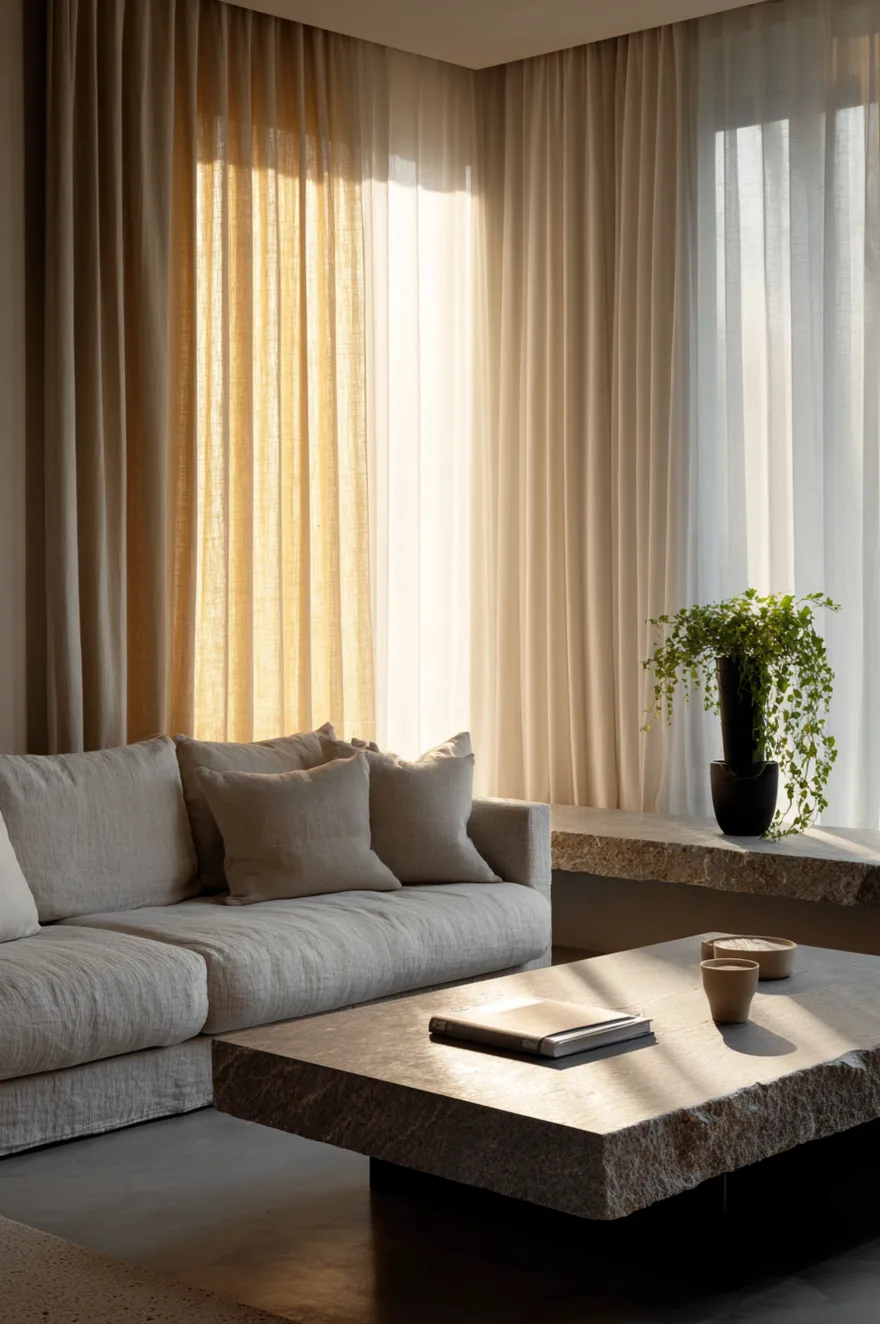
Polished concrete floors have a reputation for being cold – visually and literally. But a floor that’s been properly sealed and polished picks up ambient light in this soft, almost liquid way that warm wood floors don’t. Pair that with unbleached linen curtains hung floor to ceiling and the contrast between the cool grey underfoot and the warm cream overhead does something genuinely interesting. The linen filters afternoon light into something golden. The concrete reflects it back.
A raw-edge stone console is the anchor piece in this kind of room – it connects to the concrete floor without matching it, and the rough edge brings in that slightly undone, organic quality that keeps the space from feeling like a showroom. Keep the sofa in undyed linen. Nothing bleached bright white, nothing upholstered in anything synthetic. The material story in an organic minimalist living room design should feel consistent: stone, linen, concrete, wood. Natural things at rest together.
One trailing pothos in a matte black pot is the only plant you need. Pothos don’t mind the relatively low light that a very spare room – with minimal reflective surfaces – can produce. And the contrast of the black matte pot against all that pale material is genuinely satisfying. Swap the trailing variety for a marble queen pothos if you want slightly more visual interest in the leaf pattern.
7. The One Textile That Does All The Heavy Lifting
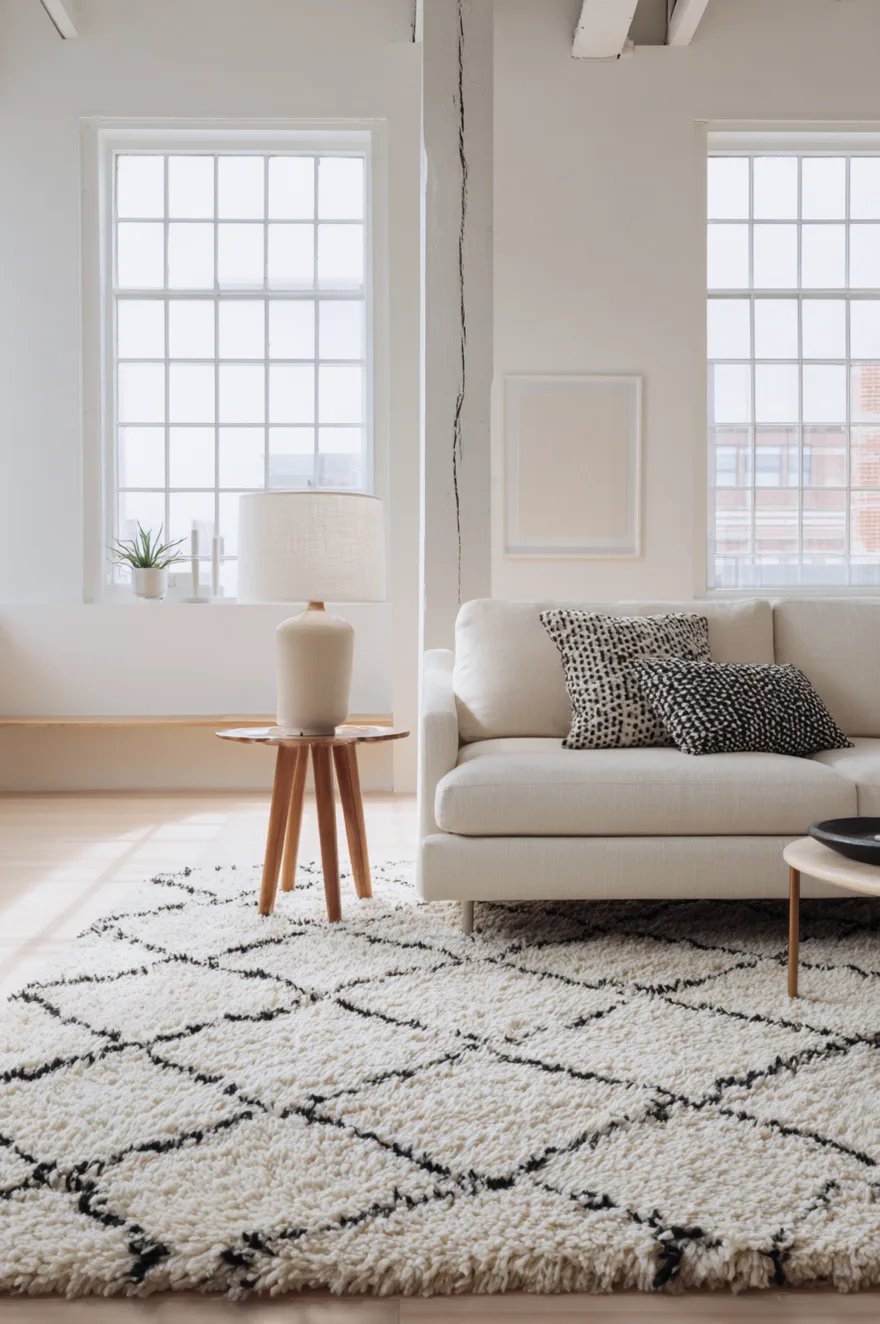
Here’s something I didn’t fully believe until I tried it: bare white walls plus zero art plus one large Moroccan wool rug in a bold cream-and-black pattern looks more intentional than most fully-decorated rooms. The rug becomes the art. It earns the look at every price point, and a good one from a vendor on Etsy or a local import shop will last fifteen years with minimal care.
The math is simple – a rug that’s large enough to go under the front legs of everything anchors the furniture arrangement, makes the room feel complete, and means you genuinely need nothing on the walls. Go at least 8×10 feet. Bigger is almost always right.
8. Modern Neutral Living Room Ideas With Soapstone Accents
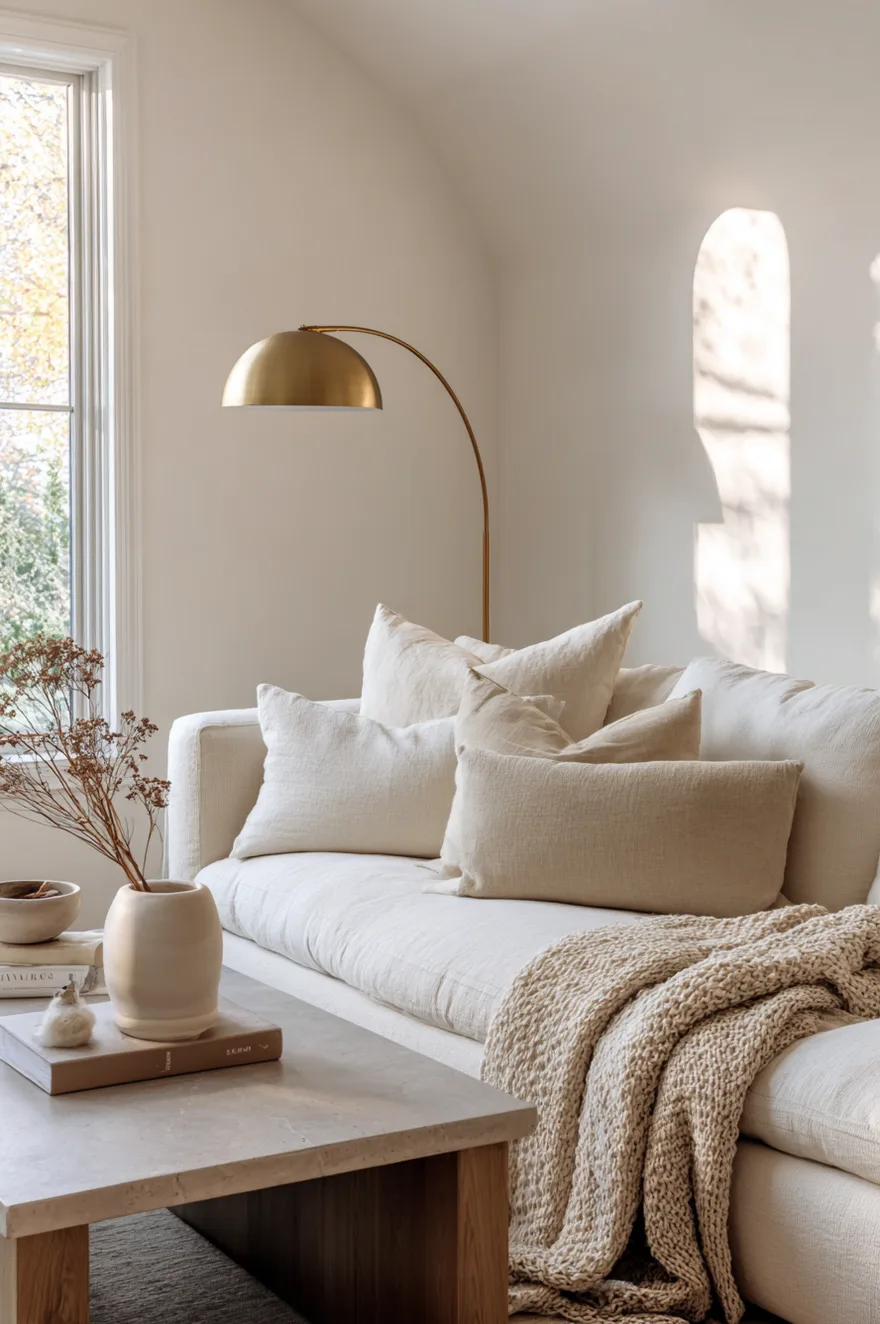
Soapstone doesn’t get nearly enough attention in living rooms. Everyone puts it in kitchens and bathrooms, but a soapstone side table or small console in a warm minimalist living room brings in this soft, slightly veined grey that reads organic in a way polished marble doesn’t. It’s matte. It feels dense. It ages well and doesn’t require sealing the way marble does.
Pair it with linen upholstery in warm ivory – not stark white, specifically ivory or cream with a yellow undertone – and a single arched brass floor lamp. The arch lamp is doing a lot here: it provides task light over the sofa without requiring a side table for the lamp base, which keeps the floor clear and the look spare. The brass and the soapstone together is a combination I keep coming back to. The warm metal against the cool stone creates just enough contrast to make the room feel considered.
If soapstone side tables are out of budget (and they often are – expect to pay $200 and up for a decent one), look for honed concrete or soapstone-look porcelain. The honed finish is what matters most for the look.
9. Why I Always Tell Clients To Go Darker
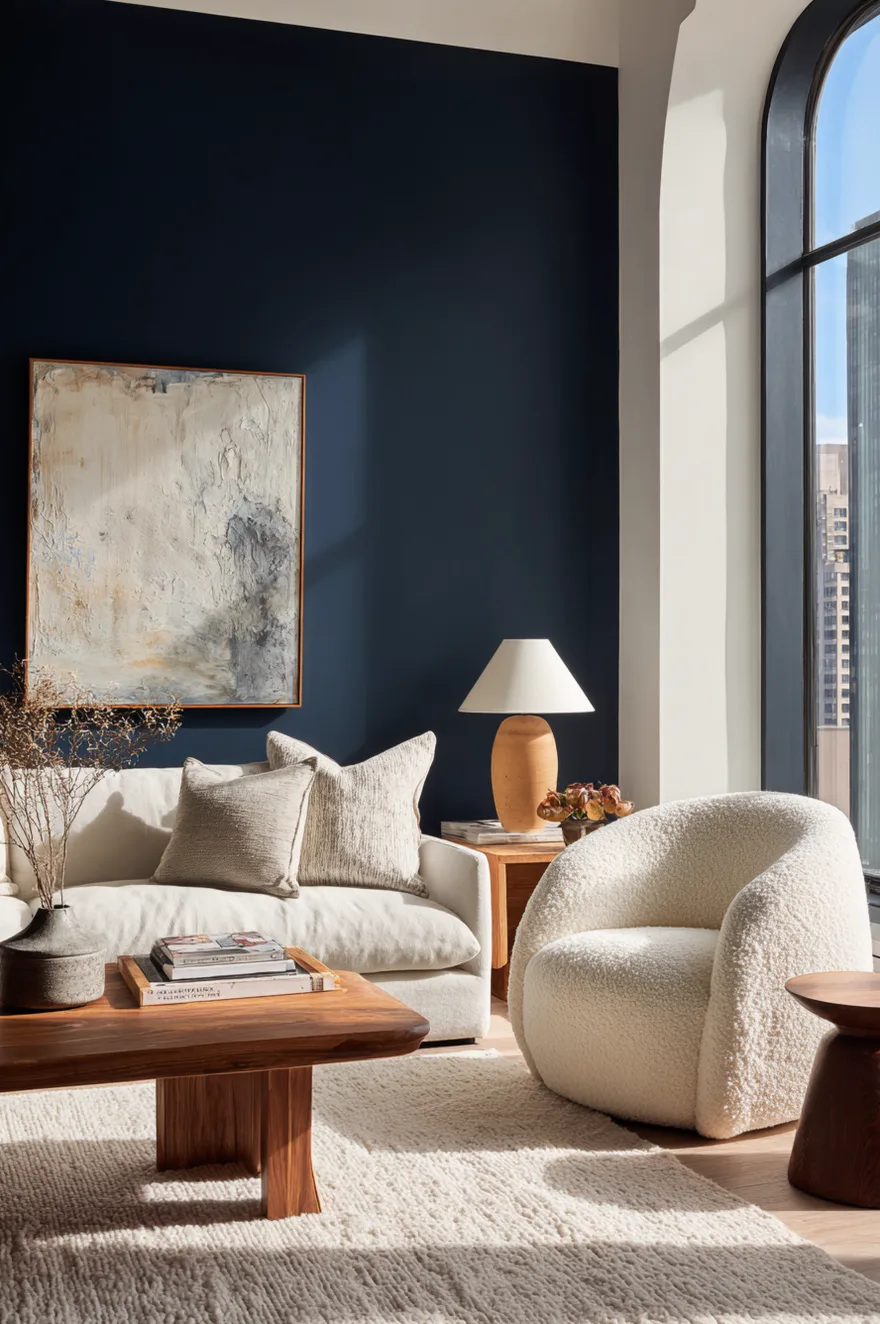
People are scared of a dark accent wall and I never really understand it. One deep navy or ink-blue wall in a minimalist living room makes every neutral piece of furniture read crisper, warmer, and more intentional. The cream sofa that was just sort of sitting there against a greige wall suddenly looks deliberate. The wood tones glow. It works in the same way that a dark background in a photograph makes the subject pop – basic contrast doing its job.
The key mistake is going cool-toned. Navy works. Dusty indigo works. But a bright, slightly purple-blue goes icy fast. Benjamin Moore’s Hale Navy is the safe bet. Farrow and Ball’s Hague Blue is slightly more complex and a bit richer. And importantly – you only need one wall. The rest stays neutral. One saturated wall is a design decision; four saturated walls is a different project entirely.
10. Cozy Minimalist Living Room Ideas That Aren’t Beige
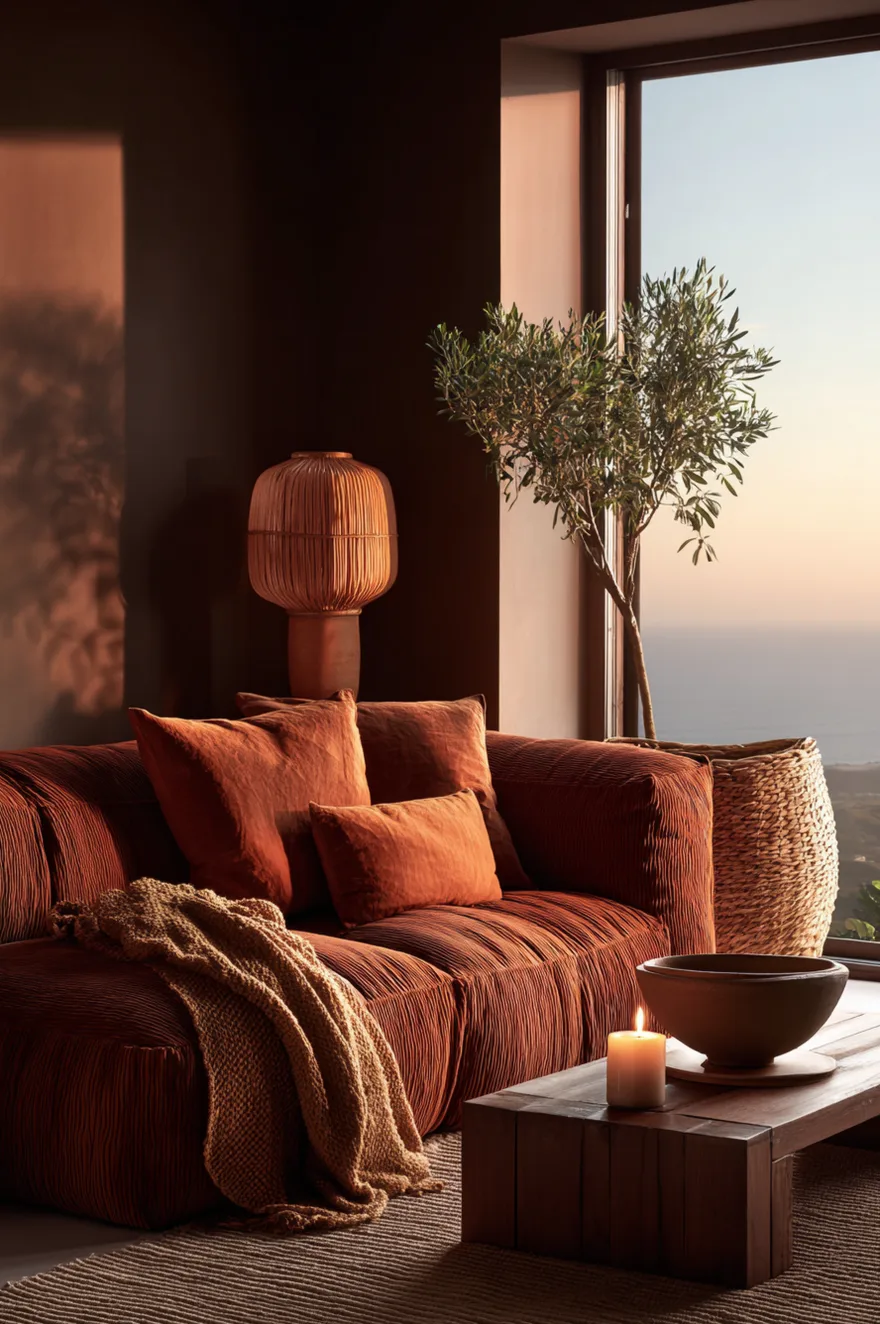
I swore for a long time that I’d never do a rust or terracotta sofa. Too risky, I thought. Too specific. I was wrong. A warm rust-toned bouclé sofa at golden hour with a terracotta ceramic lamp on beside it creates this amber-on-amber glow that no amount of beige linen can replicate. It feels like late afternoon all the time.
But here’s what makes cozy minimalist living room ideas actually minimalist: restraint in the accessories. One chunky knit throw over the arm. A small olive tree in a woven basket planter in the corner. That’s it. No pile of throw pillows, no tray of candles, no stack of coffee table books arranged at a careful angle. The rust bouclé is already making a strong enough statement that everything else should step back. The olive tree works because it’s architectural – a single vertical presence in a corner that would otherwise just be empty wall.
Let the sofa color do the work. Everything else gets quiet.
11. The Curtain Height Trick Nobody Talks About
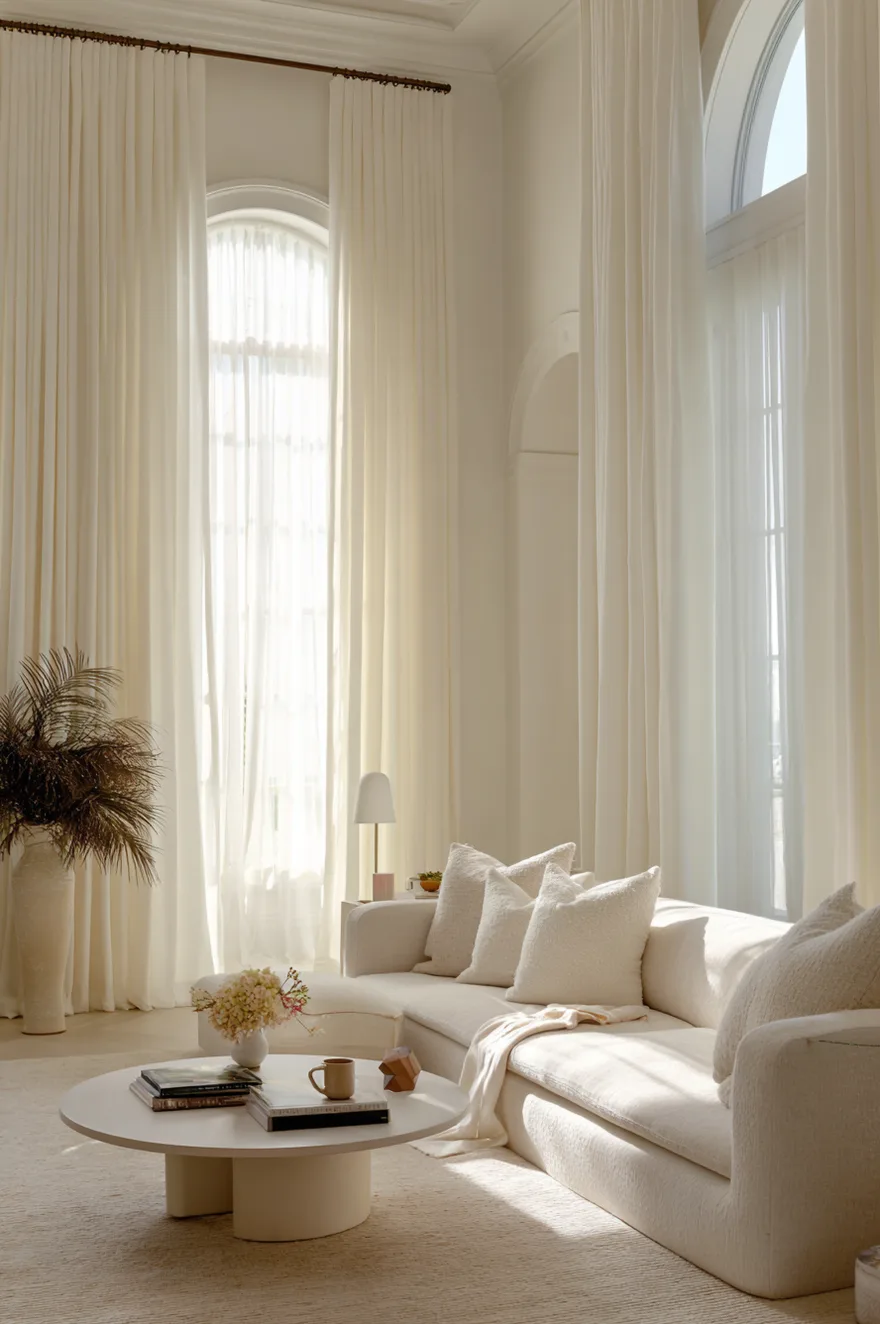
Mount the rod as close to the ceiling as possible. Always. Even in a room with standard 8-foot ceilings, hanging sheer linen panels from ceiling to floor adds what feels like a foot of height to the whole room – for the cost of a drill and a longer curtain panel.
IKEA’s HANNALILL sheers are about $20 a pair and work perfectly for this. Order the 118-inch length. Most rooms with 8-foot ceilings only need about a 96-inch drop, so you’ll have a little puddle of fabric at the floor, which is actually correct – that slight break at the floor reads luxurious and intentional. This single change is cheaper than any piece of furniture and does more for the room’s proportions than almost anything else on this list.
12. Contemporary Minimalist Living Room With Tile-To-Ceiling Drama
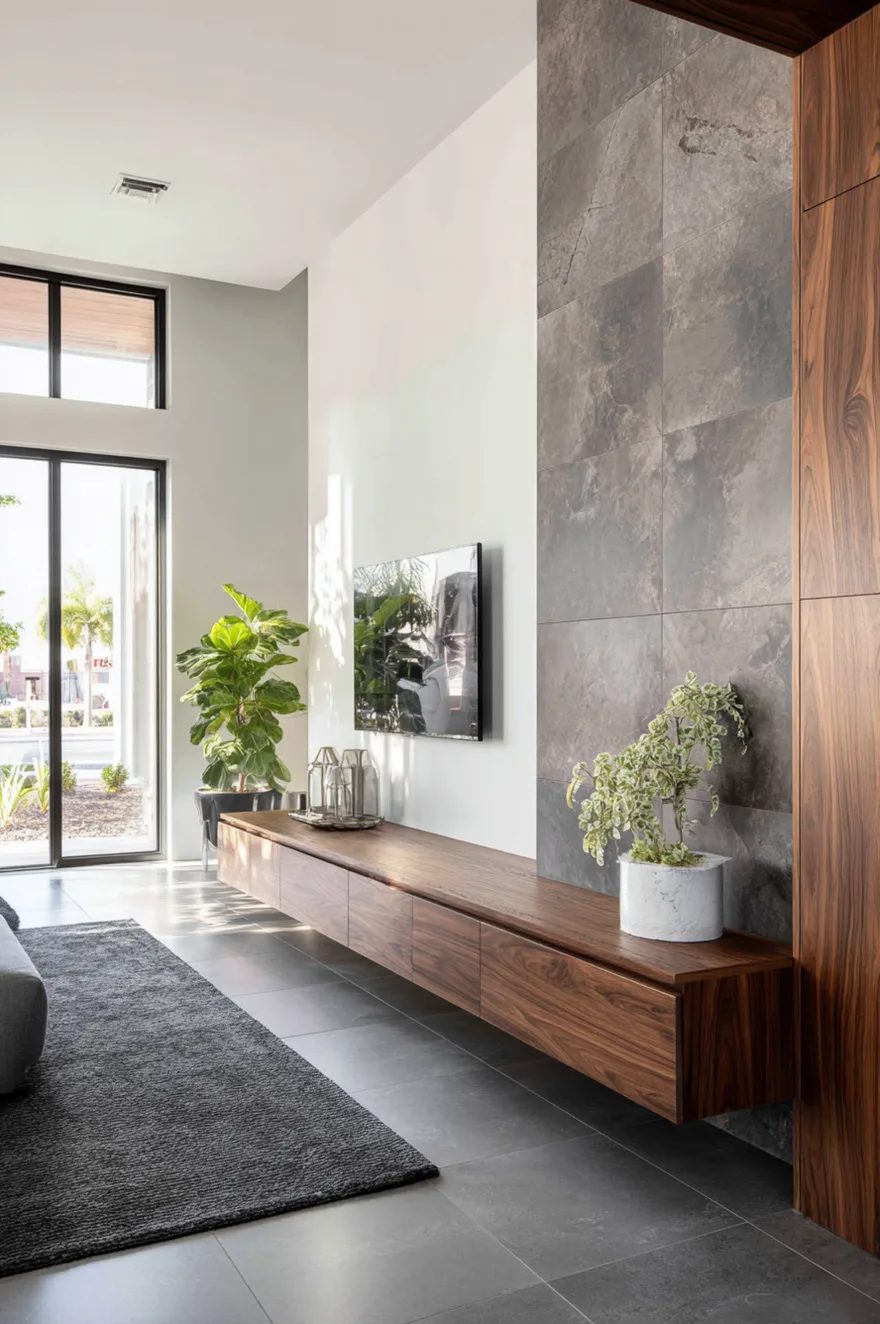
Running slim-format stone-look porcelain tile from floor to ceiling on a single feature wall is the architectural move that makes a contemporary minimalist living room feel genuinely custom – even if nothing else in the room is. The grout lines create a subtle grid pattern that reads more like texture than pattern, especially in a larger format tile (I’d go 12×24 or bigger).
Against that tiled wall, a floating walnut TV console low to the ground keeps the wall visible above the television, which is where most people make the mistake of hanging art or adding shelves and canceling out the tile’s effect. Leave it. A graphite wool rug and zero artwork elsewhere in the room lets the tile be the single visual statement. Shot from a slight angle through a doorway, this kind of room photographs in a way that makes people ask what architect designed it. Nobody has to know it’s porcelain from a tile warehouse.
13. What Most People Get Wrong About Clutter-Free Living Rooms
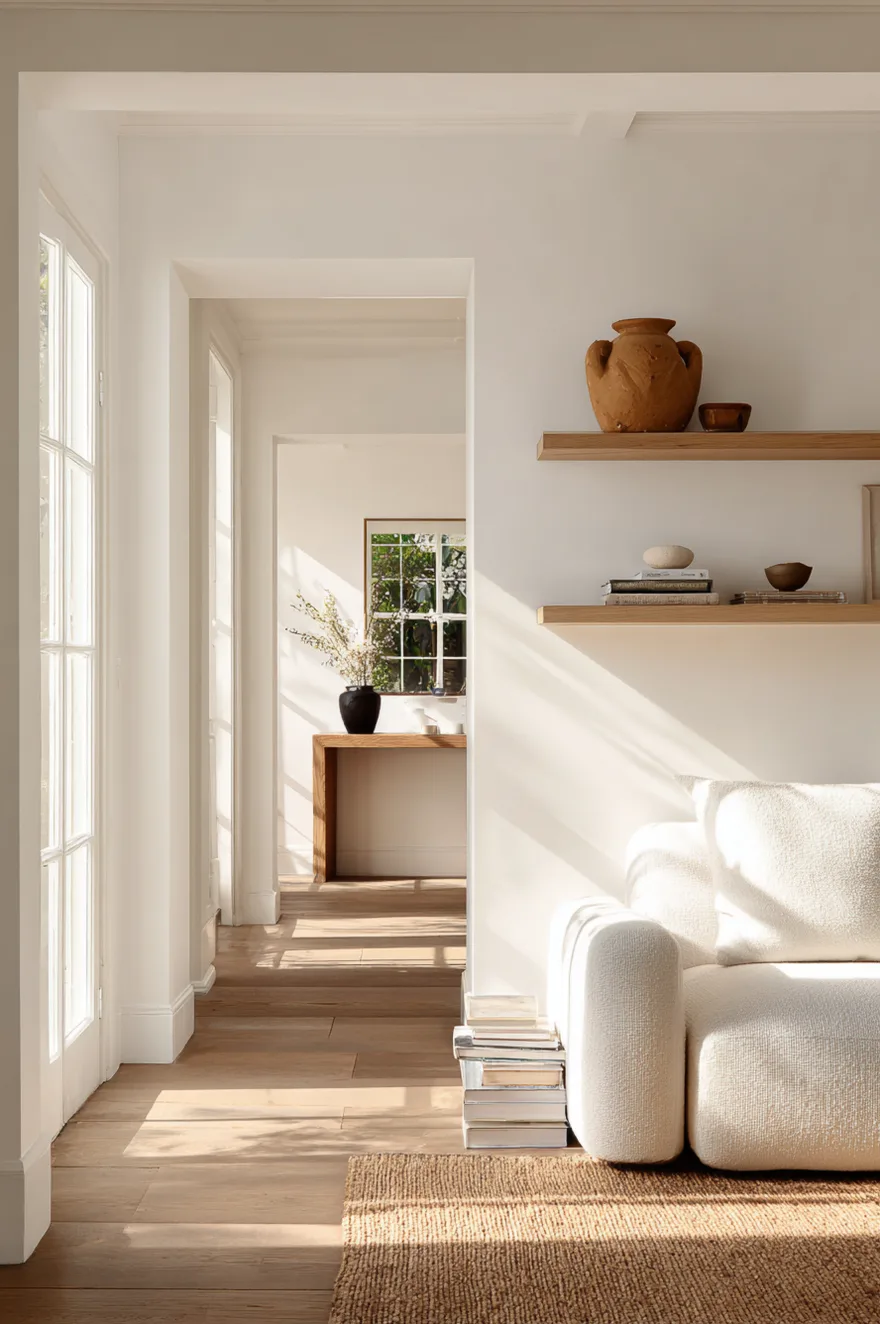
Minimalism isn’t about removing everything. I’ve been in rooms that have been stripped so bare they feel anxious rather than calm – like someone vacuumed up all the personality along with the clutter. The thing that was removed wasn’t just objects; it was evidence that a human being lives there.
The actual move is fewer things, but better things. One thrifted sculptural ceramic – something with an interesting glaze or an unexpected form – on a console does more than twelve matching Target knickknacks arranged in a grid. The single object has presence. The grid of twelve has noise. This is why I’ll spend $40 at an estate sale on one weird, heavy, beautiful ceramic bowl and put it on a completely bare shelf rather than filling the shelf with a matching “set” of anything. The restraint is the design.
14. Minimalist Living Room 2026 Trend: Soft Blacks And Warm Wood
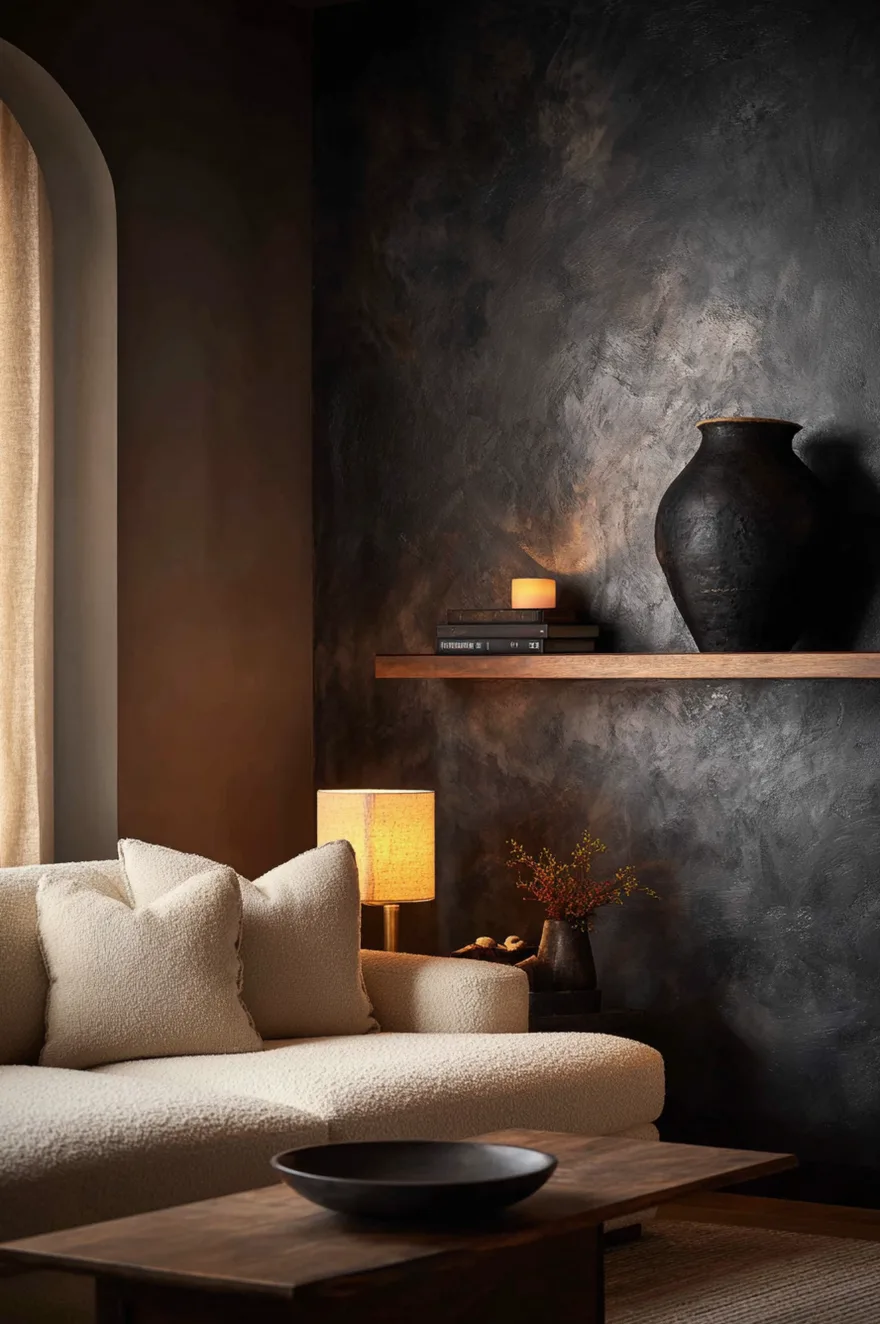
Matte black plaster walls are coming for limewash’s moment and I think they’re going to hit harder. The finish is everything – it has to be matte, not satin, not eggshell. Matte black plaster absorbs light rather than bouncing it, which makes the room feel quiet in a way that no other wall finish does.
Against that, honey-oak floating shelves and warm brass hardware are doing a lot of contrast work. The interplay between the completely light-absorbent matte plaster and the high-gloss ceramic objects you place on those shelves is genuinely striking. A single sculptural black ceramic vase on a honey-oak shelf in front of a matte black wall – the black-on-black at two different finishes creates this depth that flat photography barely captures. Try it in person. It’s a room you feel differently about depending on where you’re standing.
15. The Thrift Store Score That Anchors My Favorite Room
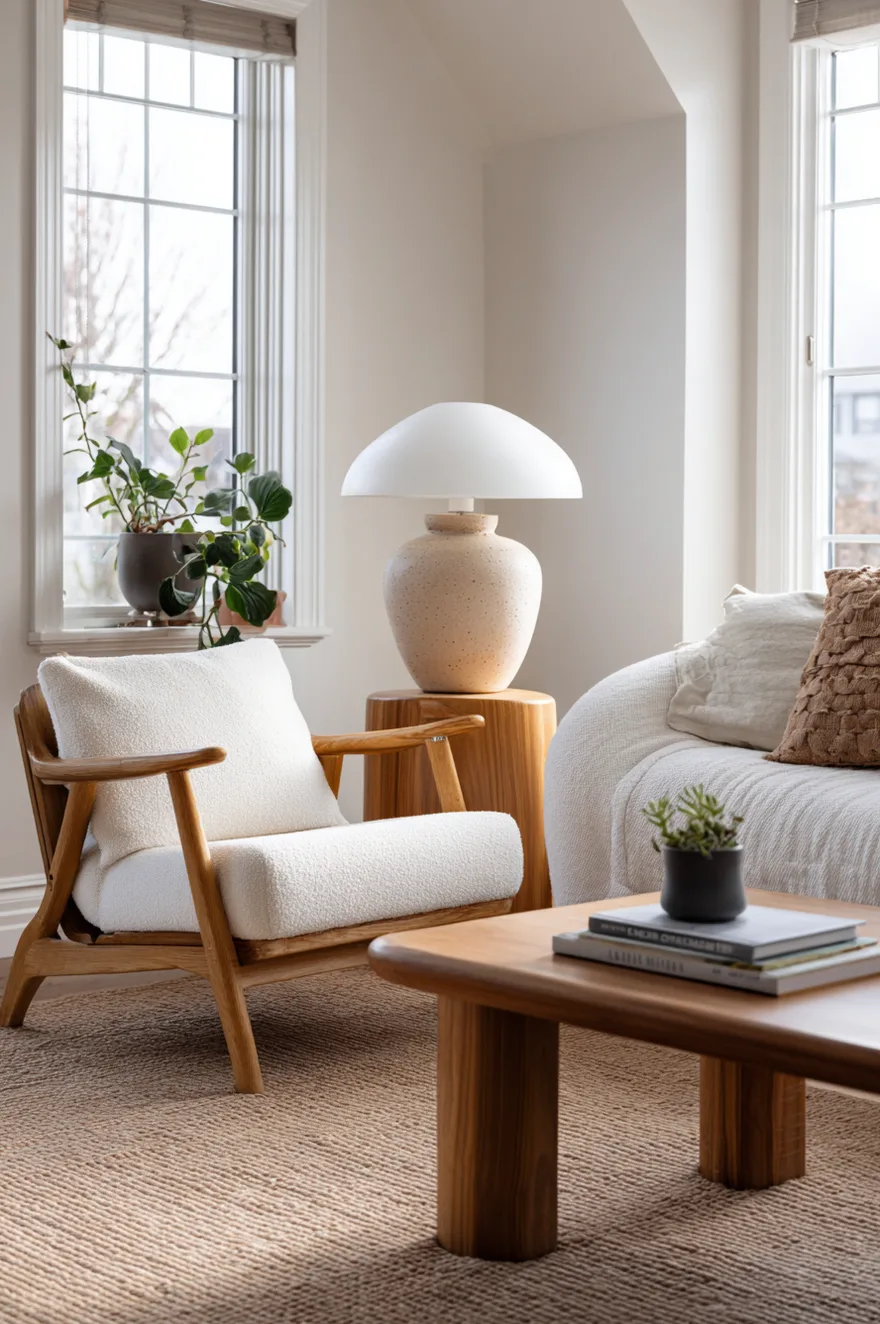
I found a mid-century side table at the Hillcrest flea market for $14. It had good bones – the tapered legs were solid, the proportions were right – but the top was water-stained and the original finish had gone chalky. I sanded it down and restained it with Varathane’s Classic Pecan, which is a warm honey-brown that sits somewhere between walnut and oak. Two coats. It took about two hours total on a Saturday morning.
Styled beside an IKEA Uppland chair with a slipcover I had made from a heavy cream cotton canvas (the Uppland slipcover system makes this almost embarrassingly easy), that $14 table looks like it came from a carefully-sourced vintage shop. And the thing is – it kind of did. The difference between a room that looks “collected over time” and a room that looks “purchased on the same Tuesday afternoon” is exactly this: one thrifted piece that you put some effort into, mixed with one honest budget piece that doesn’t pretend to be more than it is. The combination reads real. It should – because it is.
Facebook Marketplace is where I look first now before any furniture store. Search “mid century side table” and set a price max of $50. Something always turns up within two weeks.
16. Neutral Palette Living Room Ideas With Peel-And-Stick Grasscloth
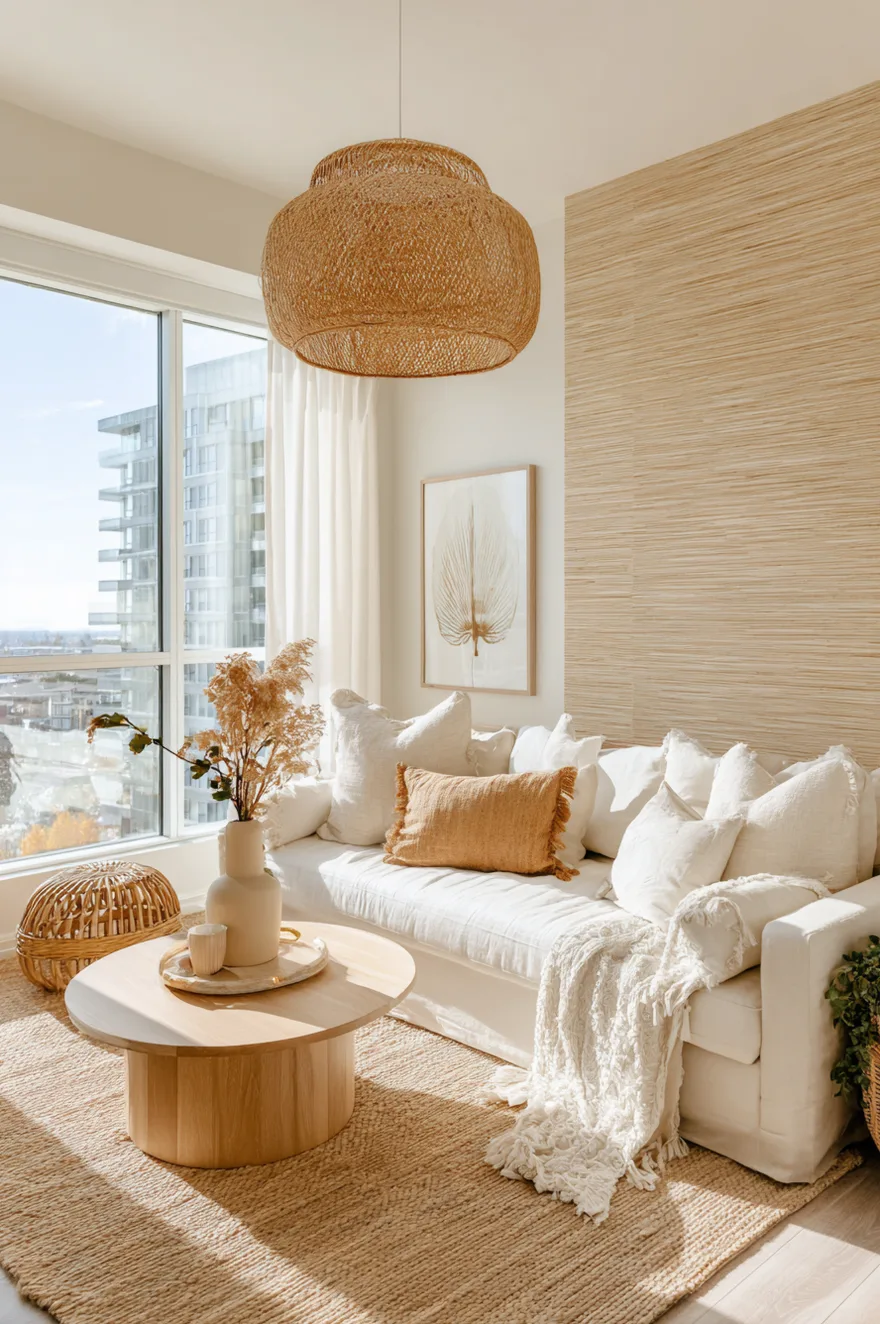
I swore I’d never do peel-and-stick anything. I was wrong. NuWallpaper and Tempaper both make peel-and-stick grasscloth that, from a normal social distance, reads as the real thing. The warm wheat tone version is the one to get – it has that natural fiber variation that makes it look genuinely woven, and on a single accent wall it adds a texture that plain paint simply cannot deliver.
In a neutral palette living room, that grasscloth wall is the texture anchor. Everything else can stay flat – a cream linen sofa, a bleached jute rug, woven rattan pendant lights if you have a ceiling connection point. The woven rattan and the woven grasscloth texture rhyme with each other without matching, which is exactly the kind of quiet visual relationship that makes a room feel designed without anyone being able to point to why.
For renters specifically: this is a completely removable wall treatment. No security deposit risk. Re-wallpaper before you move and leave the walls exactly as you found them.
17. Why A Single Oversized Plant Beats Every Gallery Wall
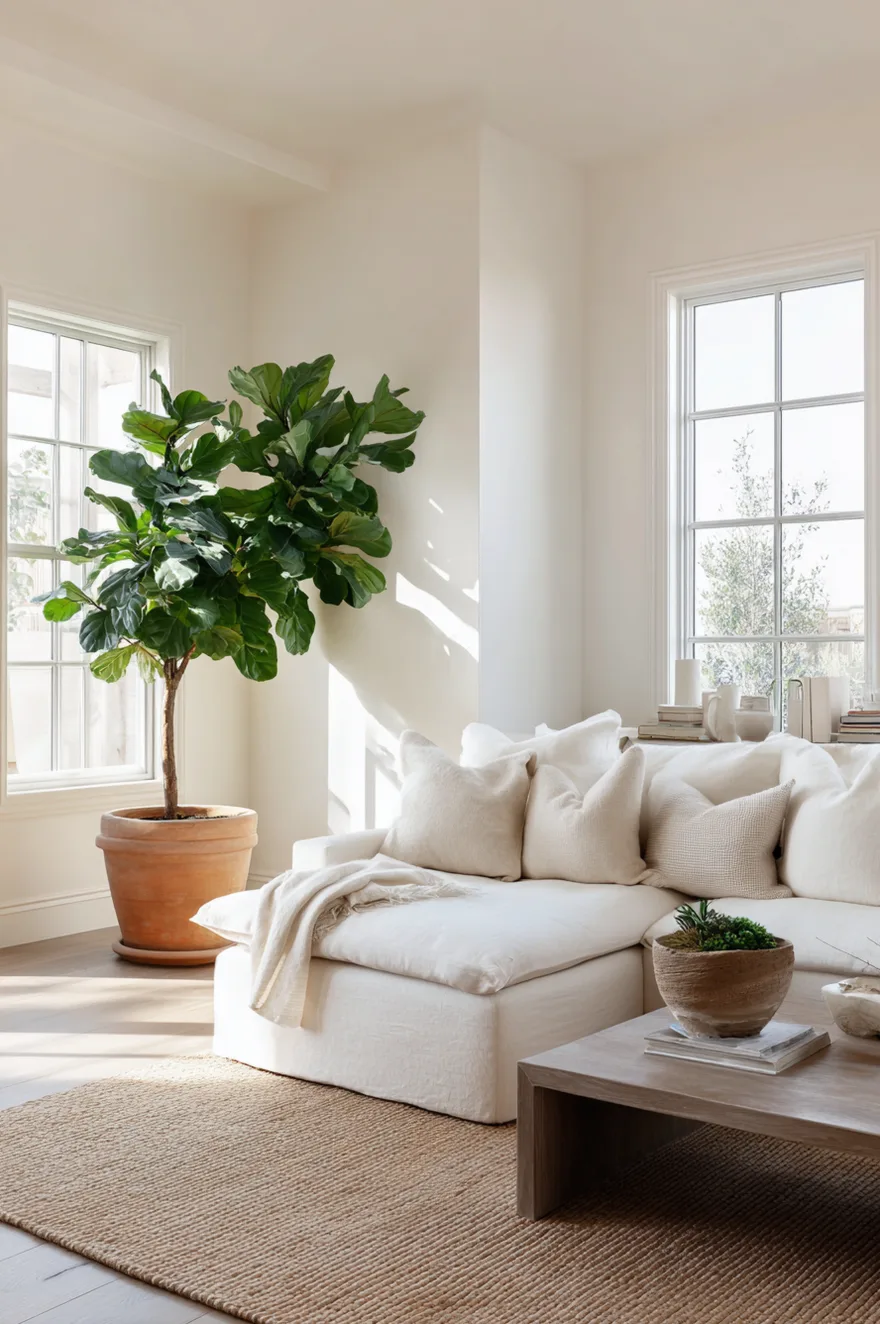
A 6-foot fiddle leaf fig in a plain terracotta pot placed in a bare corner costs maybe $80 at a local nursery. And it does more for the proportions of a minimalist living room than any arrangement of framed prints I’ve ever tried. Scale matters enormously in spare rooms – a small plant in a small pot in a large corner looks apologetic. One large plant with presence fills the corner architecturally.
The plain terracotta pot is important. No pattern, no glaze, no basket-weave planter. Just the raw orange terracotta against whatever your wall color is. That simplicity is what keeps it minimalist rather than decorative. And honestly, a healthy fiddle leaf fig or olive tree is just more interesting to look at than most art I can afford.
18. Warm Minimalist Living Room Ideas With Butcher Block Shelving
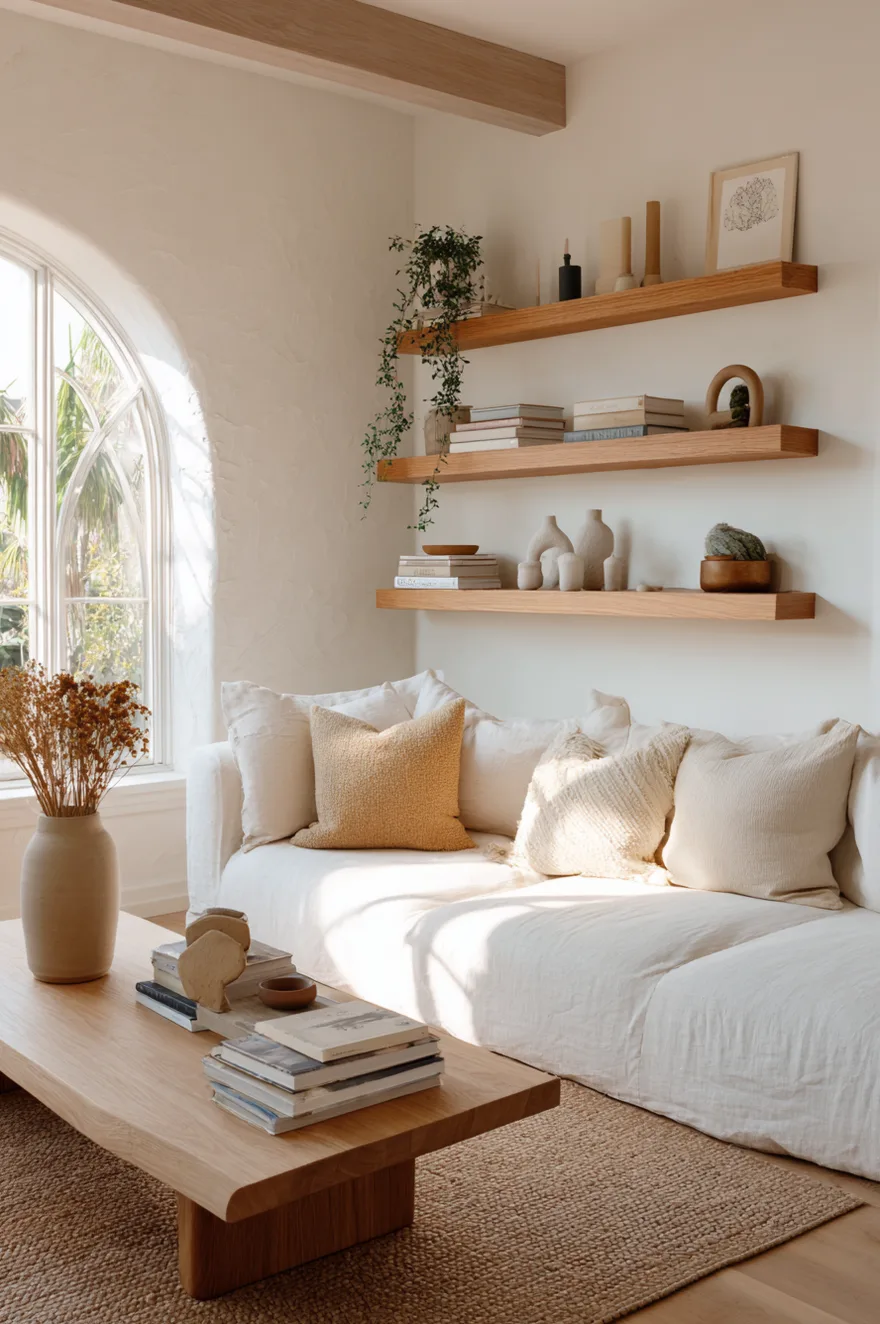
Builder-grade floating shelves are almost always too thin. They flex under weight, they look cheap, and they read “rental” in a way that’s hard to style around. Replacing them with thick butcher block planks – something with a 1.5-inch depth or more – immediately changes the whole wall. You can buy butcher block planks cut to length at most lumber yards, or IKEA’s butcher block countertop sections can be cut down and used as shelving. Sand them lightly, oil them with food-safe mineral oil, and mount them with heavy-duty blind shelf supports.
Style each shelf with exactly three objects: one ceramic, one stack of two or three books, and one trailing plant. That’s the formula. Warm afternoon light catches the grain of the butcher block in a way that painted MDF simply won’t. The restraint of three items per shelf keeps it looking intentional – not sparse from a lack of things to put there, but spare by choice.
19. Minimalist Living Room Design That Actually Feels Lived In
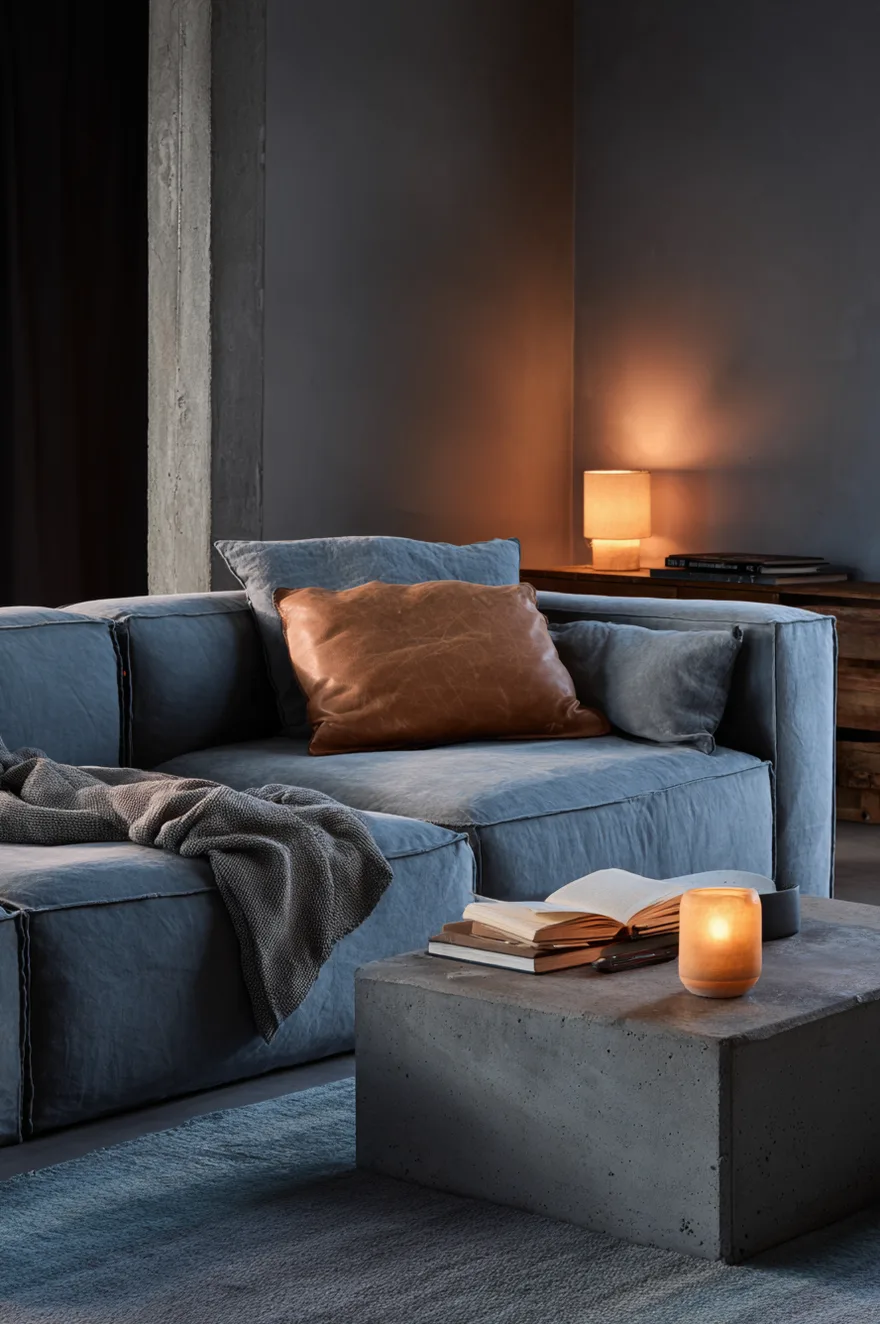
The thing that separates a room that’s photographed minimalism from minimalism you can actually live in is evidence of use. A well-worn leather throw pillow – the kind that’s slightly scuffed at the corner and has gone soft from years of being picked up and put down – on a stone-blue linen sectional does more for livability than any amount of careful styling. It looks like someone actually sits there. Because someone does.
A raw concrete side table, a low wool rug in dusty blue-grey, and soft lamp light at around 2700K pulls together a room that’s spare in the object count but genuinely full in material warmth. Leave a book face-down on the floor. Drape the throw instead of folding it. The slightly undone version is always the right version in a room like this – because perfect rooms make people nervous, and the whole point of a living room is that nobody is nervous in it.
Okay, you don’t need to do all nineteen. Pick two. Maybe start with the curtain height trick and a good rug – that combination alone will make your room feel more considered without moving a single piece of furniture. Or grab a single sculptural object at your next estate sale and see what happens when you put it on an otherwise bare shelf. I’d genuinely love to hear which of these ideas you’re trying first – drop it in the comments below.
With love,
Liv