Powder rooms are the most under-designed rooms in most homes, which is a real shame because they’re also the most forgiving place to take a risk. This roundup covers 21 powder room ideas – from bold dark walls and dramatic wallpaper to budget hardware swaps and rental-friendly tile – so you can find the ones worth trying in your own five square feet.
Most people treat their powder room like an afterthought. A builder-grade mirror, a chrome faucet still in the original finish, maybe a hand towel that coordinates with nothing. I get it – it’s small, it feels like a weird place to spend real money, and guests are only in there for thirty seconds anyway. But here’s the thing: thirty seconds is exactly how long it takes to make an impression. The powder room is the one room where you can do something genuinely bold without a contractor, a permit, or a complete nervous breakdown. It’s five square feet. Even if you hate it, you can repaint it in an afternoon. I redid ours on a Saturday while Nora napped and Benny supervised from the hallway, and it’s currently the room I’m most proud of in this whole house.
1. Bold Powder Room Ideas That Steal the Show
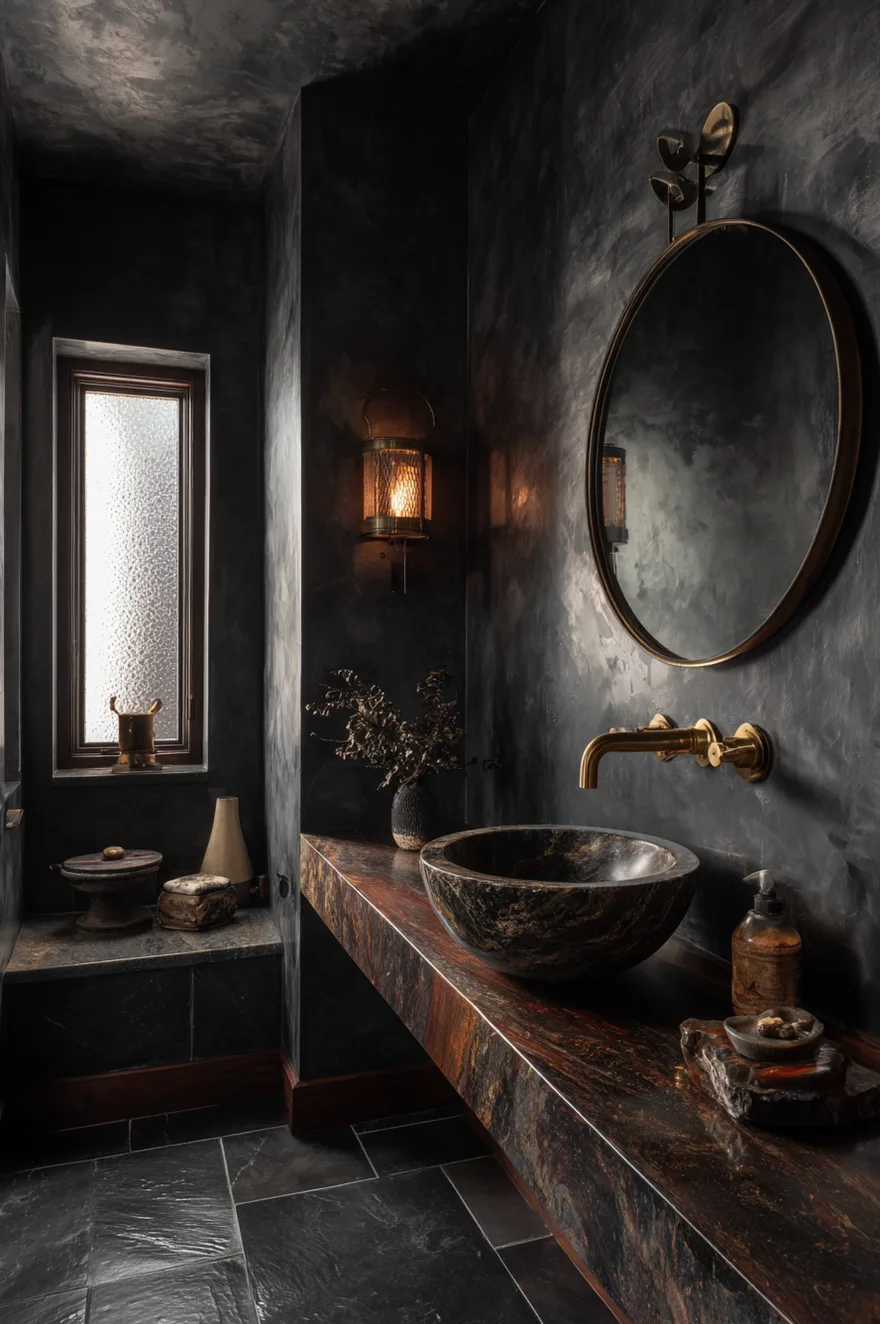
Floor-to-ceiling inky black plaster walls are my answer every time someone asks what they should do with a boring powder room. Not dark charcoal. Not navy. Black, or close enough to it that the room reads like a cave in the best possible way. Pair that with a floating black walnut vanity – the grain is so good it does half the work – and a backlit onyx or dark marble vessel sink, and you have something that feels like it belongs in a boutique hotel.
The unlacquered brass faucet is non-negotiable here. It warms up all that darkness without competing with it, and it develops a patina over time that only gets better. Start with the wall color. Everything else follows.
2. Powder Room Wallpaper Ideas Worth Committing To
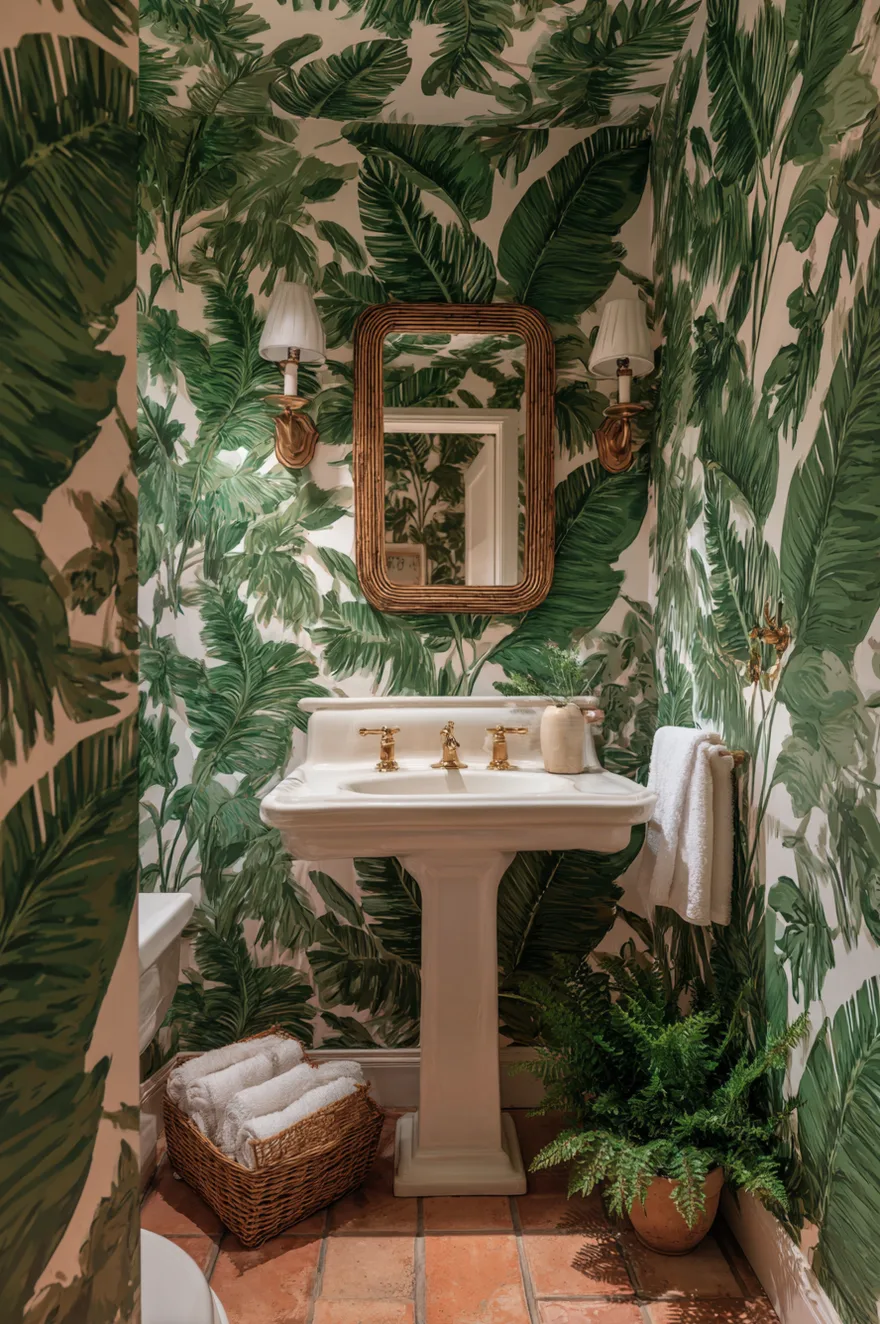
I used to think wallpaper was fussy. Too permanent, too much, too grandmother’s-dining-room. And then I saw a powder room wrapped floor-to-ceiling in oversized botanical wallpaper – leaves the size of dinner plates, trailing vines, the whole thing – and I completely changed my mind. Applying it to all four walls is one thing. Taking it across the ceiling is when it stops being decorating and starts being an experience.
Philip Jeffries makes the aspirational version. Spoonflower makes a very convincing dupe for a fraction of the price, and you can order a single roll to test the scale before you commit. The pattern you want is big – like, bigger than you think. In a small powder room, an oversized botanical print doesn’t overwhelm the room, it fills it intentionally. Tiny prints get lost and just look busy.
Pair the wallpaper with the simplest white pedestal sink you can find. A plain apron, basic hardware, nothing sculptural. The paper is doing all the talking, and a fussy sink will fight it. One round mirror with a thin frame, one sconce, done. Resist the urge to add art or shelves – the wallpaper is the art.
If you’re in a rental, check the removable options at Spoonflower or Chasing Paper. The prep is everything: clean walls, a very light skim coat on any texture, and careful seam alignment. Take your time on the first panel and the rest goes smoothly.
3. The Five-Square-Foot Room That Outshines Every Other
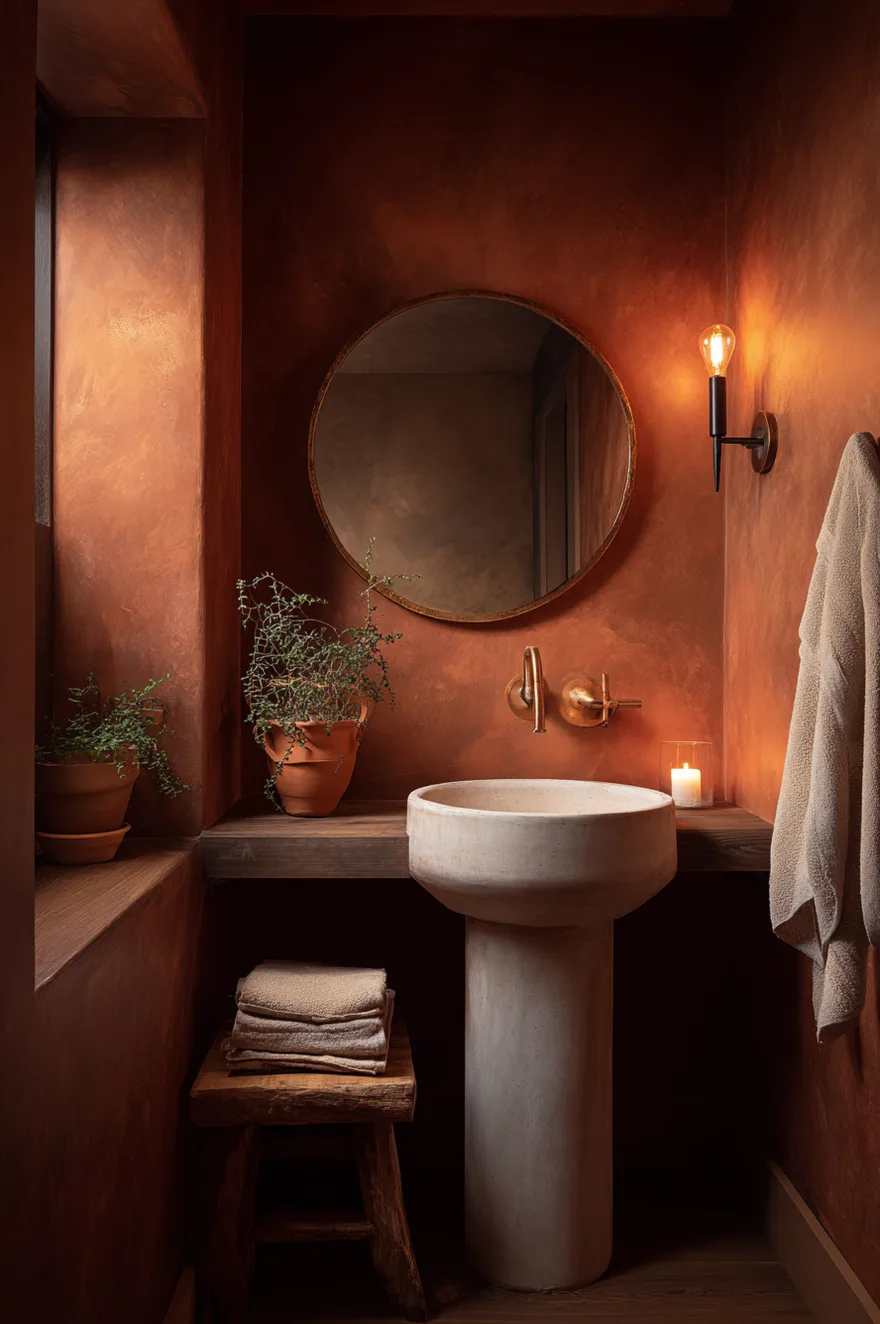
We almost painted our powder room the same agreeable greige as the hallway. I’m so glad we didn’t. On a whim – truly, I saw a picture at 11 p.m. and bought the paint the next morning – we went with a terracotta limewash finish instead. It’s not flat, it’s not perfectly even, and it looks incredible. The texture catches the light differently at every hour of the day.
A round unlacquered brass mirror hung directly on that warm wall, a single sconce with a warm Edison bulb (we’re talking 2700K, not the cool daylight kind), and suddenly the whole room feels like something you’d find at a wine bar in some old building in Santa Barbara. Moody without being dark, rich without feeling heavy. The limewash paint itself cost around $60 for the whole room, and I applied it in two passes on a Saturday afternoon.
If you’ve been nervous about limewash, start here. A powder room is low-stakes enough to practice the technique, and the imperfection is actually the point. Uneven application reads as character, not mistake.
4. Powder Room Ideas With Floating Vanity Vibes
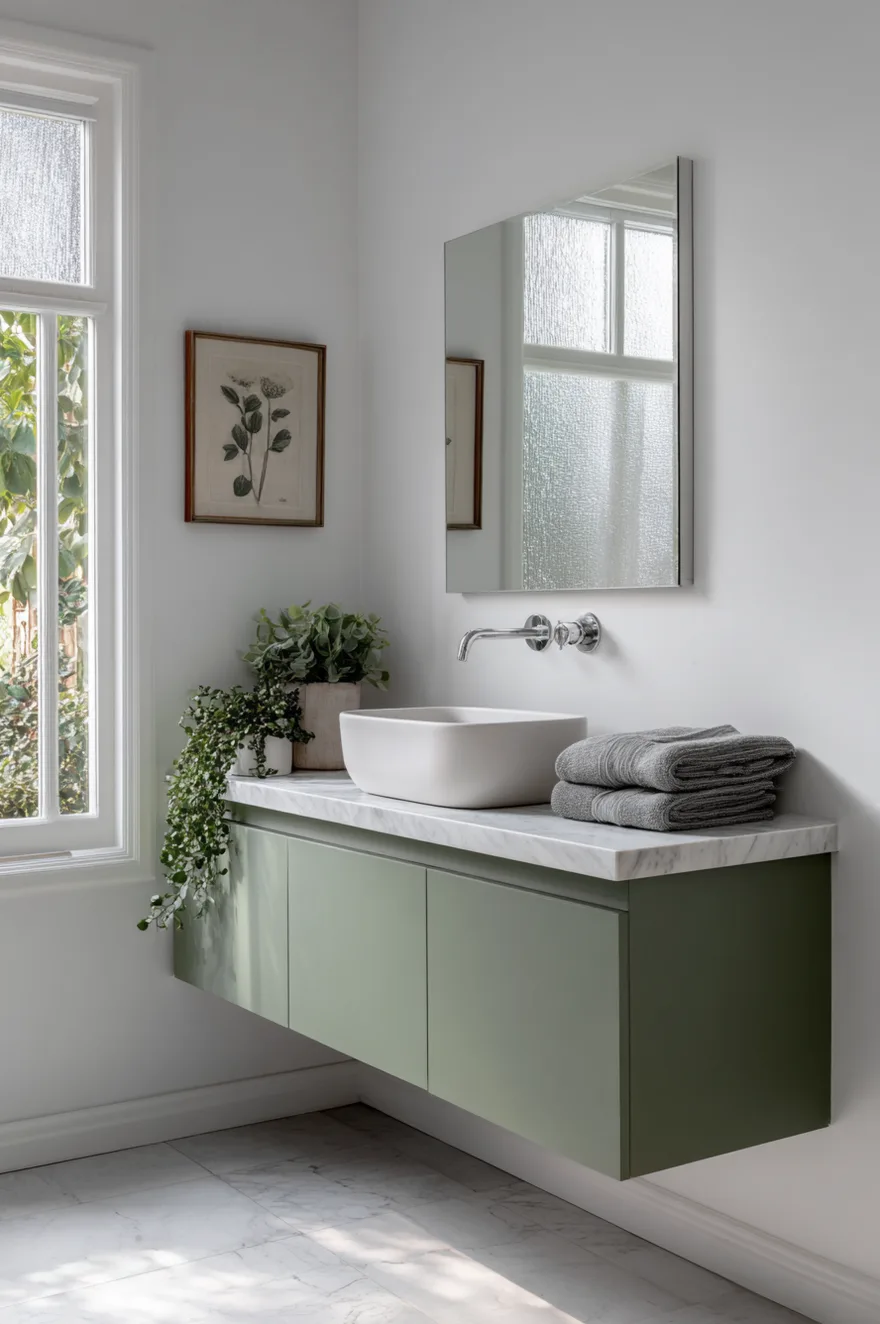
A wall-mounted floating vanity in matte sage green is one of those things that photographs beautifully and looks even better in person. The negative space beneath – usually around 12 inches of clearance – creates a shadow line on the tile floor that makes the whole room feel considered and intentional rather than just thrown together.
Top it with a honed Calacatta marble-look quartz (not polished – honed is softer and doesn’t show every water spot the way glossy does), add a vessel sink, and choose brushed nickel hardware to keep it from going too warm. The contrast between the sage cabinetry and the light stone top is doing a lot of heavy lifting. And cleaning under a floating vanity is genuinely easier, which matters when you have a toddler who drops things everywhere.
5. Why I Always Recommend Going Dark in Here
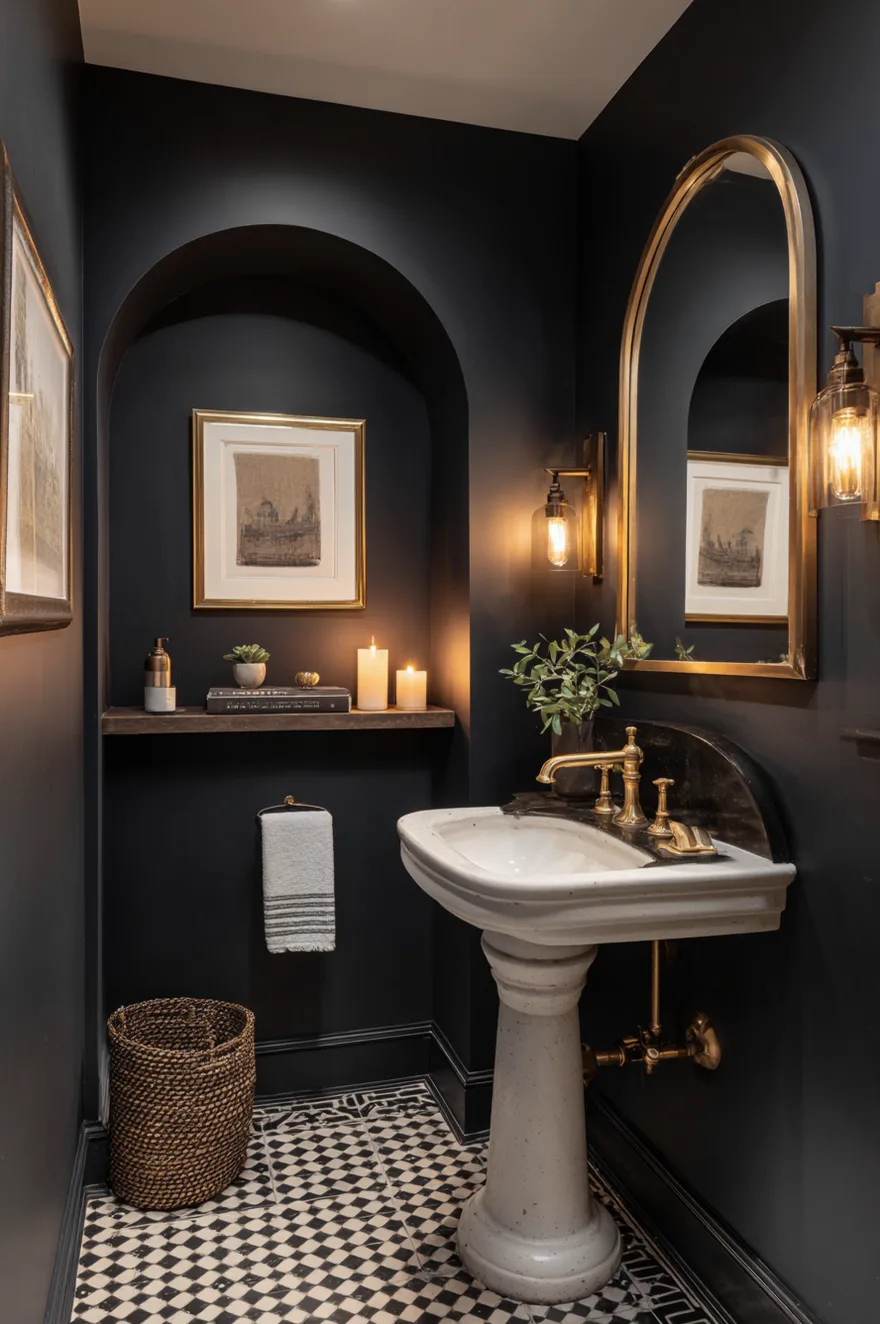
Powder rooms get used in thirty-second bursts. There’s no one living in there, no one needing it to feel open and airy, no one concerned about resale value at 7 a.m. on a Tuesday. So why are we all still painting them the same creamy white we use everywhere else?
Dark color reads luxurious in photos and in person. It makes the fixtures pop. And – this is the practical argument I give everyone – it completely hides the fingerprints your guests pretend they didn’t leave on the walls. Go dark. You can always paint it back. You probably won’t want to.
6. Powder Room With Fluted Panels and Brass Hardware
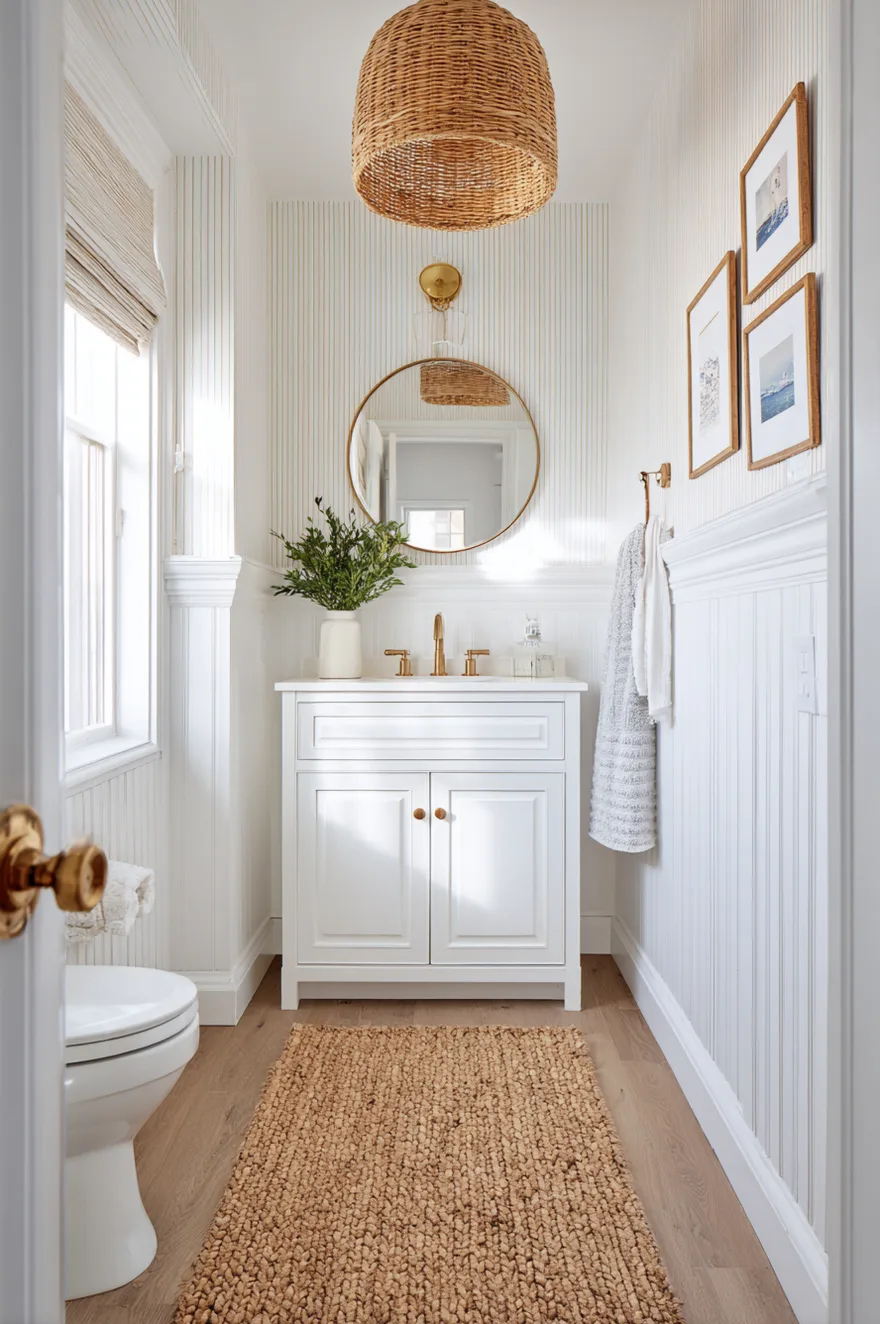
Fluted MDF panels are one of the better DIY projects circulating right now, mostly because they look genuinely expensive and they’re not actually that hard to install. Cut the panels to height, glue and nail them to the wall in a grid, fill the seams, prime, and paint a warm cream. The vertical lines draw the eye up and add a quiet architectural rhythm to what would otherwise be a flat wall.
Add a picture rail across the top – even a simple piece of trim works – and hang a few small framed prints from it. Then put unlacquered brass cabinet pulls on a basic two-door vanity below, and hang a rattan pendant overhead for warmth. Shot from a slight angle in the doorway, this setup has a sort of soft, collected quality that doesn’t feel like a mood board. It feels like someone actually lives there.
The brass pulls are the move that ties everything together – back to what I said in section 1 about unlacquered brass warming up a room. Same logic applies here, just lighter. Swap the pulls before you do anything else and see if you even need the rest.
7. Small Powder Room Ideas That Feel Expansive
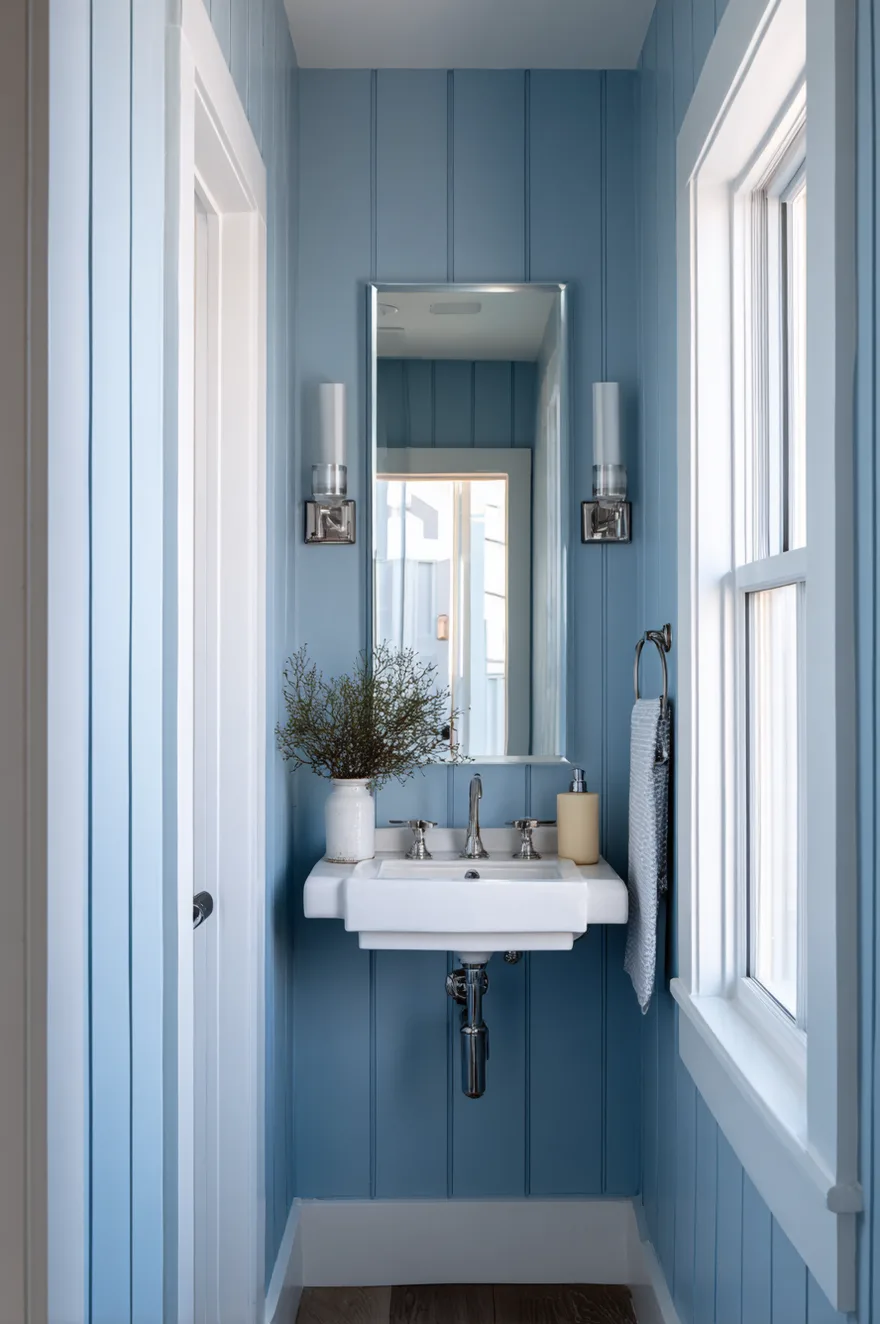
Vertical shiplap is one of the few things that genuinely makes a small room feel taller, and in a powder room, every inch of perceived height matters. Paint it a soft stone blue – something in the blue-gray family, not too saturated – and hang a slim rectangular mirror that runs almost to the ceiling.
A petite wall-hung sink keeps the floor completely open, which is the other part of making a tight space feel less tight. When guests can see the floor all the way to the wall, the room reads as bigger than it is. Skip the vanity cabinet if you’re really squeezed, and store extras in a small basket on a floating shelf instead.
8. A Swap You’ll Wish You Did Sooner
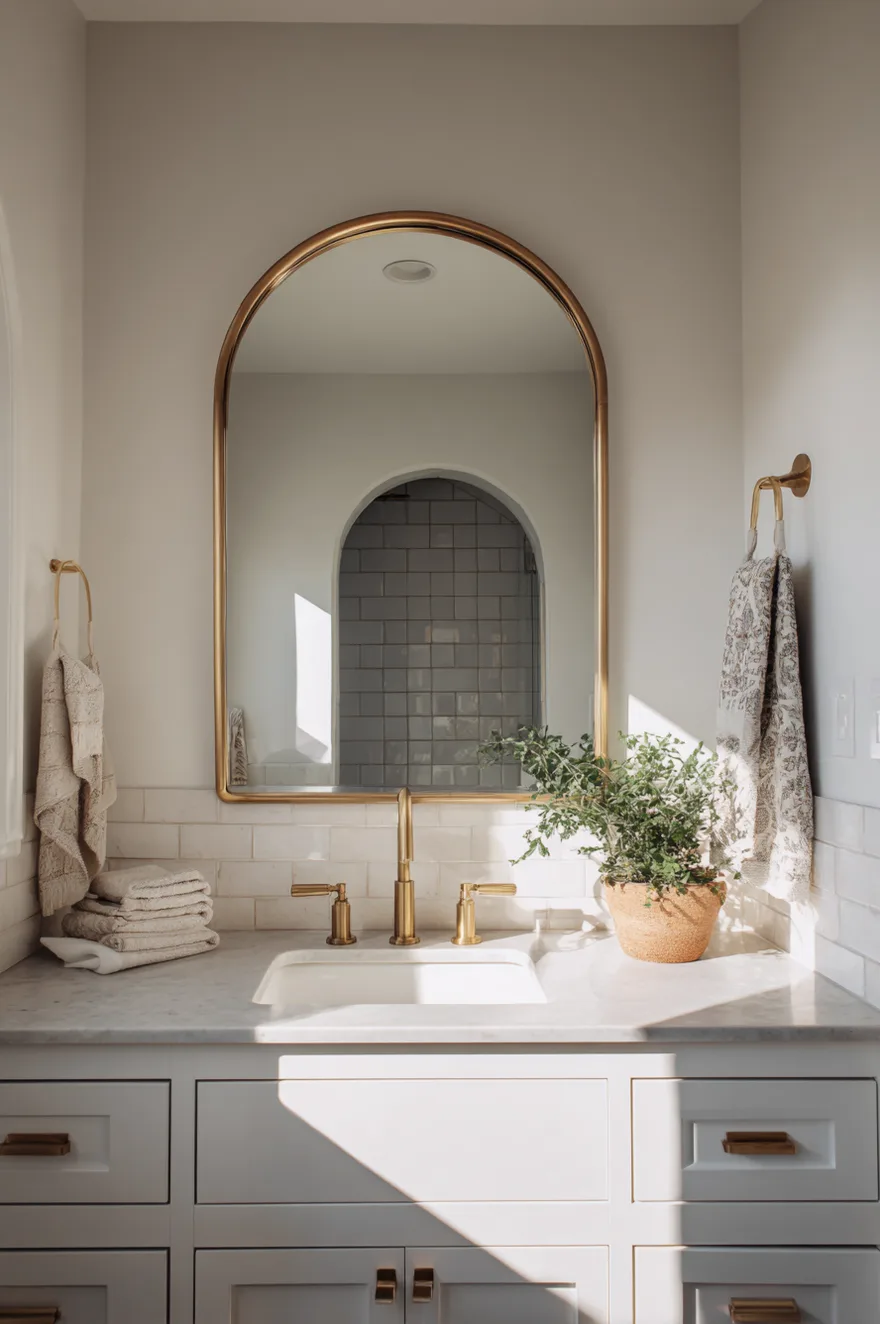
Replace your builder-grade round mirror with an oversized arched or scallop-edge mirror. Same wall. Same vanity. Completely different room. HomeGoods and Amazon both carry options in the $40 to $80 range that look like they cost triple that. The shape is doing all the work – it adds an editorial quality to even the most generic white vanity underneath it.
This is genuinely the fastest powder room upgrade I know. An hour including removing the old mirror and patching the anchor points. Start here if you’re overwhelmed by everything else.
9. Powder Room With Dark Marble You Can Actually Afford
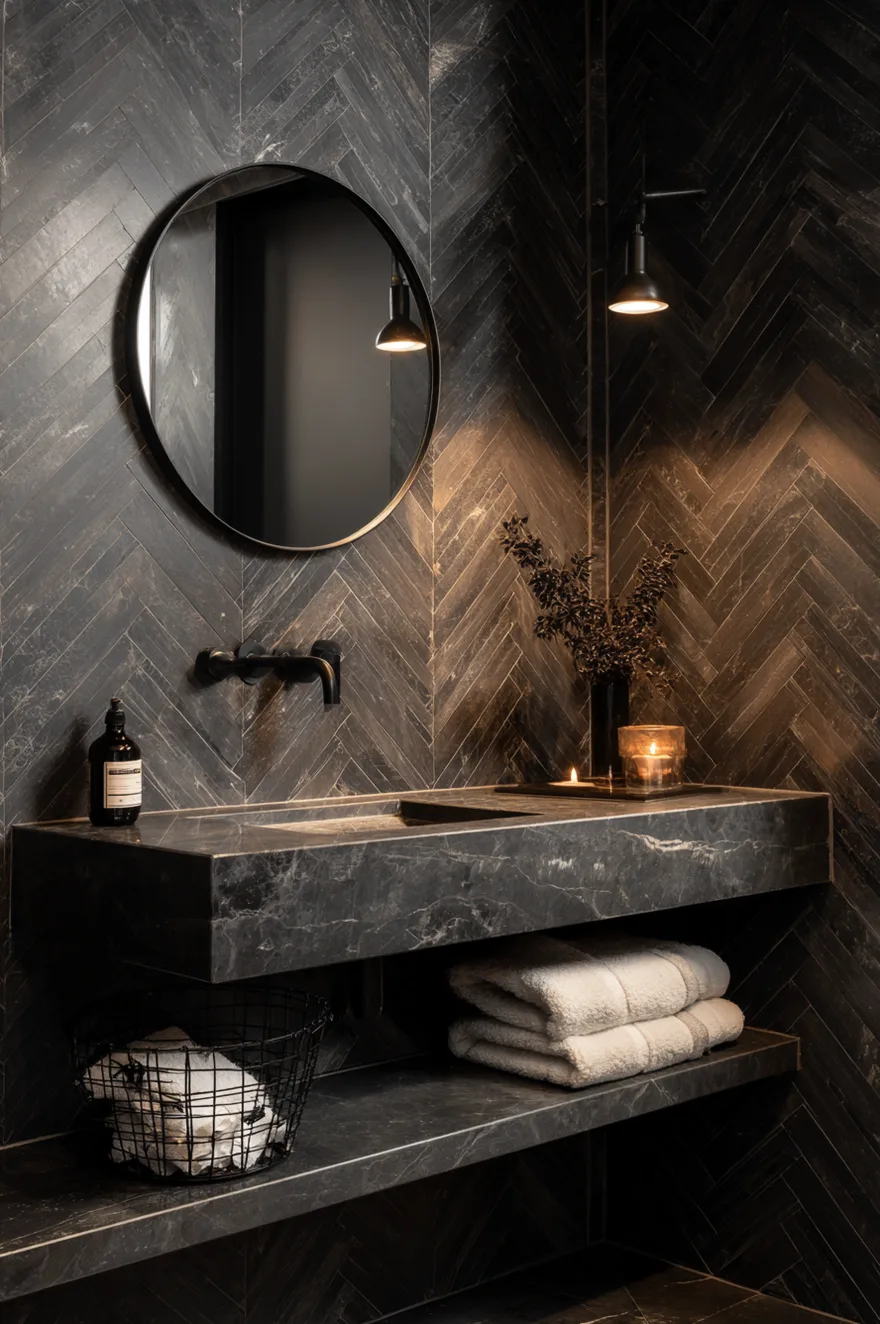
Real Nero Marquina slab marble is gorgeous and it costs as much as a used car. Porcelain tile in a Nero Marquina look is about $4 to $8 per square foot and, in a powder room, you need maybe 60 to 80 square feet total – walls included. The math is very different.
The key detail is the layout: herringbone, floor-to-ceiling. Not straight-set, not stacked. Herringbone breaks up the surface and makes the dark tile feel dynamic instead of just heavy. Large-format porcelain in a 12-by-24-inch size works well here – fewer grout lines means the pattern reads cleaner and the veining gets to do its thing without constant interruption.
Grout color matters more than most people realize. Go with a very dark gray grout, almost charcoal. White grout on dark tile looks immediately builder-grade and actually emphasizes every imperfection in the layout. Dark grout blurs the seams, makes the veining in the tile pop by contrast, and ages gracefully instead of turning dingy. Pair with a matte black wall-mount faucet and a simple white semi-recessed sink to give the eye a clean landing spot.
10. What I’d Do With That Awkward Nook
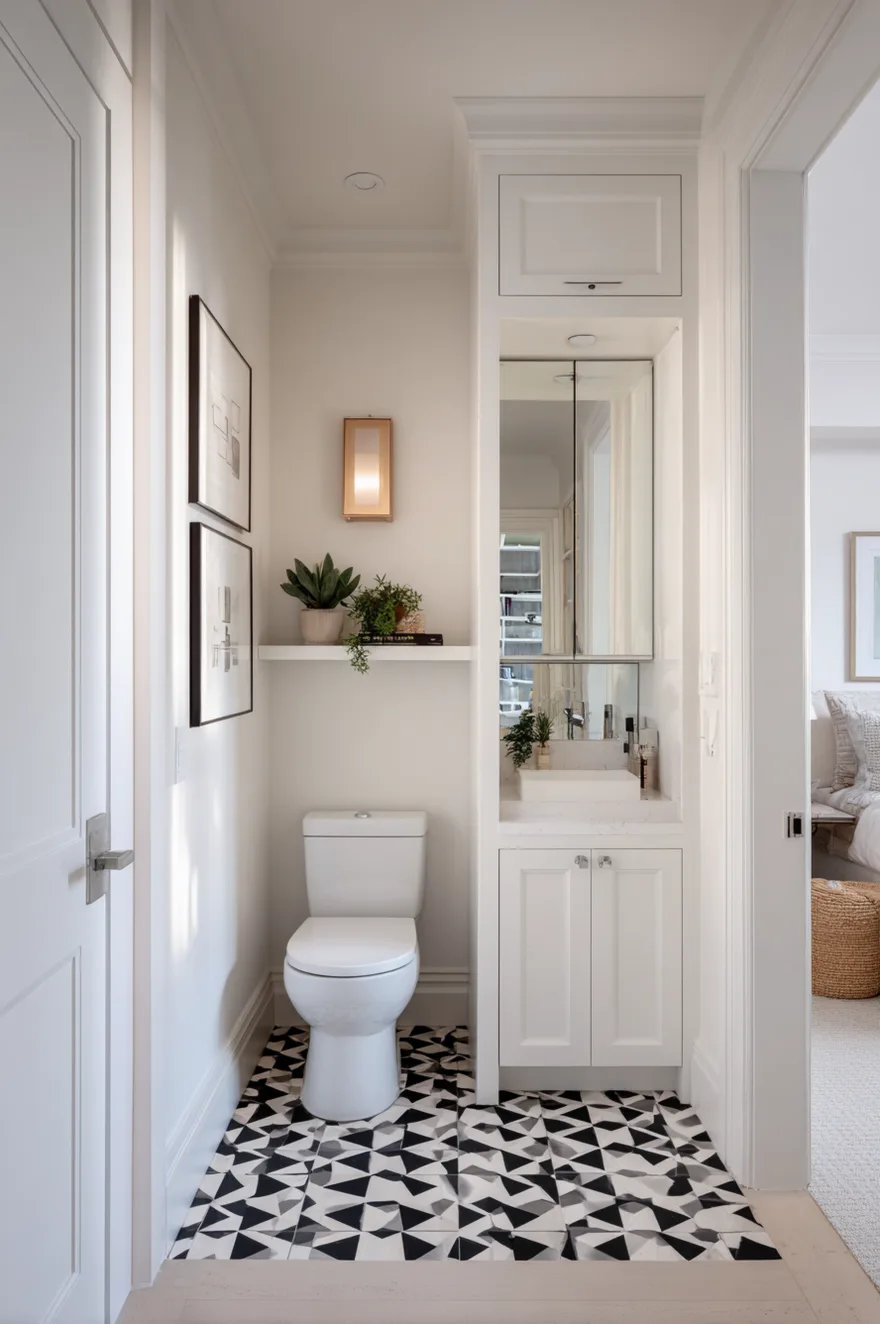
A hallway closet conversion is one of those things that seems impossible until you actually look at the dimensions. A standard closet is around 24 inches deep and 36 inches wide – that’s tight, but it’s workable for a powder room if you use a wall-mount toilet (which projects only about 12 inches from the wall instead of the usual 28) and skip the traditional vanity entirely.
I swore I’d never use peel-and-stick tile. I was wrong. In a converted closet powder room, a single dramatic peel-and-stick tile floor is the right call – you’re covering maybe 6 or 7 square feet, so the cost is minimal and the visual impact is huge. A mirrored cabinet instead of a vanity handles storage without eating into the footprint. You step in, you feel like the space is intentional and complete, not just a closet someone walled off.
The wall-mount toilet is the real investment here – budget around $400 to $600 installed – but everything else in this conversion can be done affordably. Treat the toilet as the one place you spend real money and keep everything else simple.
11. Modern Powder Room Ideas With Clean Sculptural Lines
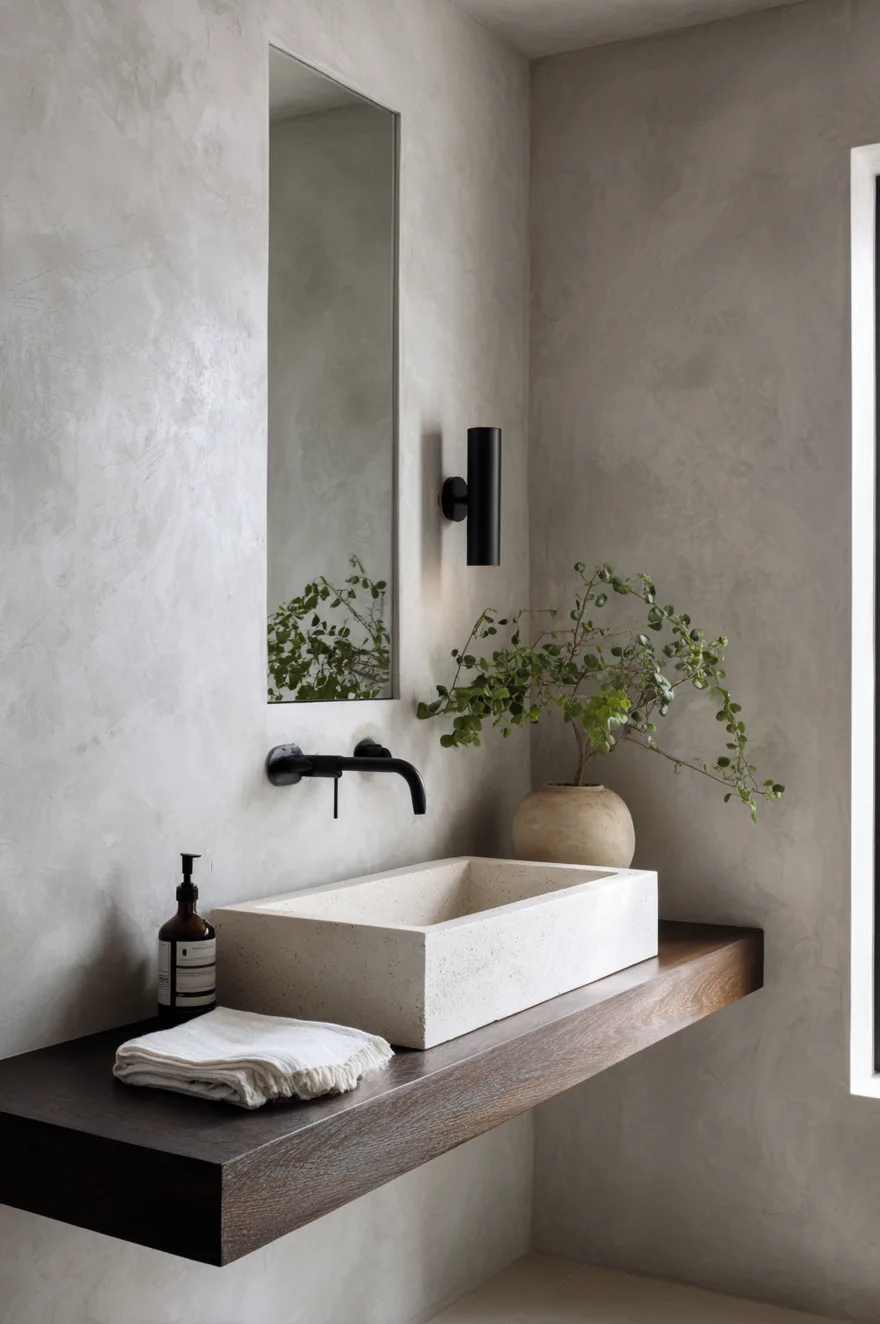
Minimalism in a powder room only works if the materials are doing something interesting. A smooth concrete-look plaster wall earns its simplicity because the texture is subtle and alive – it’s not just a flat painted drywall pretending to be fancy. Pair that with a solid white stone rectangular basin sitting directly on a thin floating shelf of smoked oak, and suddenly there’s a quiet tension between the warm wood and the cool stone that keeps the room from feeling sterile.
Matte black everything else: faucet, sconce, drain cover. No mixed metals, no decorative towel hooks, no art. One trailing plant in a simple ceramic pot, one folded linen hand towel. The restraint is the whole point. Modern powder room ideas in this direction photograph beautifully in crisp natural daylight – the clean lines and the lack of clutter make every surface legible from across the room.
Honestly, still not totally sure this look works with little kids around. Nora left a handprint directly in the center of our concrete-look wall. It came off fine, but I held my breath for a second.
12. Powder Room With Botanical Wallpaper and Warm Rattan
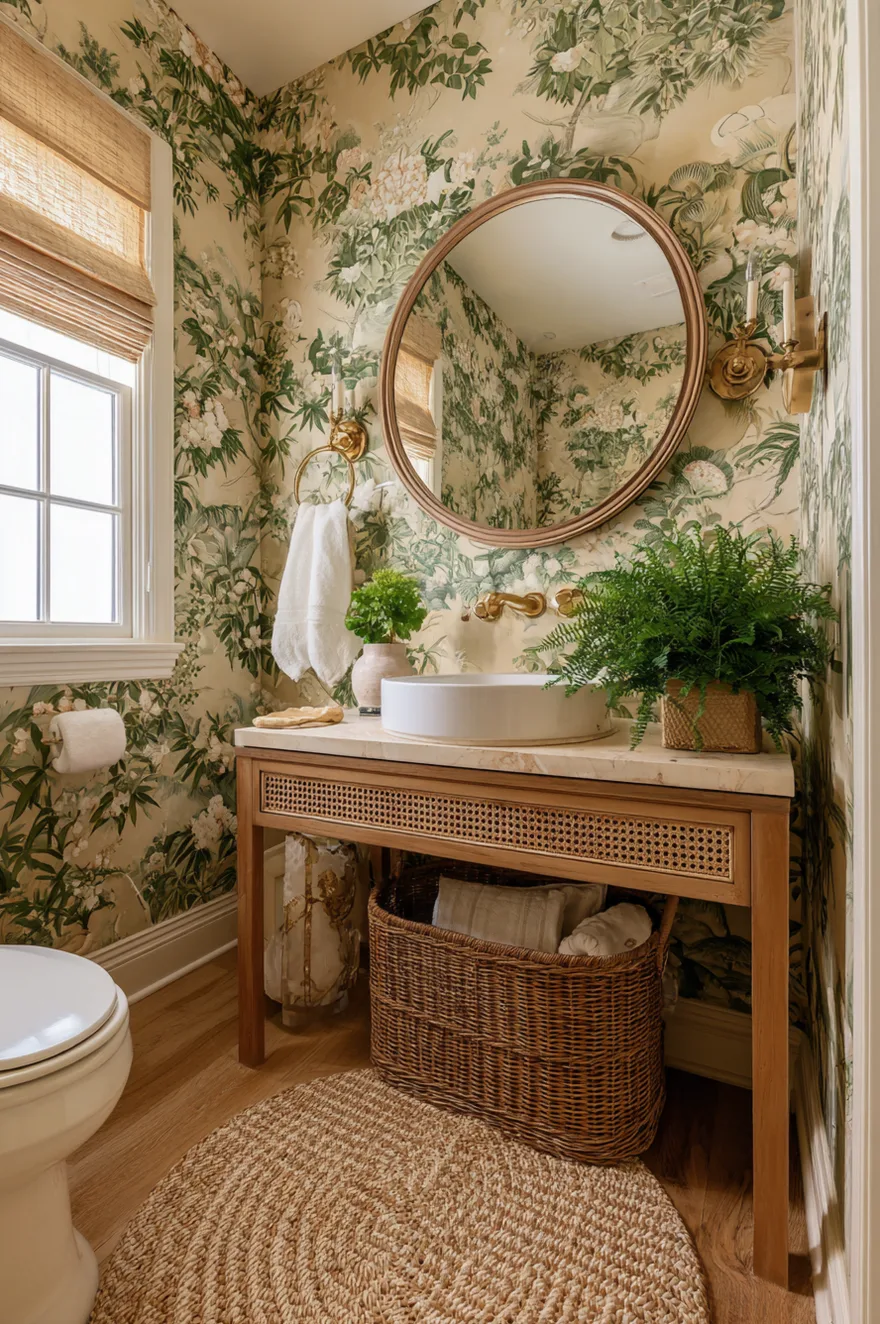
Rifle Paper Co. makes a chinoiserie botanical wallpaper with a cream background that is genuinely one of the prettiest things I’ve seen in a powder room. Spoonflower has several good dupes in the same family for considerably less per roll. The cream background keeps it from going too dark, and the botanical motifs – birds, trailing branches, blooms – give the room a layered, collected feeling without requiring actual collecting.
A rattan-front vanity pairs with this wallpaper the way a good rug pairs with an IKEA sofa – the natural texture grounds all that busyness without competing. Add a round wood-framed mirror and woven seagrass floor tile, and the whole room has a warm, almost organic quality. Keep the hardware in brushed gold and leave some breathing room on the vanity surface. Two items max: a small bud vase and a hand soap with a nice label.
13. The Wainscoting Glow-Up Nobody Expects
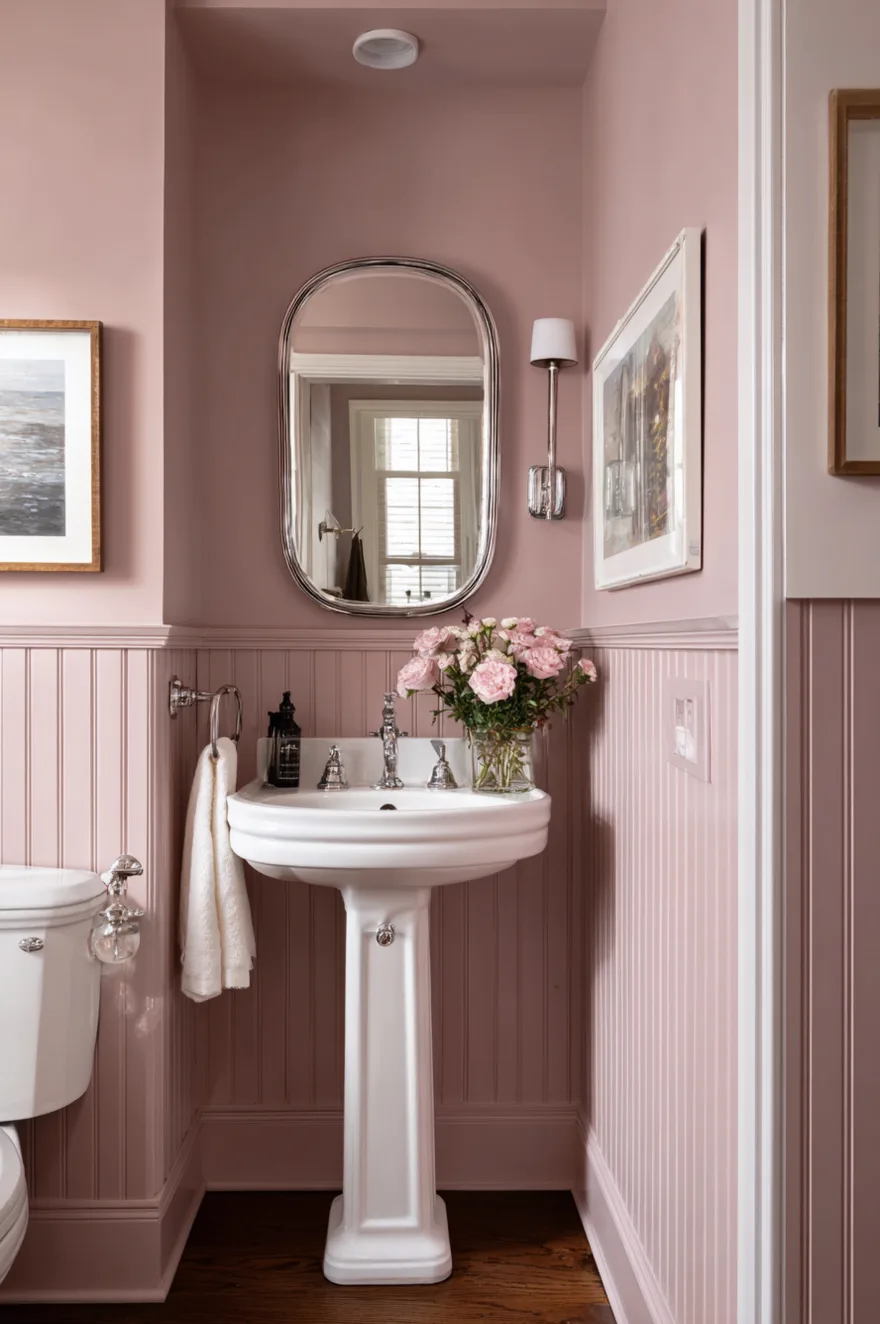
Classic beadboard has a reputation problem. People assume it means beach house or grandmother’s bathroom, and in the wrong color it can absolutely read that way. But paint it a dusty mauve – a genuinely moody, gray-leaning mauve, not a pink – and the whole character shifts. Take the upper walls in a slightly lighter tint from the same paint family for a tone-on-tone effect that’s more sophisticated than it has any right to be.
The chrome vintage-style faucet is the contrast element that keeps it from going too precious. Warm tones need a cool-toned metal to cut them, and chrome does that job quietly. This is the powder room that gets the most comments at a dinner party – people can’t quite figure out why it works, but it does. And beadboard panels are still one of the more approachable DIY installs, even for beginners.
14. Powder Room With Wainscoting for a Timeless Look
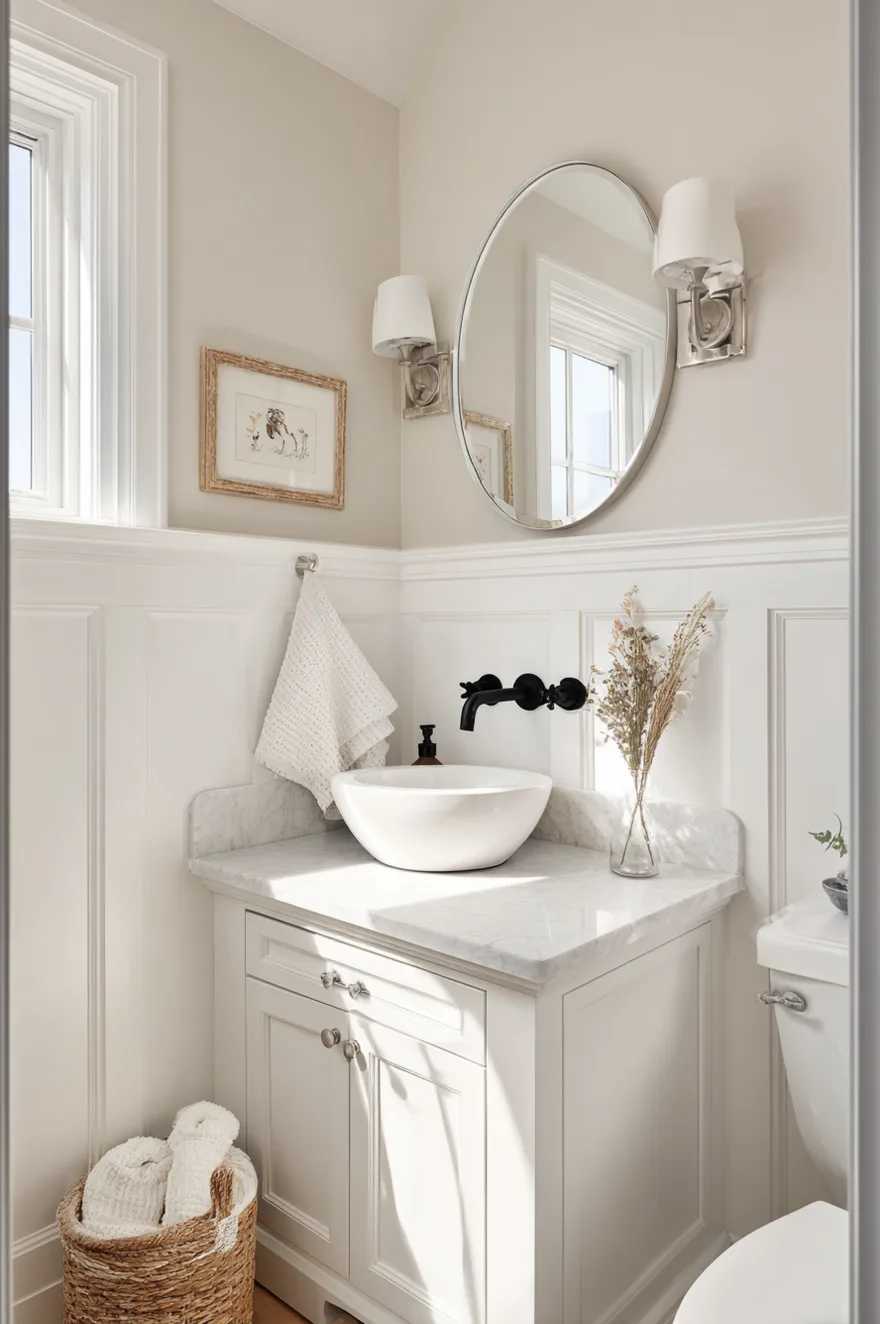
Board-and-batten at 48 inches high – so it sits just above the average countertop height – is the proportional sweet spot for most powder rooms. Benjamin Moore White Dove on the panels, a soft warm linen on the walls above. The two-tone effect sounds simple and it is, but the panel depth casts a tiny shadow line that adds just enough visual texture to keep the room from reading as flat.
A furniture-style vanity with an oval undermount sink and polished nickel hardware keeps everything clean and classic. Shoot this room from a slight angle to show the panel depth – straight-on photography flattens the whole thing and you lose the detail that makes it worth doing. Polished nickel holds up better to the daily humidity of a bathroom than unlacquered brass would here, since the look is already refined and you want the hardware to stay that way.
15. The Tile Ceiling Trick That Changes Everything
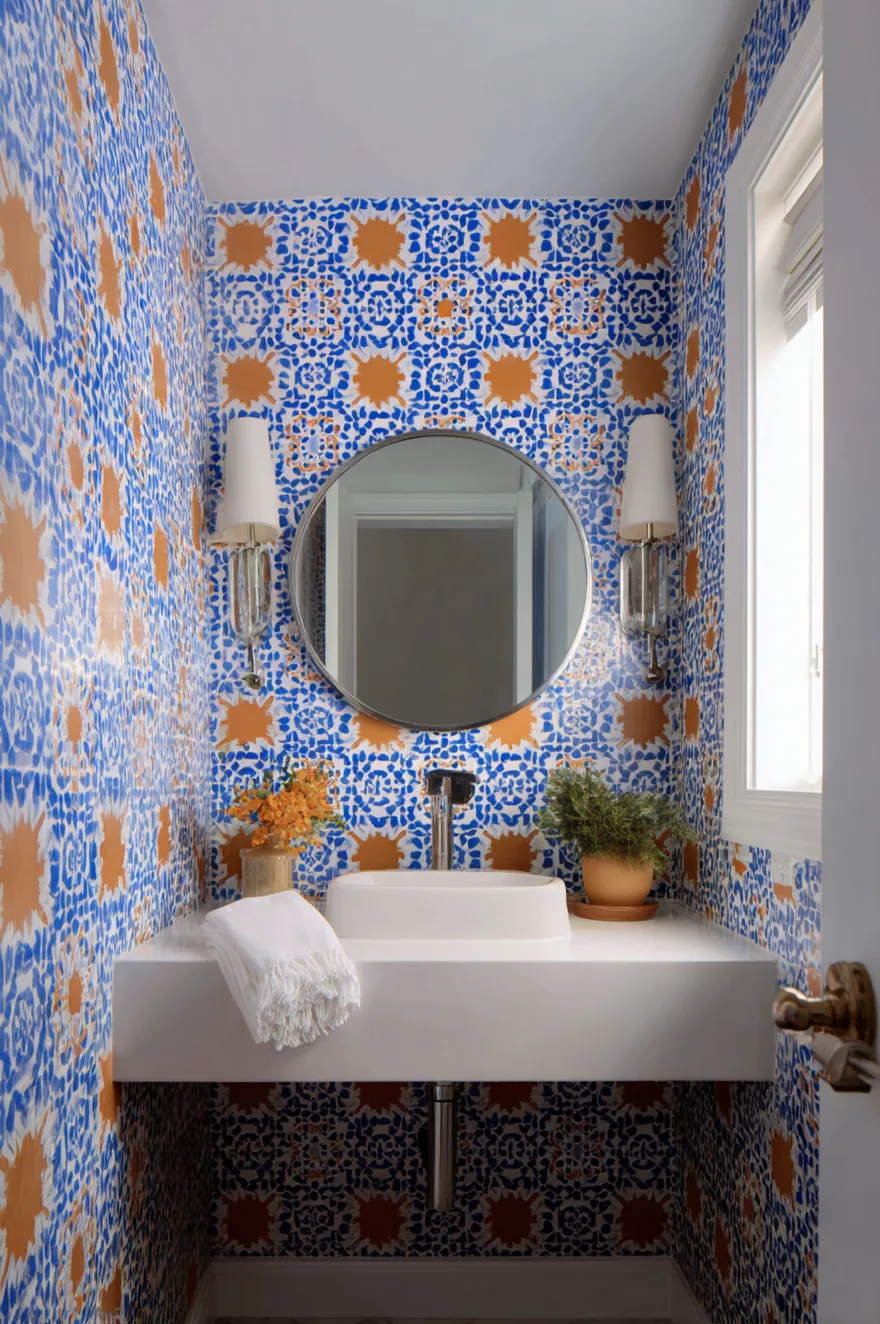
Taking tile up the walls and across the ceiling is the move that makes a tiny powder room feel intentional in a way that nothing else quite does. It’s a jewelry box you step inside – every surface is part of the same pattern, and the room stops being a room and starts being a thing.
The tile I keep coming back to is a terracotta and cobalt geometric encaustic cement-look porcelain. The pattern is old-world without being fussy, and the two-color palette is saturated enough to make an impact but not so complex that it fights itself. Leave only the vanity front and mirror bare – those are your visual anchors, the places the eye rests before returning to the pattern.
The installation is more involved than a standard tile job because you’re working on an overhead surface, and I’d recommend hiring a tiler for the ceiling portion specifically. But the total tile cost for a small powder room is still manageable, usually under $400 in material even with a patterned porcelain. And the result is the kind of room people specifically take a photo of before they leave.
16. Small Space Bathroom Ideas That Borrow From Hotels
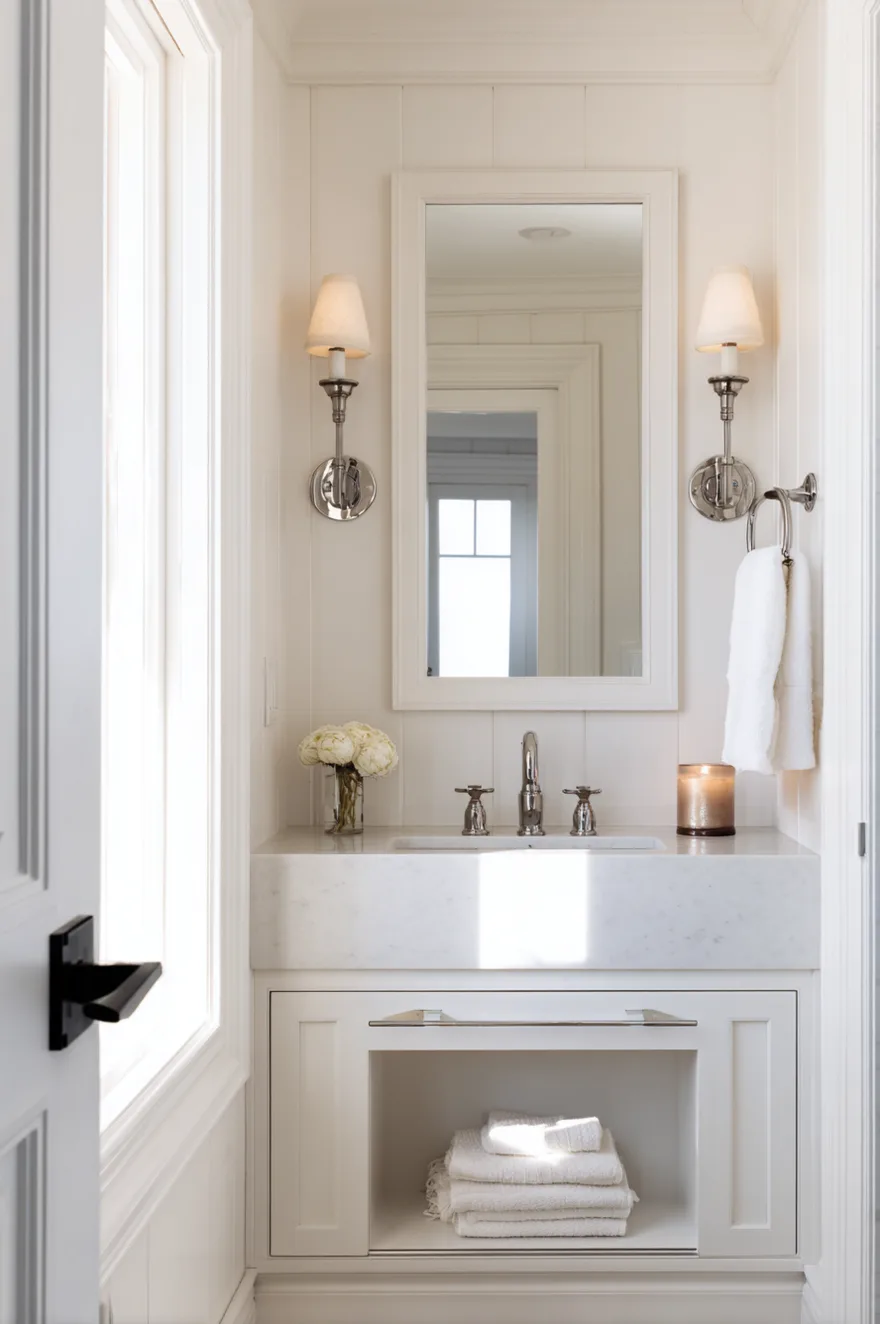
Hotels figured out small bathroom design decades ago and the rest of us are still catching up. The two moves they use that translate directly to a powder room: a full-length mirror on the back of the door, and a sconce on either side of the vanity mirror instead of overhead lighting.
The door mirror – ideally around 18 by 48 inches for a standard door – doubles the perceived depth of the room by bouncing light from the vanity back across the space. Flanking sconces at roughly 60 inches from the floor to the center of the bulb give even, flattering light that a single overhead fixture simply can’t produce. For the sconces, a simple cylindrical form in brushed nickel or matte black, about 4 to 5 inches in diameter, reads clean without being boring. The combination of both mirrors working together makes even a 20-square-foot powder room feel like it has a second room hiding behind it.
17. Powder Room Ideas 2026 Lean Into Curves
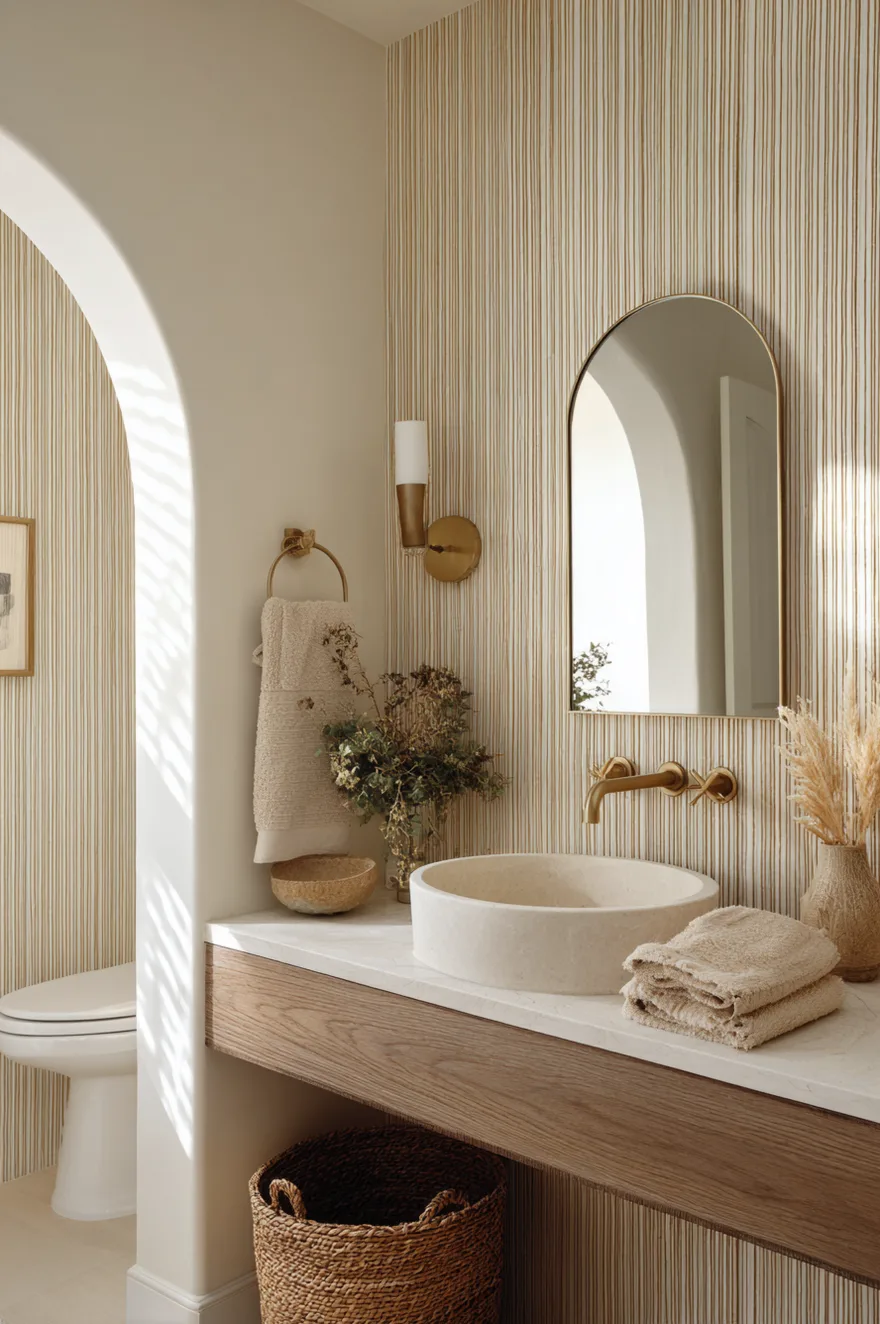
Sharp corners are on their way out, at least in small rooms where they make everything feel rigid. An oval sink instead of rectangular, an arched mirror, a circular wall sconce, curved fluted tile on the accent wall – none of these is a dramatic change individually, but together they soften the tight box of a powder room in a way that photographs really well.
Curved vanities specifically have come way down in price. You can find decent options now at price points that feel very IKEA-adjacent without being IKEA, which is a good thing in a room that needs a slightly more custom feel. Start with the mirror shape if you’re not ready to replace the vanity – an arched mirror is the lowest-commitment way to test whether curves suit your space.
18. Why Peel-and-Stick Is Not a Compromise
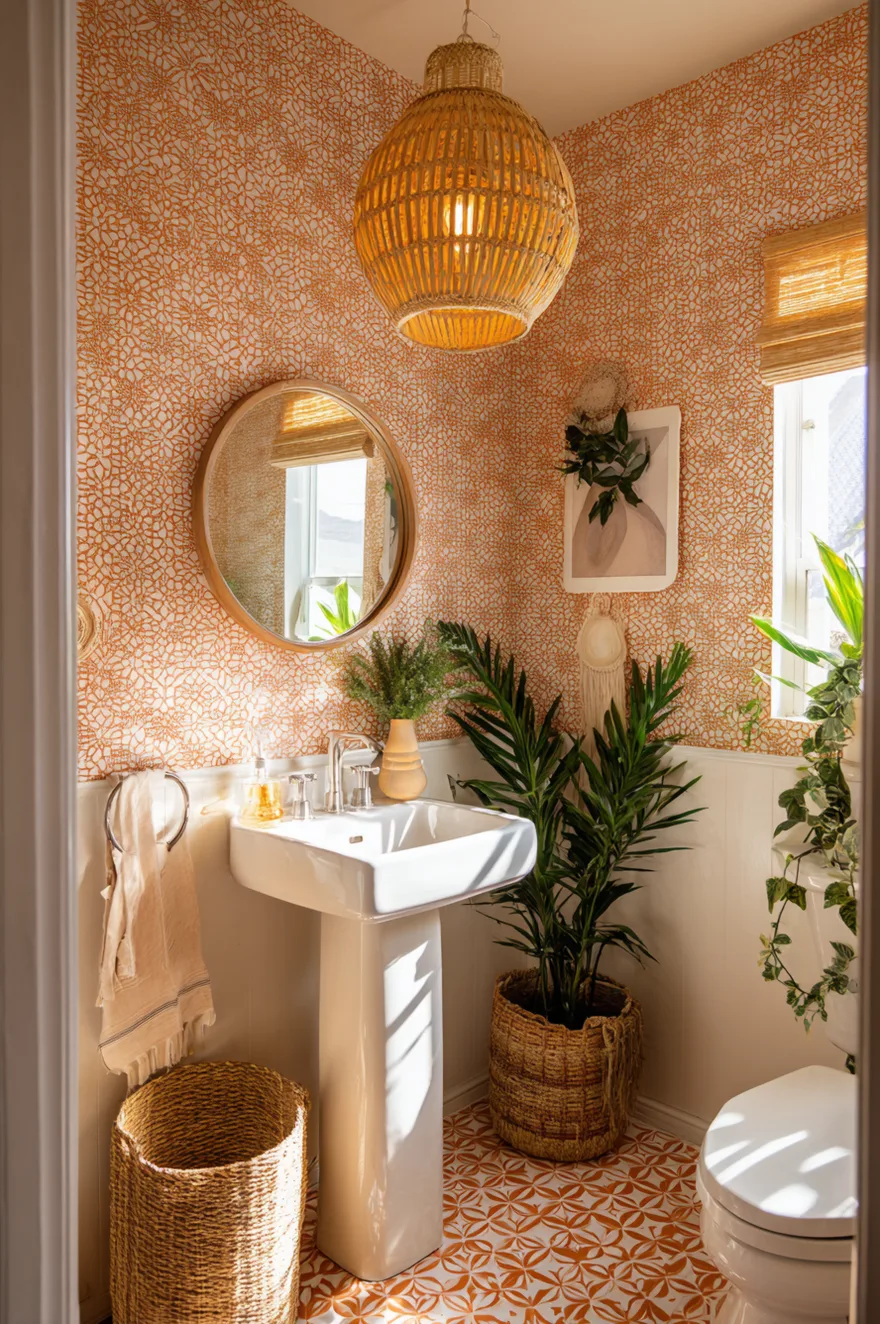
I said it in section 10 and I’ll say it again more directly: peel-and-stick has gotten genuinely good. Smart Tiles makes a Moroccan mosaic pattern that looks correct in person, and Chasing Paper’s removable wallpaper holds up to humidity better than most people expect. In a rental powder room, these two products together – peel-and-stick tile on the floor, removable grasscloth-look paper on the upper walls – create a layered result that reads collected, not budget-constrained.
Prep is everything. Clean the surface with isopropyl alcohol, let it dry completely, and start from a centered point so the pattern is balanced. Any texture on the wall needs a skim coat first or the seams will show. Do that one extra step and it will stay put.
19. That One Thrift Find That Made the Whole Room
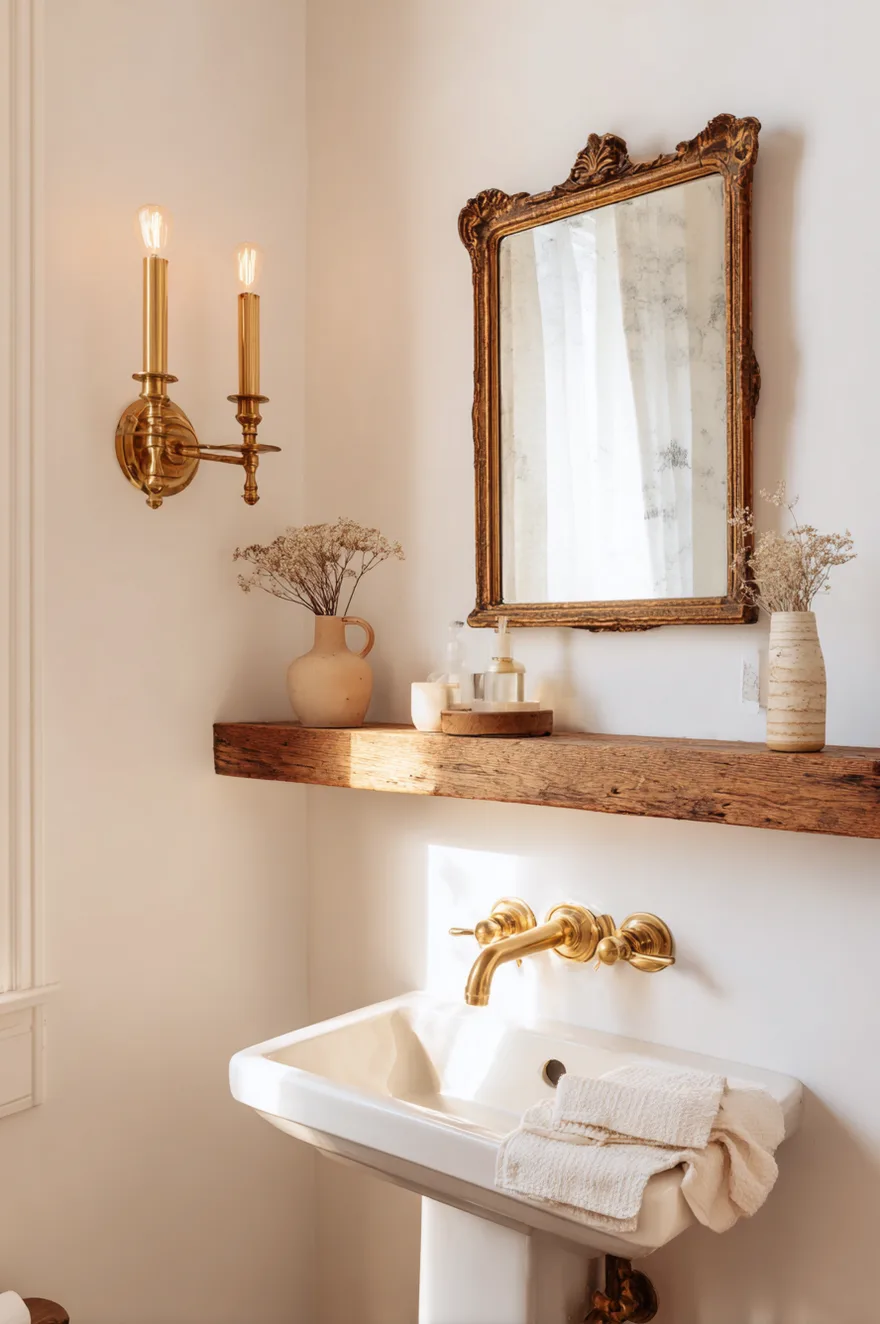
A $12 brass candlestick from Goodwill. That’s where this powder room started. I found it on a Saturday morning at the Hillcrest Goodwill, thought it was too good to pass up even though I had no plan for it, and spent the next few weeks figuring out what to do with it. Eventually I had it rewired as a wall sconce – a local lighting shop does this for around $30 to $50 depending on the piece – and mounted it beside an antique beveled mirror I found at an estate sale the following month.
That combination – the candlestick sconce and the slightly imperfect mirror with its foxed silver backing – became the anchor for the entire room. I picked the wall color to work with the brass. I chose a simple pedestal sink so nothing competed with the mirror. I found a small wood shelf that matched the warmth of the candlestick base. Every other decision in that room came after and because of those two thrift finds.
Hunting for one great statement piece first and designing around it almost always produces a more personal result than starting with a floor plan and filling it in. The room ends up feeling like it has a story, because it does. And the whole thing costs a fraction of buying everything new because you’re only buying the important things new – everything else is found, thrifted, or already owned.
20. Small Powder Room Ideas With Big Pattern Energy
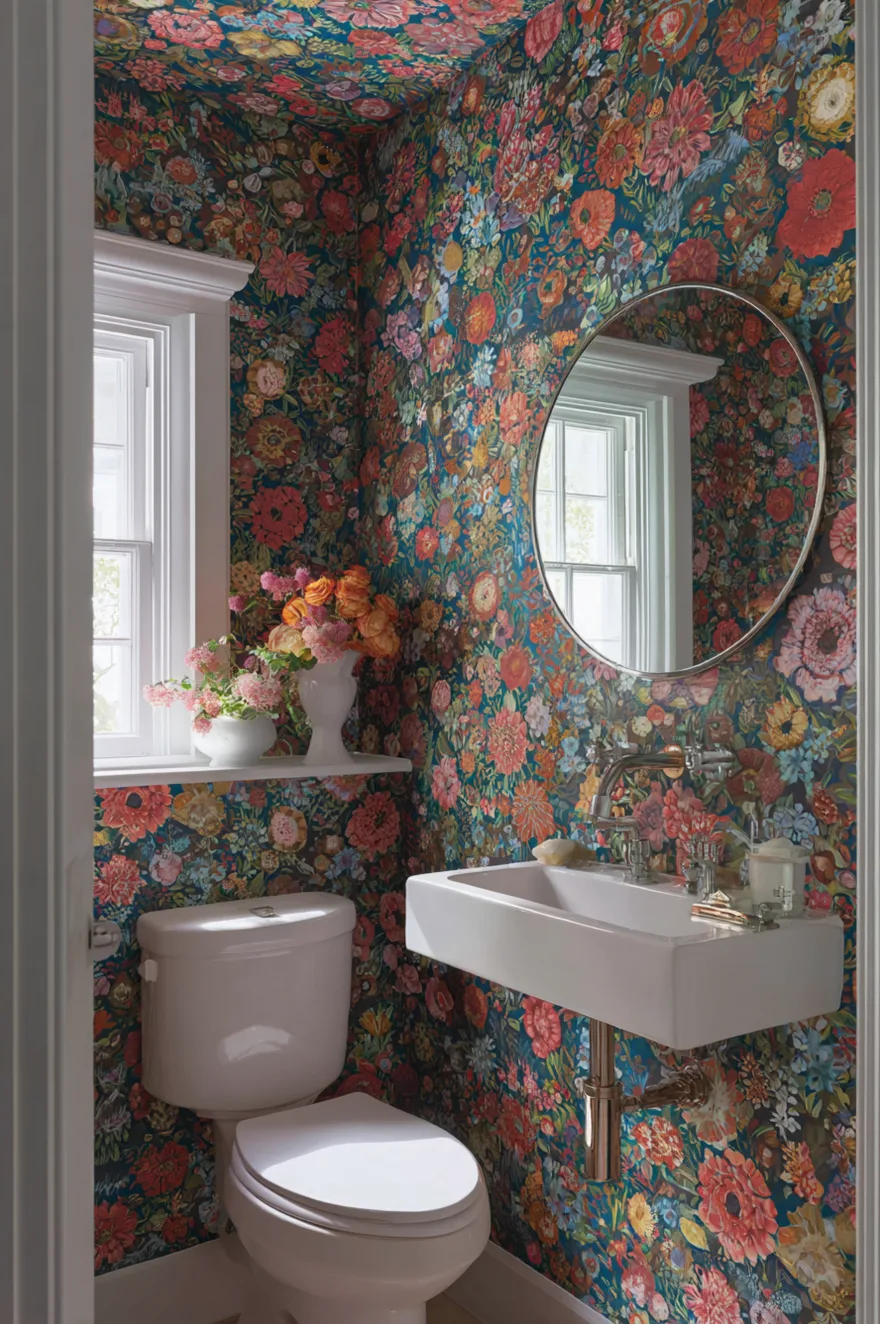
A maximalist multi-color floral wallpaper in jewel tones – emerald, rust, cobalt, all of them at once – sounds overwhelming in a tiny powder room. It is not. It is exactly right. The small scale of the room contains the pattern in a way a large room can’t, so instead of feeling chaotic it feels intentional and complete.
Take the paper inside the vanity cabinet doors too. When guests open it for hand lotion or whatever, that moment of pattern inside the cabinet is genuinely delightful. Keep the sink, toilet, and all fittings matte white so the eye has somewhere to land and rest before it goes back to the pattern. White gives the room its breath.
21. The Hardware Upgrade That Costs Under Fifty Dollars
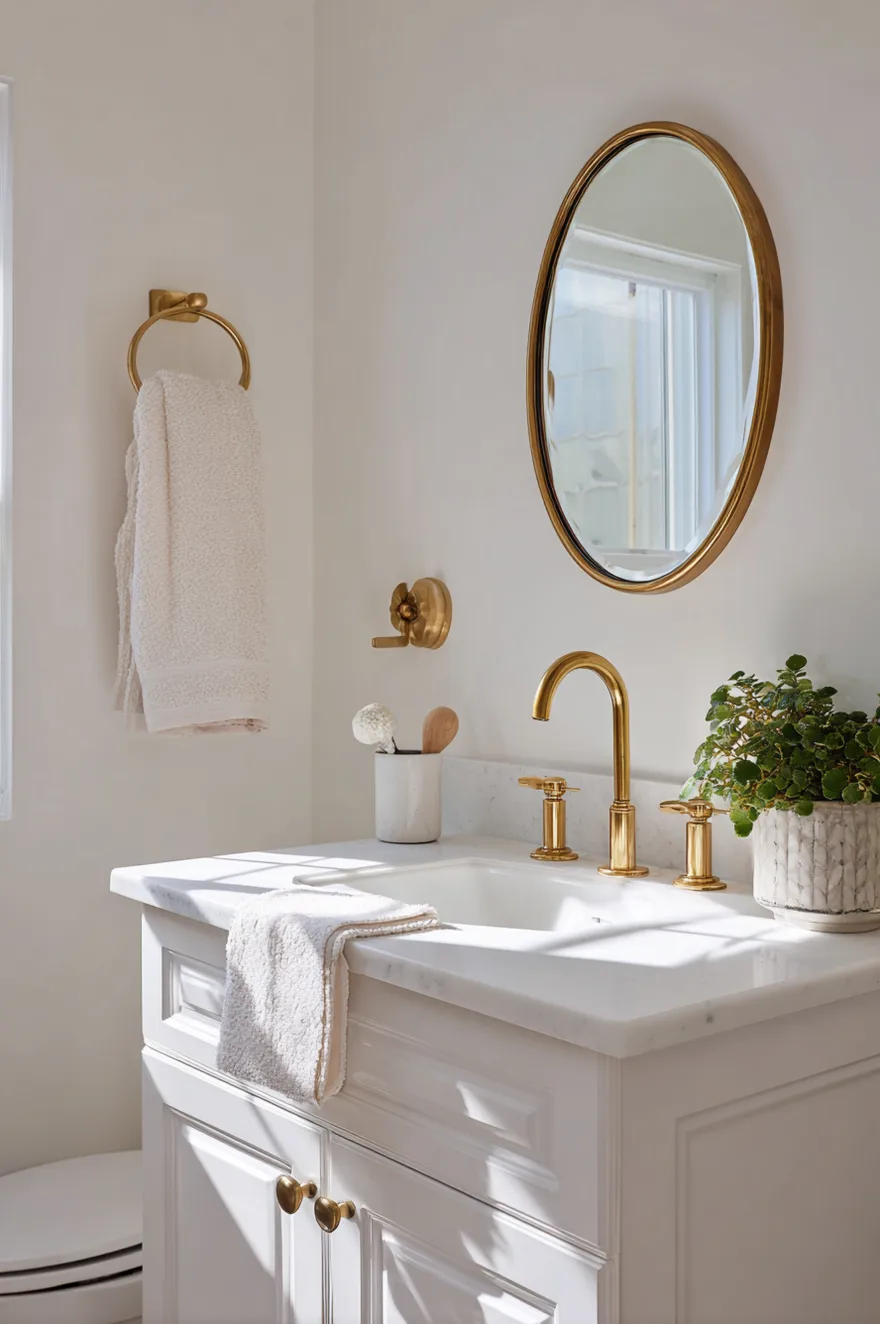
The faucet is expensive to swap. Everything else is not. A towel ring, a toilet paper holder, and a robe hook in builder-grade chrome can be replaced with unlacquered brass or antique bronze versions for $10 to $20 each. Amazon’s basics hardware line carries decent unlacquered brass options, and Rejuvenation has a more refined version at a slightly higher price point if you want something that’ll last decades.
Here’s the thing about mixing finishes that most people get wrong: they either commit to one metal everywhere, which is fine but a little flat, or they mix too many and it looks accidental. The move is to mix one polished brass and one matte brass finish – say, a polished unlacquered brass towel ring and a matte antique brass toilet paper holder. The difference in sheen adds depth and makes the room feel like someone with real taste put it together, not someone following a checklist. But keep it to two finishes total. Three is where it starts to look like you couldn’t decide.
Swap the hardware in a single afternoon. It’s the kind of change that makes you want to show everyone who comes over, which is exactly the energy a powder room should have.
You don’t have to do all of this. Pick two ideas that feel genuinely exciting to you – not the ones that seem most responsible or most neutral, but the ones you keep coming back to. That’s usually where the good rooms come from. Drop a comment below and tell me which one you’re thinking about. I want to know if anyone actually does the tile ceiling, because I’m still working up the nerve to do it myself.
With love,
Liv